From Saint-Imier to Paris – Observatory Chronometer No. 565606 and the Grand Prix Programme of Longines

June 29, 2026

For decades, the words ’Grand Prix Paris 1900’ engraved on a Longines case back have been accepted as a romantic symbol of horological triumph. But behind the engraving lies a deeply calculated industrial strategy.

It arrived as a listing in a German auction catalogue in November 2025. A Longines pocket chronometer, 18-karat gold, hunting case, the usual descriptive language, nothing that would have distinguished it at first glance from dozens of similar pieces I had seen over the years. But the movement number 565606 was there in the catalogue text, which is not always included, and for a collector who has learned to pay attention to such things, a number is a starting point. The catalogue correctly identified the piece as an observatory chronometer, tested at Neuchâtel in 1900. But what it did not reveal was the broader context in which this movement belonged.

As I usually do in these situations, I wrote to Philippe Hebeisen, Brand Heritage Historian at Longines, whom I have had the good fortune to know through many years of research and exchange. I gave him the movement number and asked what he could find.

His reply confirmed what the catalogue description could not fully convey: movement No. 565606 is part of a structured series prepared for the Paris Exposition Universelle of 1900. The case, he noted, was marked Grand Prix Paris 1900.

This piece had not survived 125 years by accident. It had passed through history with its context still intact.

I bought it.

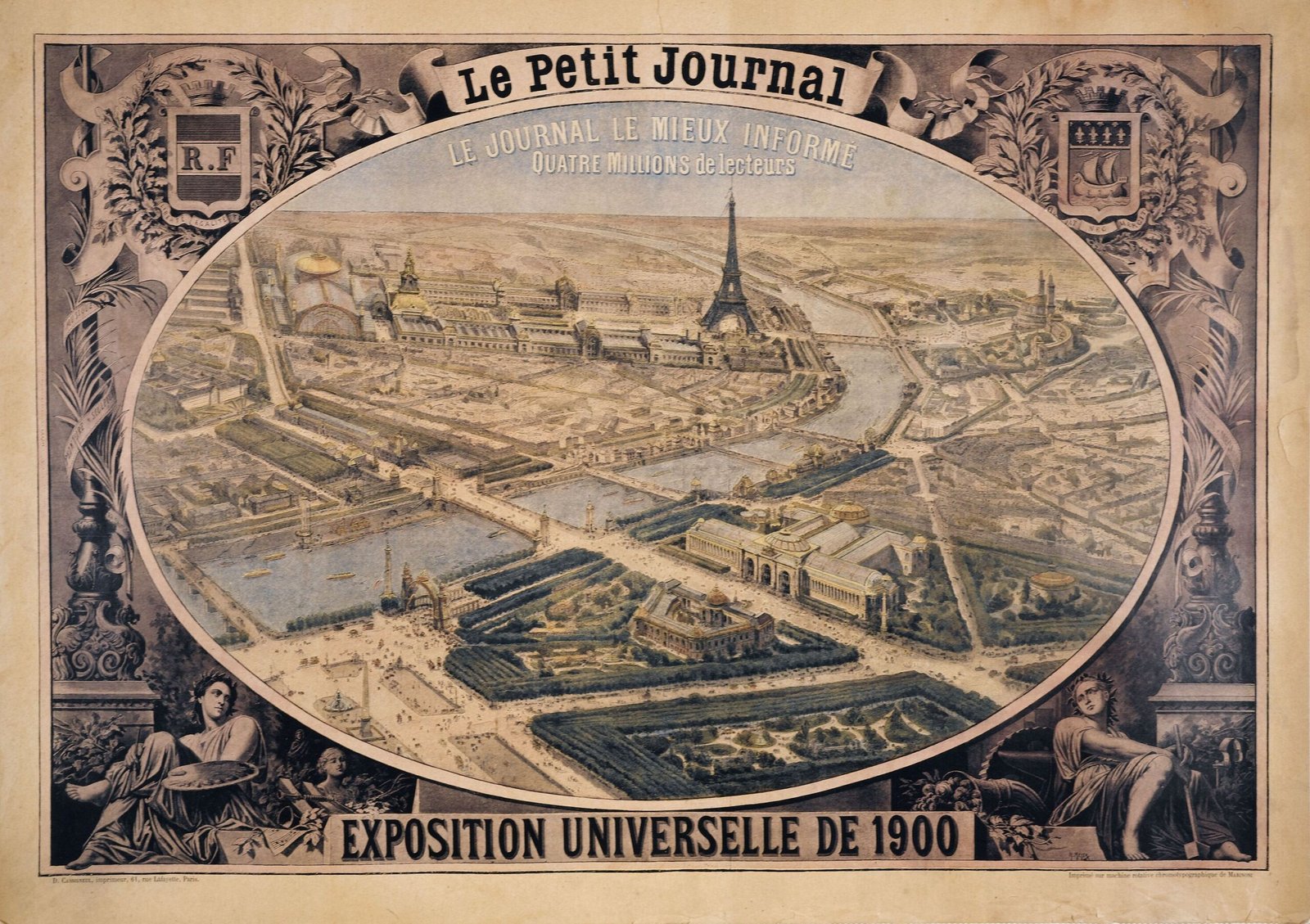
Le Petit Journal panorama poster advertising the Exposition Universelle, Paris 1900.

The Object Itself

There is a particular quality to holding a piece like this for the first time. A standard Longines pocket watch from 1900 is already a substantial object, but an observatory chronometer from the same movement blank feels different. The weight is the same, but the standard of execution is not. When you open the back, you are looking at a machine that was built to clear a specific, measurable hurdle. Every surface, every jewel setting, the curve of the balance spring everything has been attended to by a specialist who understood exactly what they were doing and why.

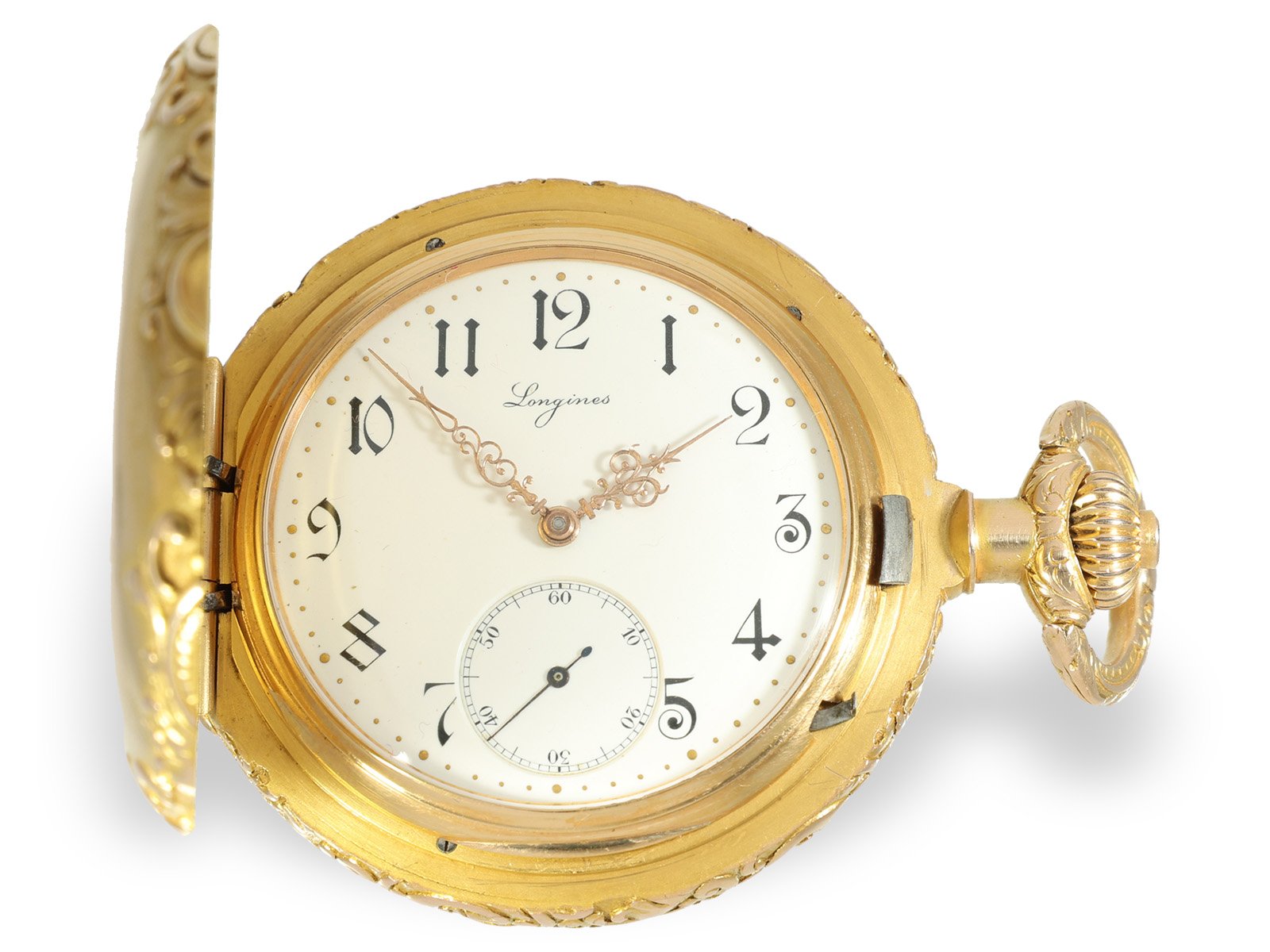
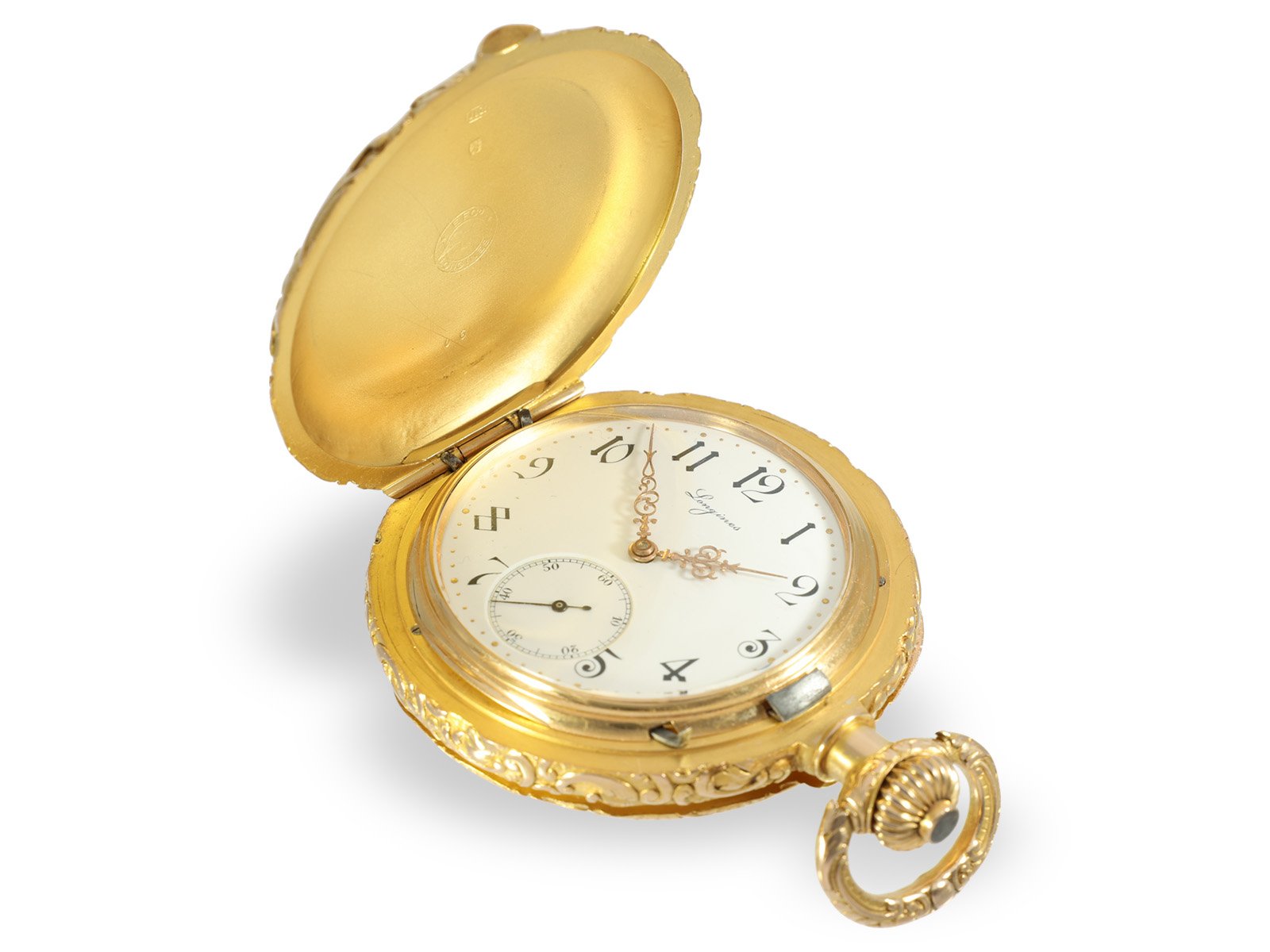
Observatory Chronometer No. 565606 - 18K gold à-goutte hunting case (savonnette), 55.5mm diameter, 180g total weight, with floral-engraved bezel. Front view with dust cover open showing the white enamel dial signed Longines with gold Arabic numerals and rose-gold breguet hands.
The dial: white enamel, Arabic numerals, subsidiary seconds at 6 o'clock - characteristic of Longines presentation-grade chronometers of the period.

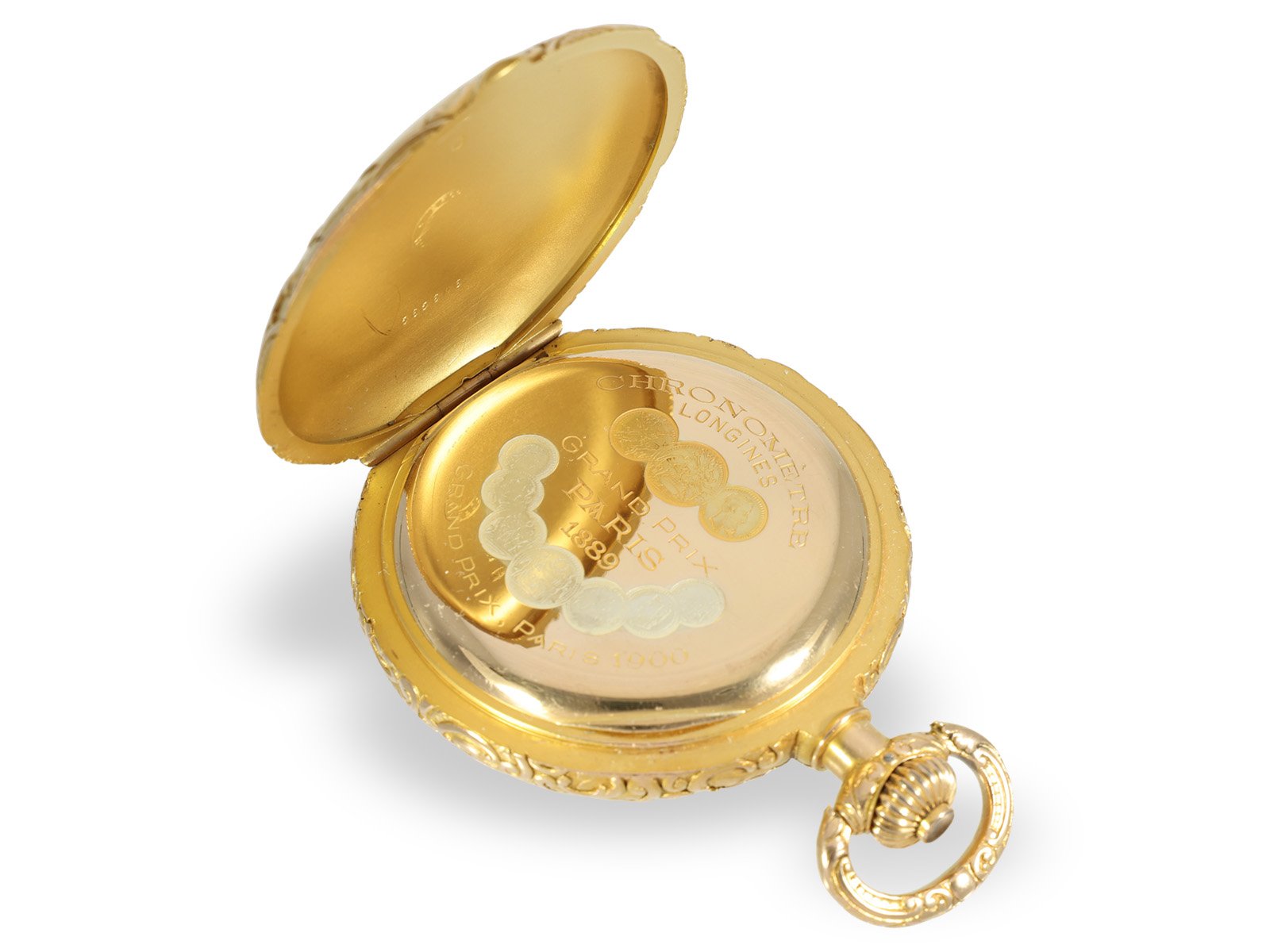
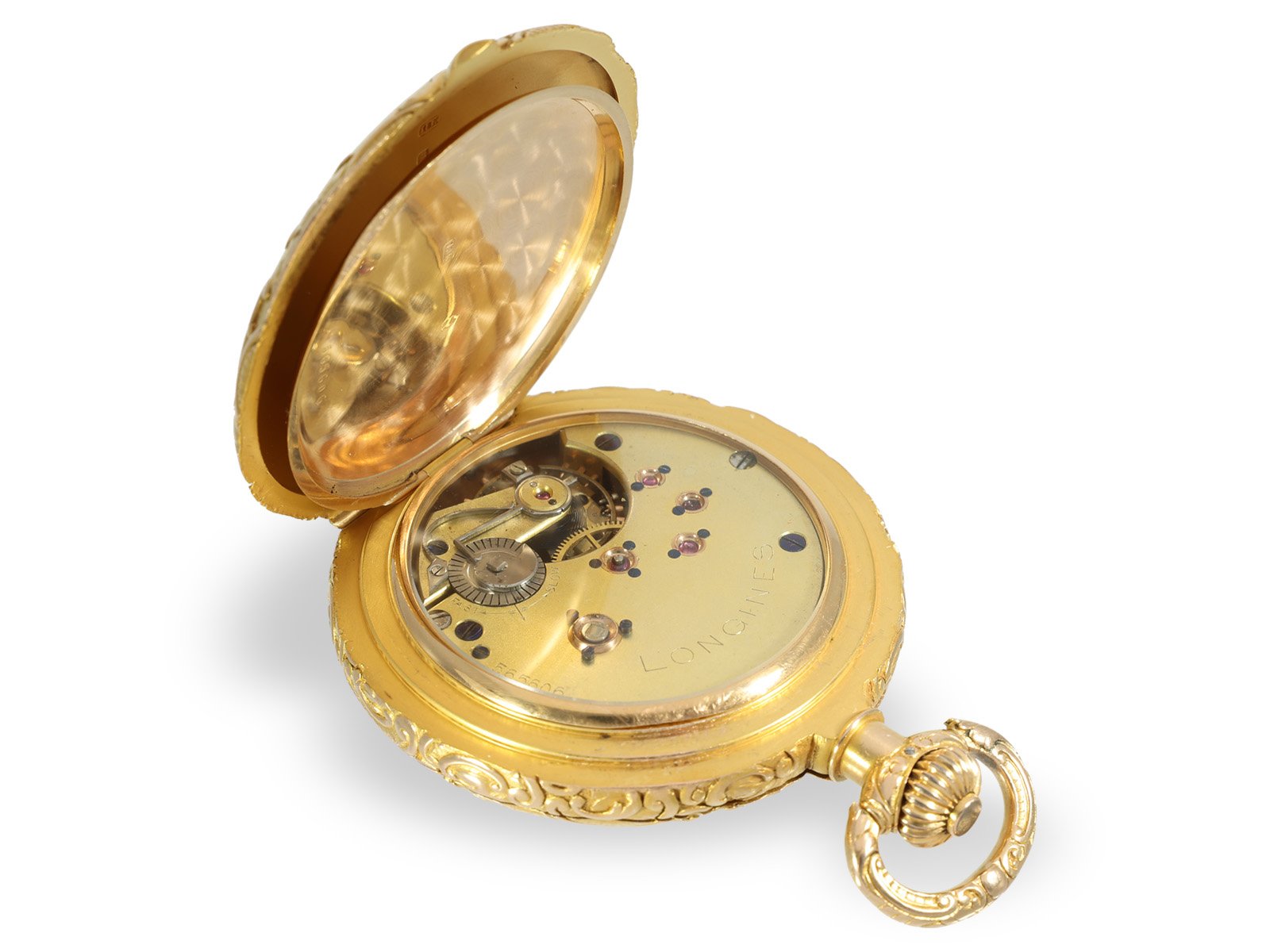
The case is an à-goutte hunting-case, the form known in French as a savonnette, its name derived from the rounded, soap-like profile of the closed case. The front and back cover snap open with the characteristic click of well-made gold. Inside the front cover, on the dust shield, the word CHRONOMÈTRE is engraved. On the inside of the cuvette  the secondary back cover that protects the movement the marking reads Grand Prix Paris 1900.

The cuvette (inner back cover), engraved: CHRONOMÈTRE LONGINES – Grand Prix Paris 1889 – Grand Prix Paris 1900 The enumeration of both Grand Prix awards confirms the case was prepared for the 1900 exhibition and marked accordingly.

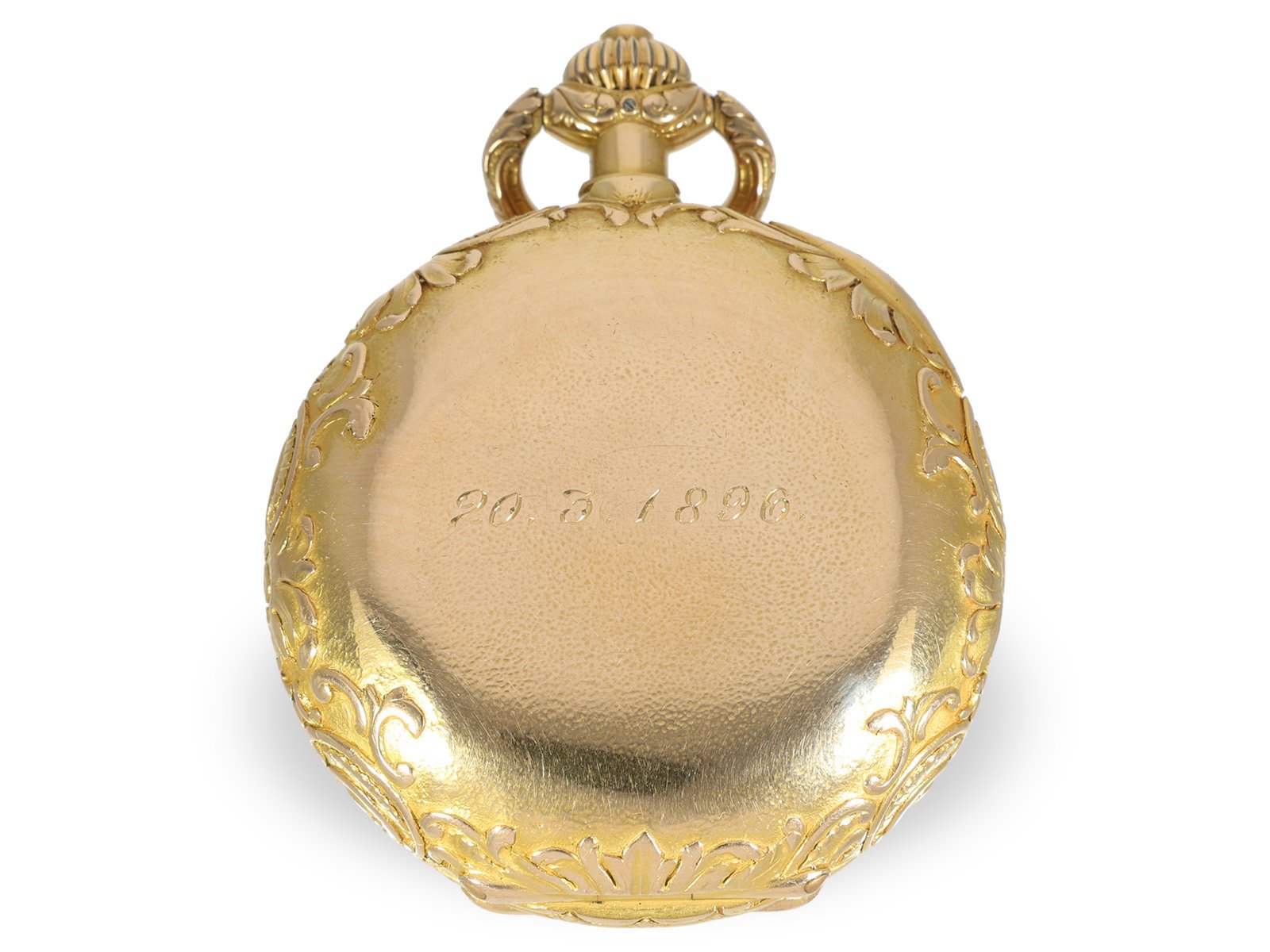
These two inscriptions, taken together, are an unusually precise statement of context for a pocket watch of this period. The outer back cover carries a further detail: the engraved date 20.3.1896 predating the exhibition by four years (as per the engraving), suggesting that the case, or at least its personalisation, may predate the 1900 programme. It is a small anomaly that the archives have not yet resolved.

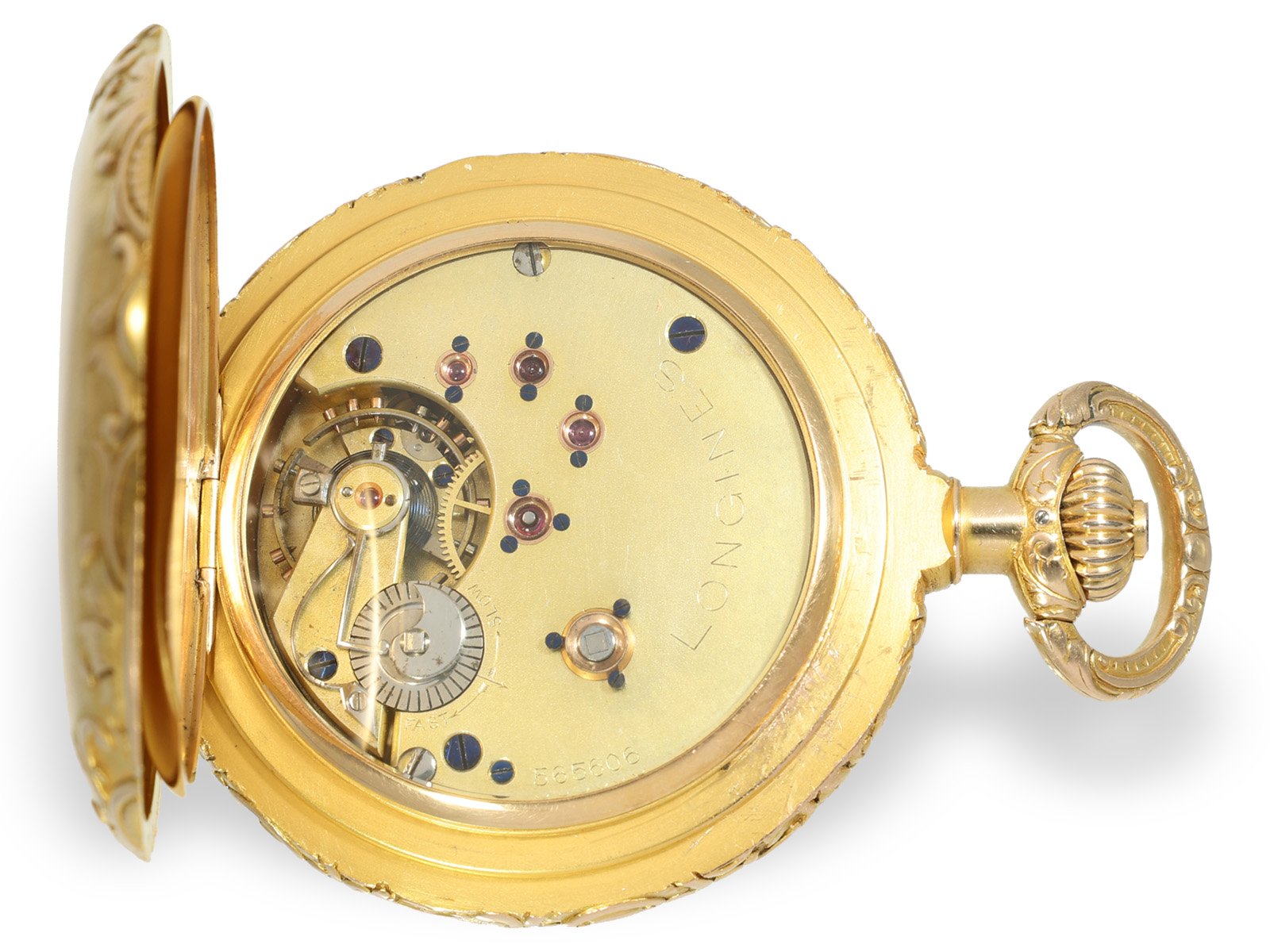
The movement is a Calibre 19AS, meaning a 19-ligne movement roughly 42.8 millimetres in diameter of the type that Longines had brought to a high level of refinement by the turn of the century. The entry in the Neuchâtel Observatory register records the name of the person responsible for its preparation: A. Vuille-Roulet, of Saint-Imier. The category, Chronomètres de Poche  Classe B. The year: 1900.

The movement — Calibre 19AS, 19 lignes, with the Longines signature engraved on the gilt three-quarter plate. Movement number 565606 is visible at the lower right.
Movement No. 565606 — the number that connects this object to the Neuchâtel Observatory register of 1900 and to the documented 565601–565612 series.

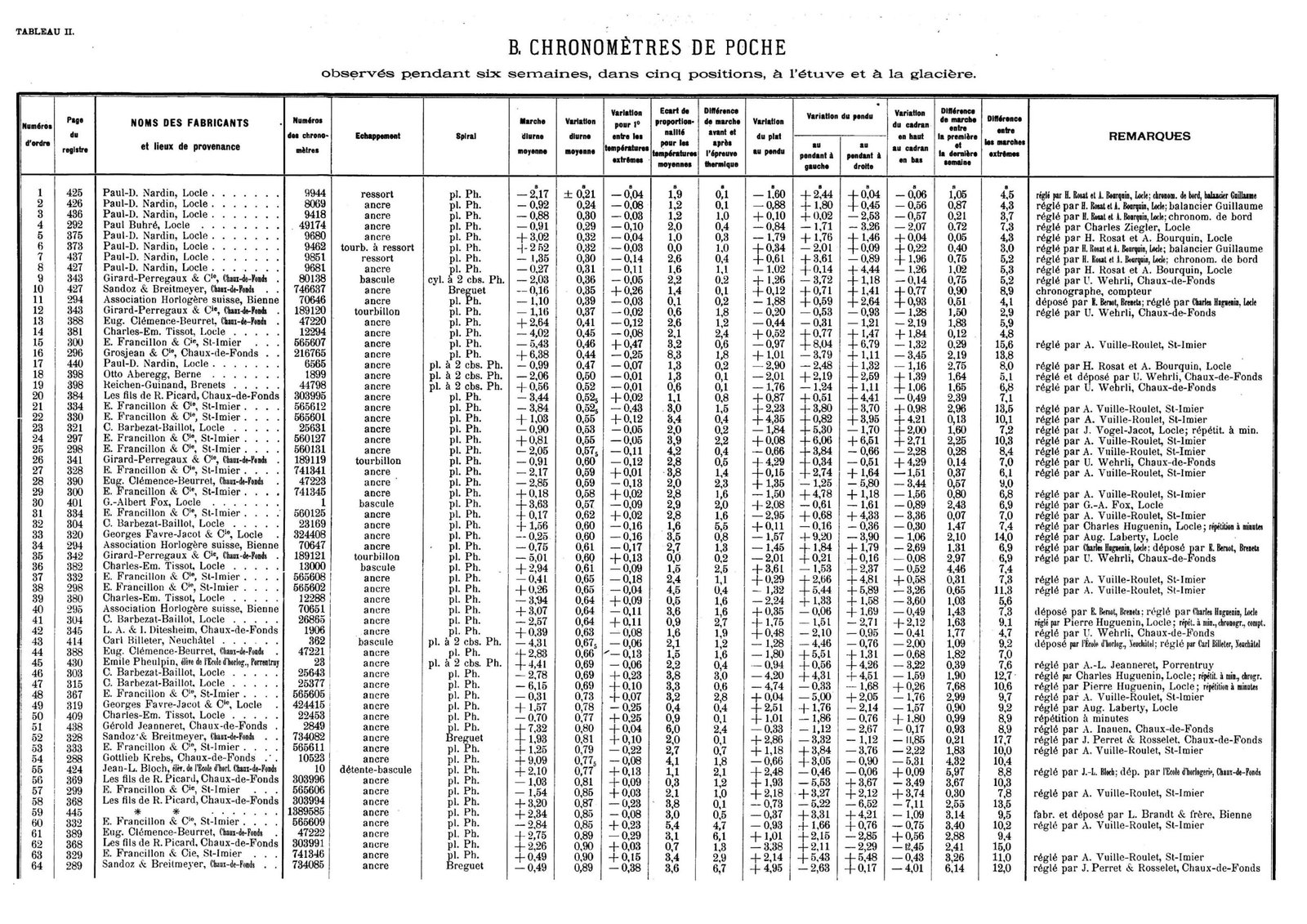
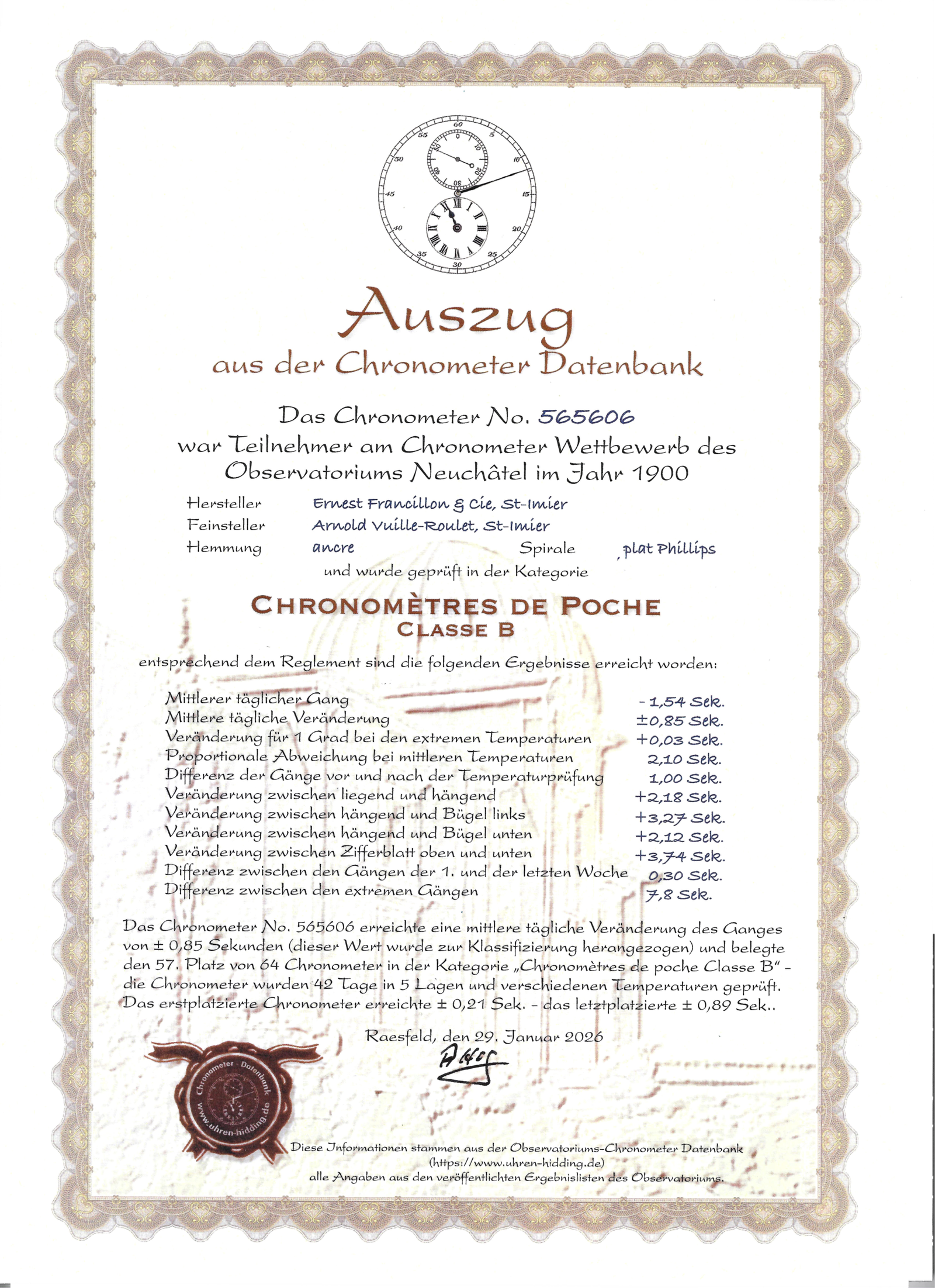
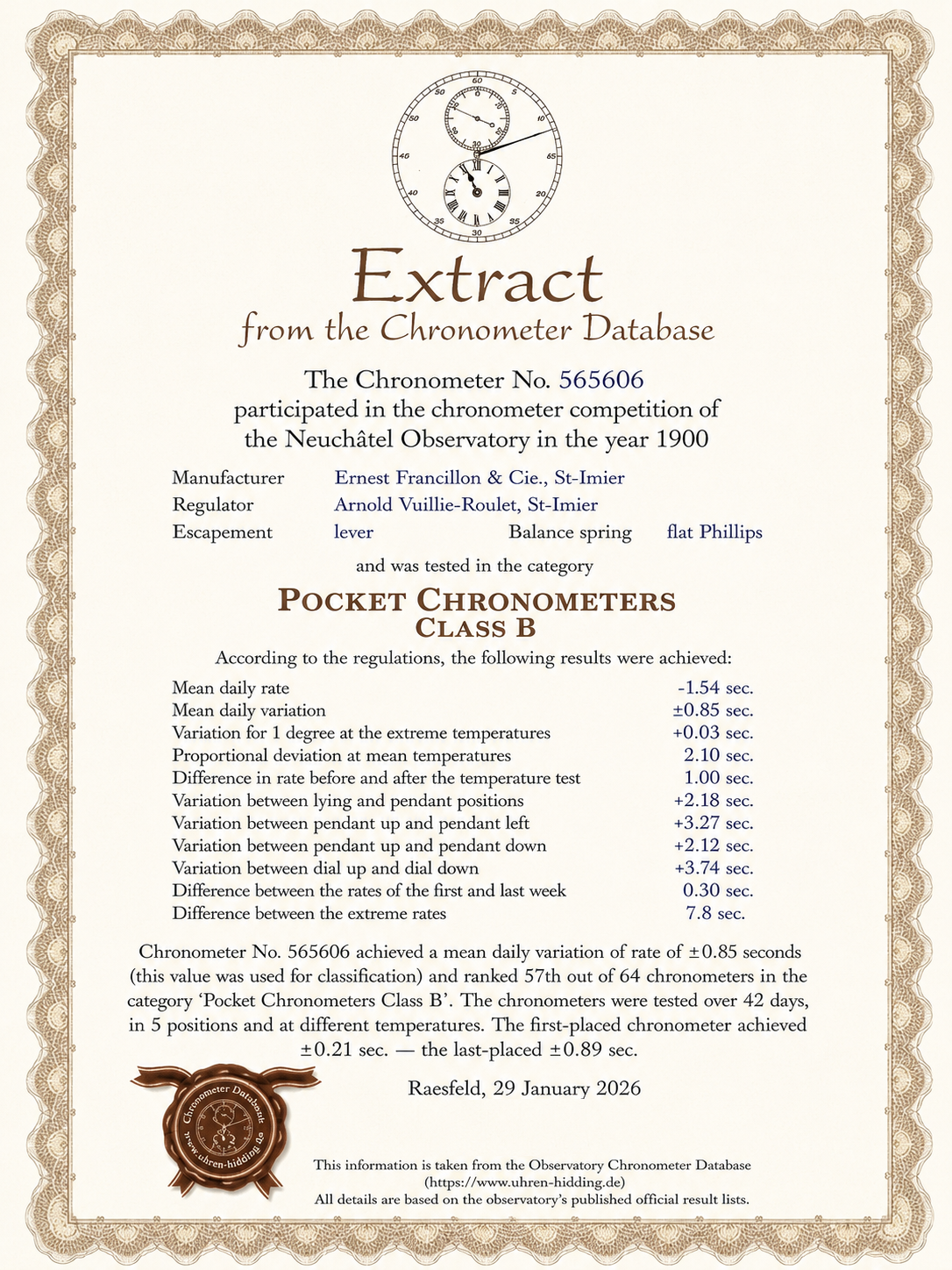
Accompanying the watch is an extract from the 1900 Neuchâtel testing documentation, a piece of paper that connects the object to its moment of measurement with a directness no later description can replicate. The mean daily rate was −1.54 seconds per day. The mean daily variation is the figure that matters most for classification; it was only ±0.85 seconds per day. In the ranking of certified chronometers in its category, movement No. 565606 placed 57th out of 64.

Collectors sometimes flinch at a ranking like 57th out of 64. They should not. The rank should be read in context. The relevant number is not 57, but 64: these were the 64 pocket chronometers that passed the most demanding category of the most rigorous chronometer testing then available in Switzerland, in a year when Longines presented 15 such pieces in that category alone. The rank is a position within an elite group, not a consolation.

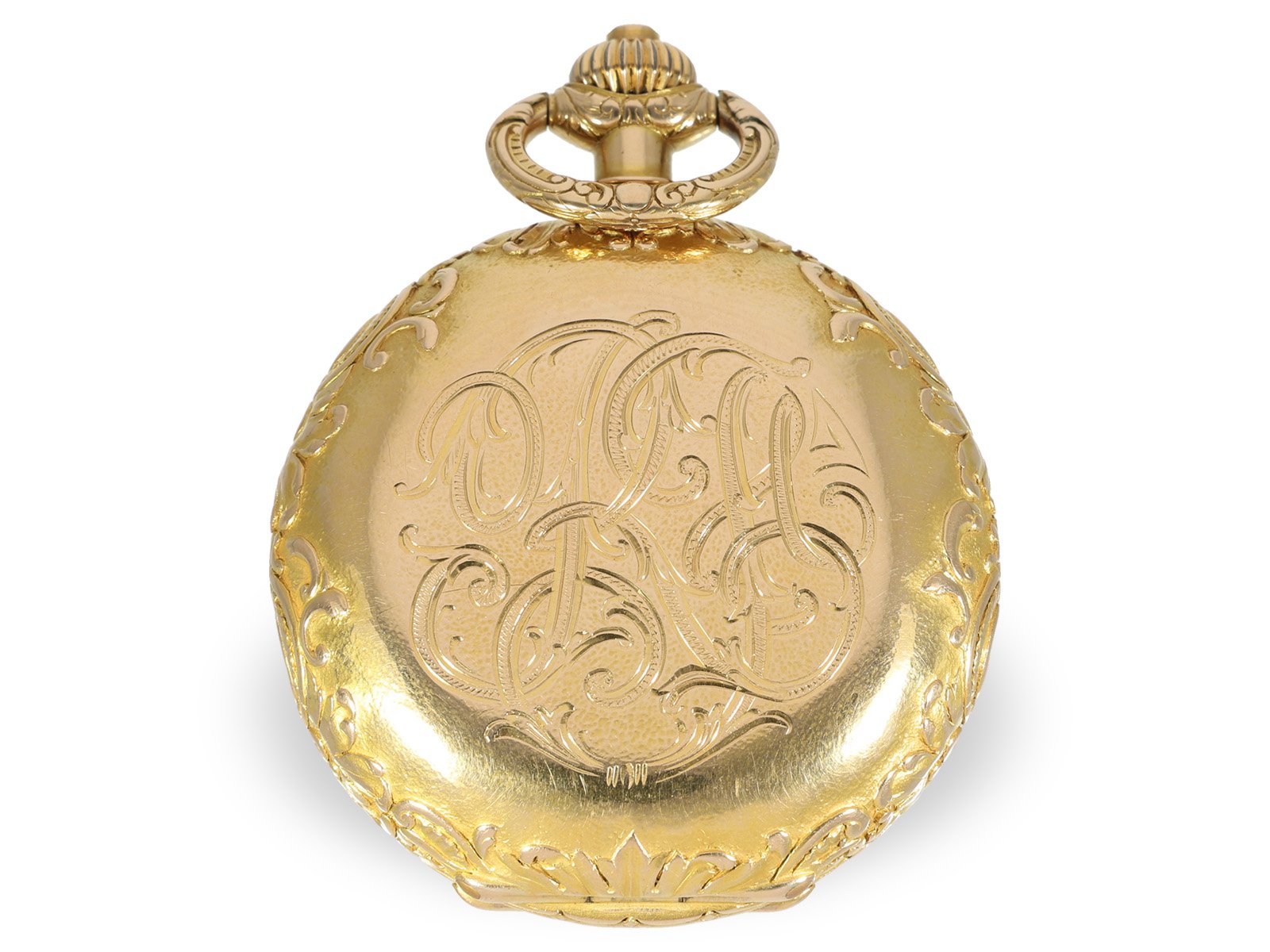
The outer back cover — engraved monogram within a floral cartouche. The case was personalised at the time of its original sale.
The outer back cover with the engraved date 20.3.1896 — predating the exhibition, suggesting that the case, or its personalisation, may predate the 1900 submission – a detail that raises questions the archives may yet answer.

The Neuchâtel Trials

The Neuchâtel Observatory trials are often mentioned in horological literature, less often explained. It is worth pausing briefly to understand what this institution actually represented.

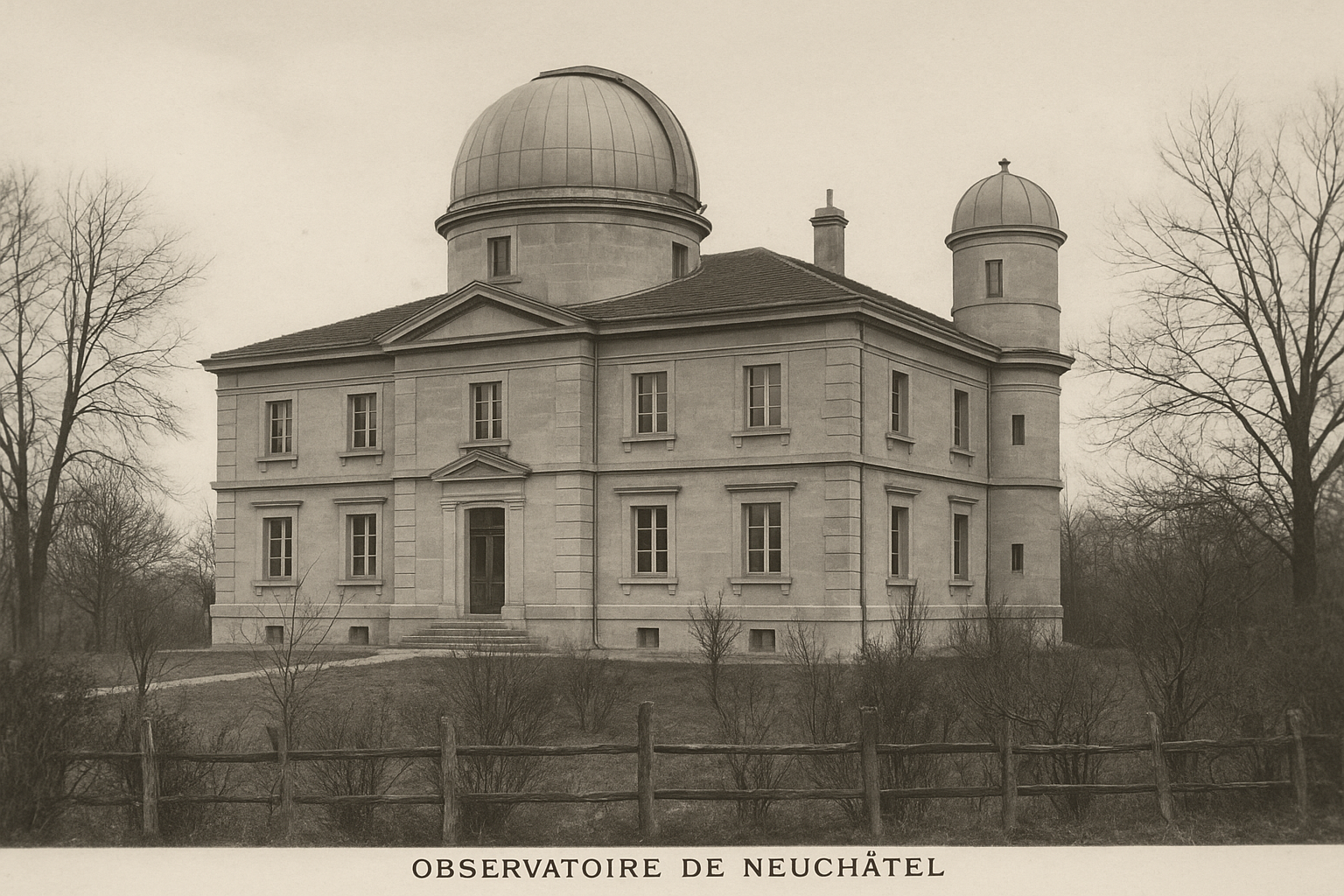
The contest was conducted by the Observatoire Astronomique et Chronométrique de Neuchâtel, which had been holding such trials since the mid-nineteenth century, establishing over decades a reputation as the most rigorous independent testing authority in Switzerland. The trials were not a marketing exercise. They were regulated scientific measurement, and the standards applied to pocket chronometers in 1900 were severe.

The Observatoire Astronomique et Chronométrique de Neuchâtel, main building. Period photograph, circa 1900.

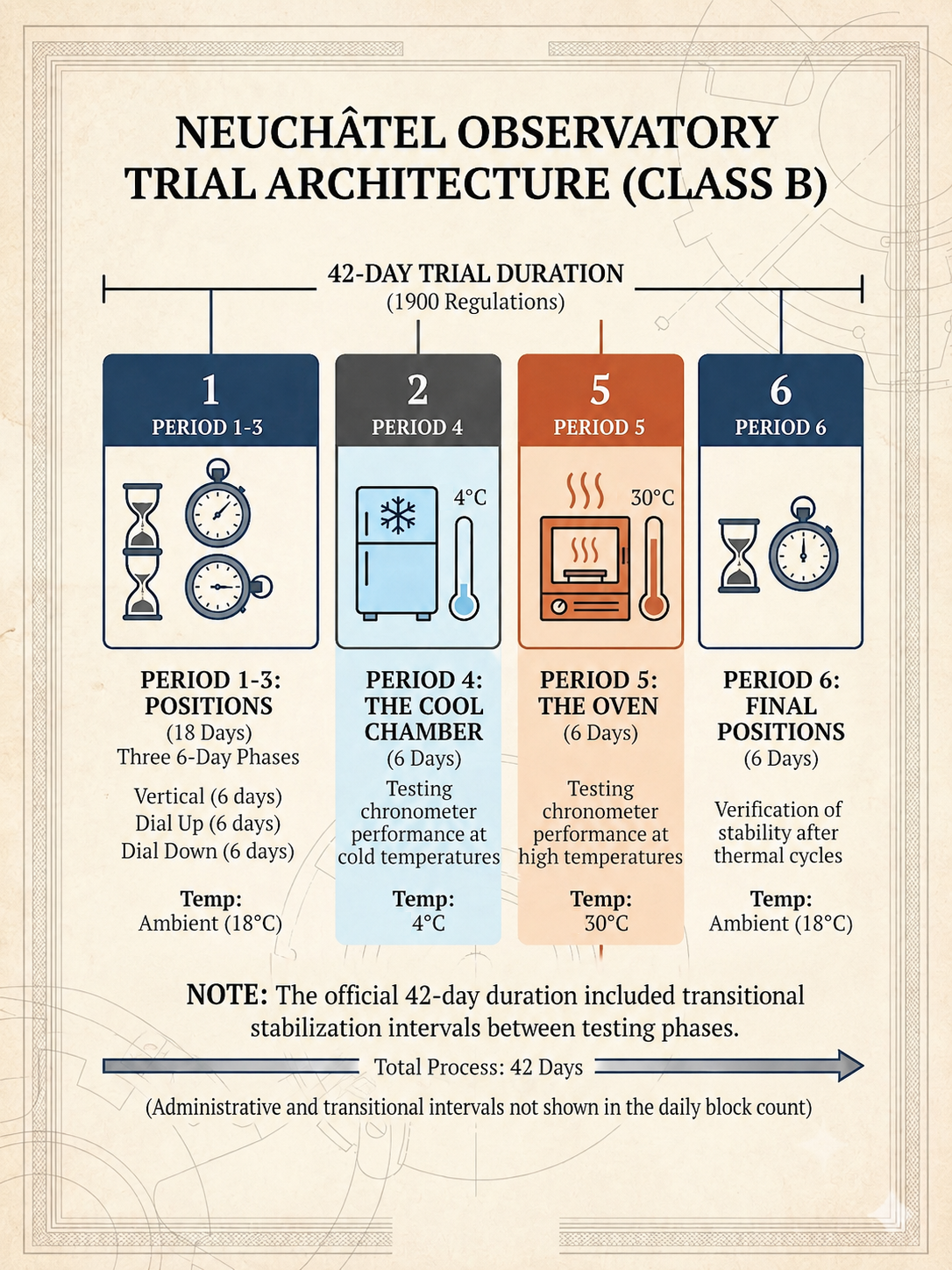
Classe B, the category in which No. 565606 was registered, was the most demanding of the pocket watch classes. The test ran for six weeks. During that period, each movement was measured in five different positions and subjected to deliberate temperature variations. A heat chamber and a cold chamber were used to simulate the range of thermal conditions a chronometer might encounter in real use. The classification value, the mean daily variation, was computed across all these conditions, not under ideal circumstances. Any movement that emerged with a certified bulletin de marche had been proved, not merely claimed.

The Architecture of Precision – Neuchâtel Observatory Trial (Class B, 1900 Regulations)

To achieve certification, movement No. 565606 had to survive a grueling 42-day scientific gauntlet. This timeline breaks down the official trial structure defined by the 1900 regulations: 18 days of testing positional errors across vertical and horizontal planes at ambient temperature (18°C), followed by extreme thermal stress testing in a cool chamber (4°C) and an oven (30°C), before returning to final stability verification. Visualizing this rigid testing architecture emphasizes that observatory chronometry was not a matter of symbolic prestige, but a heavily regulated, scientific measurement of systemic reliability.

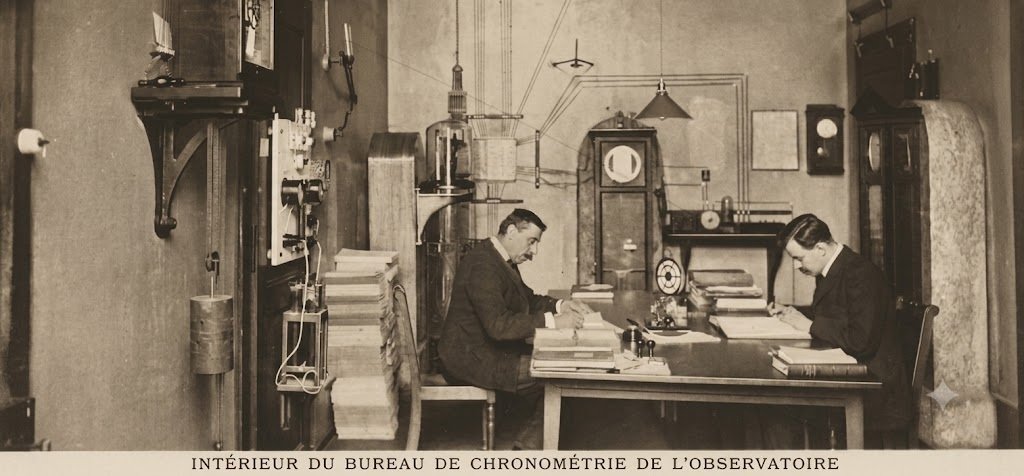
The Salle du Service Chronométrique of the Neuchâtel Observatory, circa 1900. This is the room in which Chronometer No. 565606 was measured over 42 days in five positions and at varying temperatures.

In the 1900 trials, 64 pocket chronometers completed and passed the Classe B programme. Longines submitted 15 of them – the largest contingent from any single manufacturer in that category.

What made Longines’ performance at Neuchâtel in 1900 particularly noted was not only its scale. A contemporary report, widely circulated in the Swiss watch trade, described a detail that went beyond the numbers: “I need only mention the sensational fact presented by this case of six chronometers, having on the first attempt obtained six bulletins from the Neuchâtel Observatory.” The report went further: “One of these chronometers, with a daily variation of 0.29 seconds, is thereby ranked 13th among the 162 chronometers that took part in the six-week trials.” And the observation that made this genuinely worth noting: “These pieces had not been specially prepared; they were at the Observatory solely to obtain the bulletin.”

That last sentence is the key. Observatory competitions of the period were routinely gamed by manufacturers who prepared special pieces, movements built to entirely different standards than anything that left the factory in normal production. Longines sent production watches and placed 13th in the combined field of 162.

Tableau II — B. Chronomètres de Poche, observés pendant six semaines, dans cinq positions, à l’étuve et à la glacière. The complete official results table of the 1900 Neuchâtel Category B trials, listing all 64 certified chronometers. E. Francillon & Cie., St-Imier, appears in 15 entries. Movement No. 565606 is visible at rank No. 57, with a mean daily rate of −1.54 s and a mean daily variation of 0.85 s.
Extract from the Chronometer Database, Observatoire de Neuchâtel, 1900. Chronometer No. 565606: Chronomètres de Poche — Classe B. Manufacturer: Ernest Francillon & Cie., St-Imier. Regulator: Arnold Vuille-Roulet, St-Imier. Mean daily rate: −1.54s; mean daily variation: ±0.85s; ranked 57th of 64. (Collection: Guido Hamacher)
English translation of the original German chronometer extract for Longines Observatory Chronometer No. 565606, translated and prepared for publication by Guido Hamacher. With kind permission of Klassische & Antike Uhren — A. Hidding, Raesfeld, Germany, www.uhren-hidding.de.

The Series

When one régleur is responsible for an entire series of twelve observatory-class movements, all bearing consecutive numbers, all submitted to the same trials in the same year, this is not coincidence or individual initiative. This is an industrial programme.

The series performed consistently. Across the eleven documented movements, the average daily rate deviation was approximately −1.3 seconds per day, the average daily variation approximately 0.67 seconds per day, and the average extreme difference approximately 10.6 seconds. These are not the numbers of a manufacturer striving for occasional excellence. They are the numbers of a manufacturer that had built reproducibility into its process.

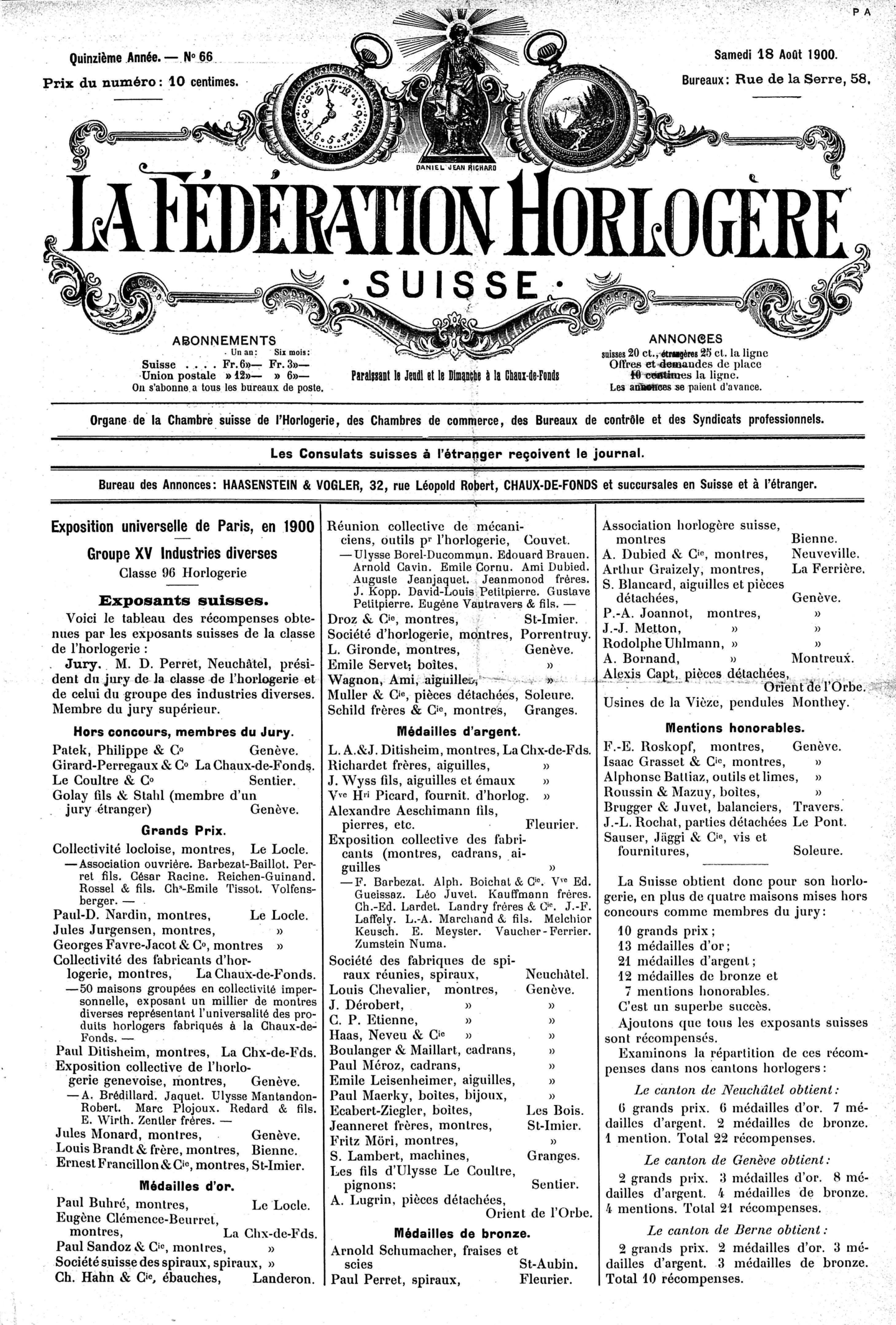
La Fédération Horlogère Suisse, the leading trade publication of the Swiss watch industry, reported at the time on “four series of twelve chronometers with consecutive numbers” that Longines had presented in Paris — all having received first-class bulletins. The 565601– 565612 series was one of these four. The others, like this one, would have been prepared by the same measured, systematic approach: consecutive numbers, a single regulator, a deliberate spread across testing categories, all documented and presented as a unified body of evidence.

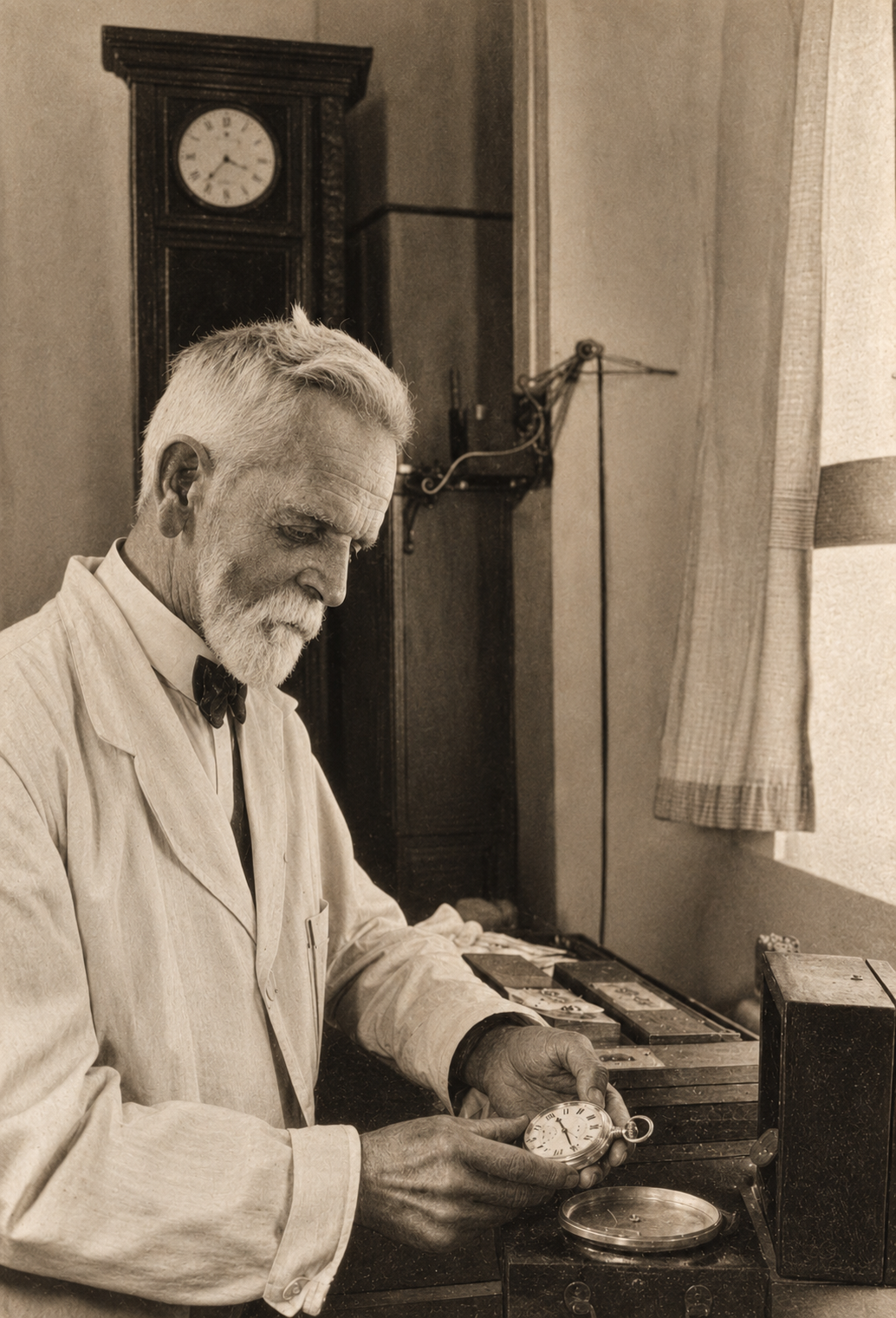
Arnold Vuille-Roulet (1857–1947), the Longines precision regulator responsible for the preparation of the documented 565601–565612 observatory chronometer series. Period photograph.
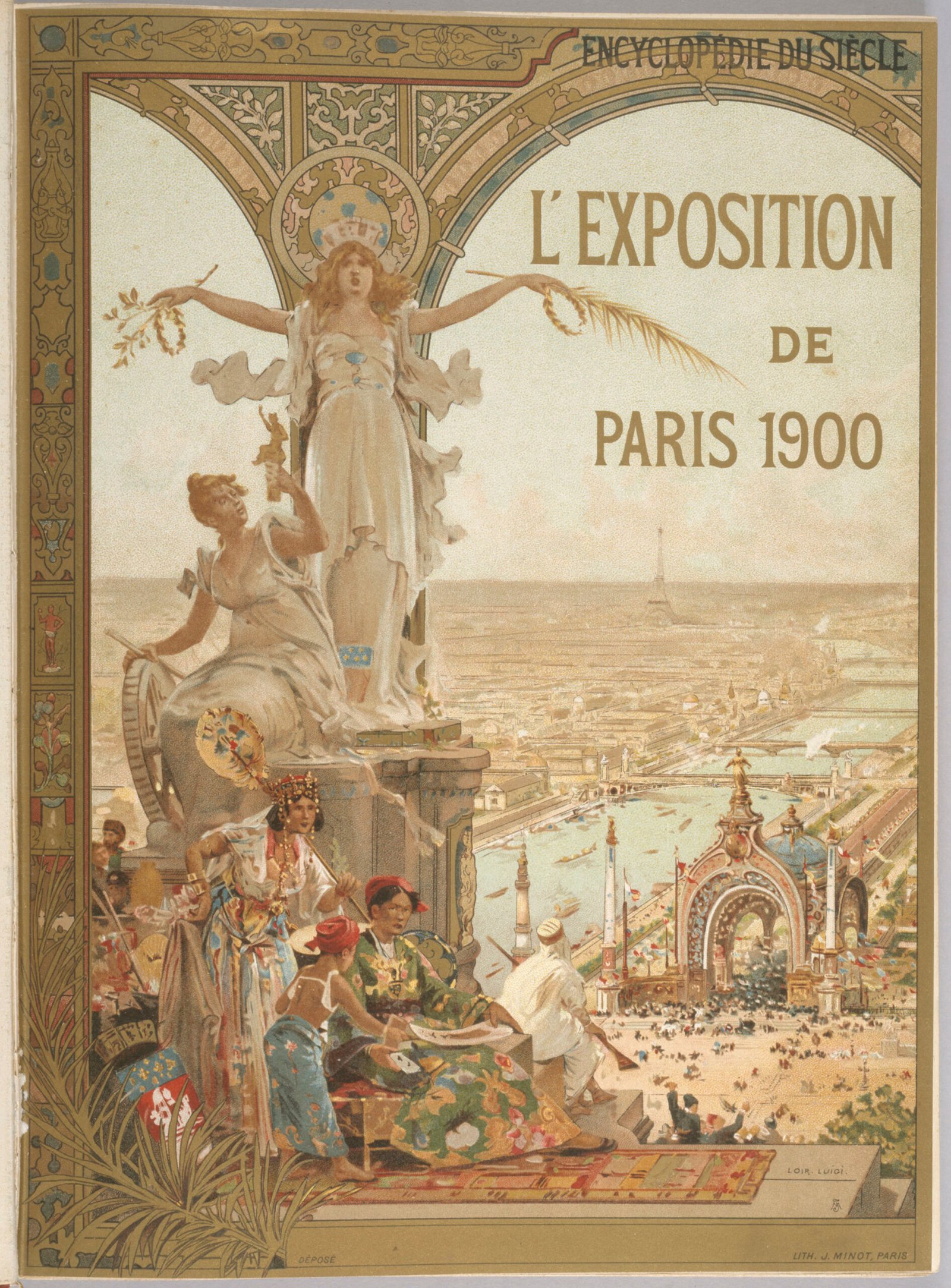
Cover illustration from “L’Exposition de Paris 1900”, Encyclopédie du Siècle, showing an allegorical view of the 1900 Paris Exposition with the Eiffel Tower and exhibition grounds in the background.
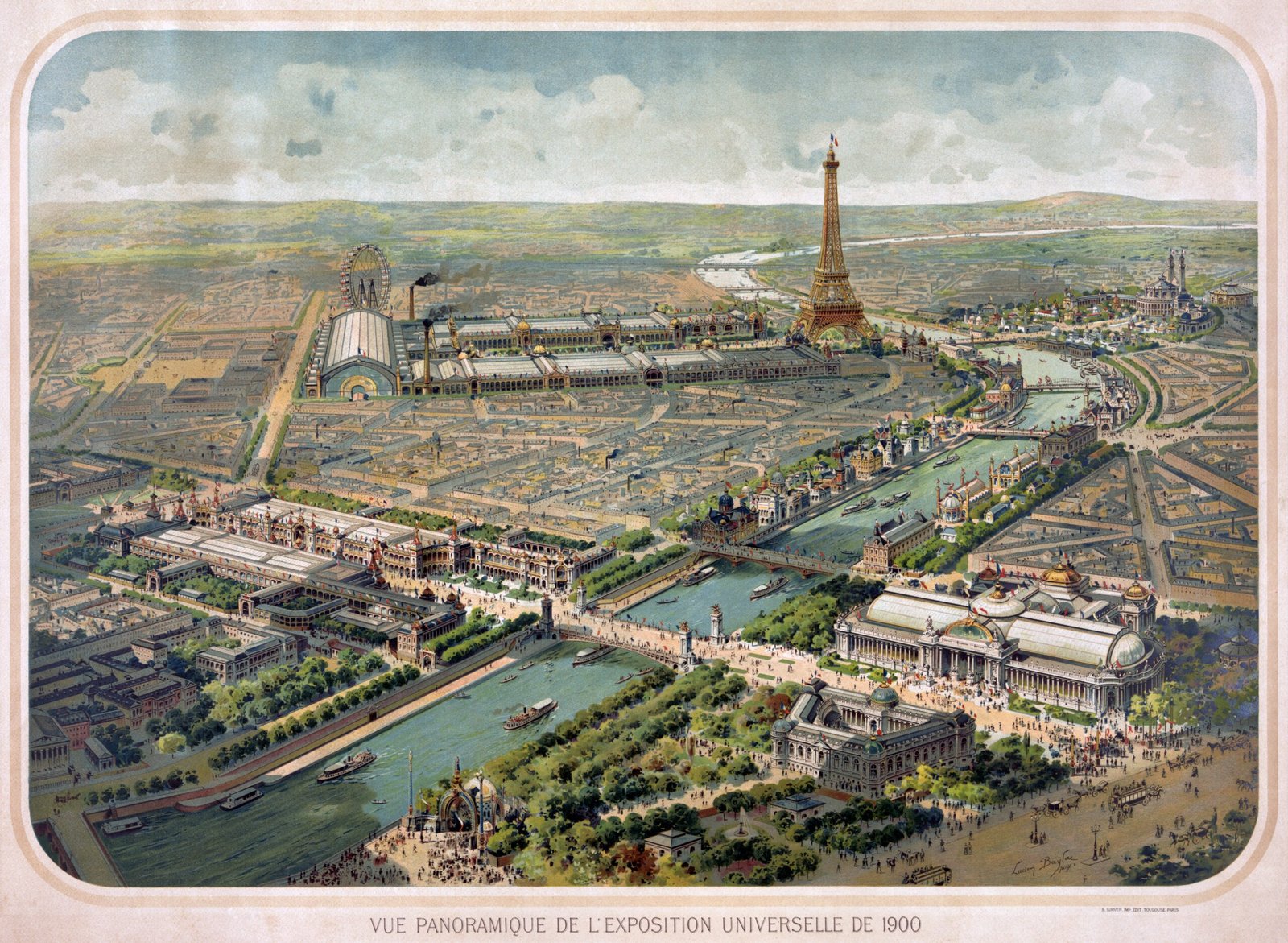
Panoramic aerial view of the Exposition Universelle, Paris 1900, with the Eiffel Tower, the Champ de Mars, the Seine and the main exhibition grounds.

It is difficult today to fully grasp what the Exposition Universelle of 1900 meant to those who experienced it. From 14 April to 12 November, more than fifty million visitors passed through its gates a number that was itself a statement: the world had become connected enough to gather on an unprecedented scale.

The exhibition covered 216 hectares along both banks of the Seine, ten times the size of the 1855 exposition. The Champ de Mars, the Trocadéro, the Esplanade des Invalides and the riverbanks were absorbed into a single, coherent vision of modernity. This was not a trade fair with a grand backdrop. It was a deliberate demonstration of what a nation could achieve when it chose to present its full industrial, technological and cultural capacity.

The scale was matched by ambition. Over 83,000 exhibitors participated, nearly 43,000 prizes were awarded, and 127 congresses brought together 80,000 participants

This was not merely commerce on display. It was the organised presentation of industrial power, technological capability and national identity.

Attendance required commitment. A ticket cost 1 Franc, while a typical worker earned 40–50 centimes per hour. Visiting the exposition was a conscious decision, time and money deliberately spent. The Visitors came to experience the technological future first-hand.

Visitors encountered a world in transition: electric lighting on an unprecedented scale, moving walkways, early electric vehicles, diesel engines and sound recording technology.

These were not curiosities. They were early manifestations of technologies that would soon become part of everyday life.

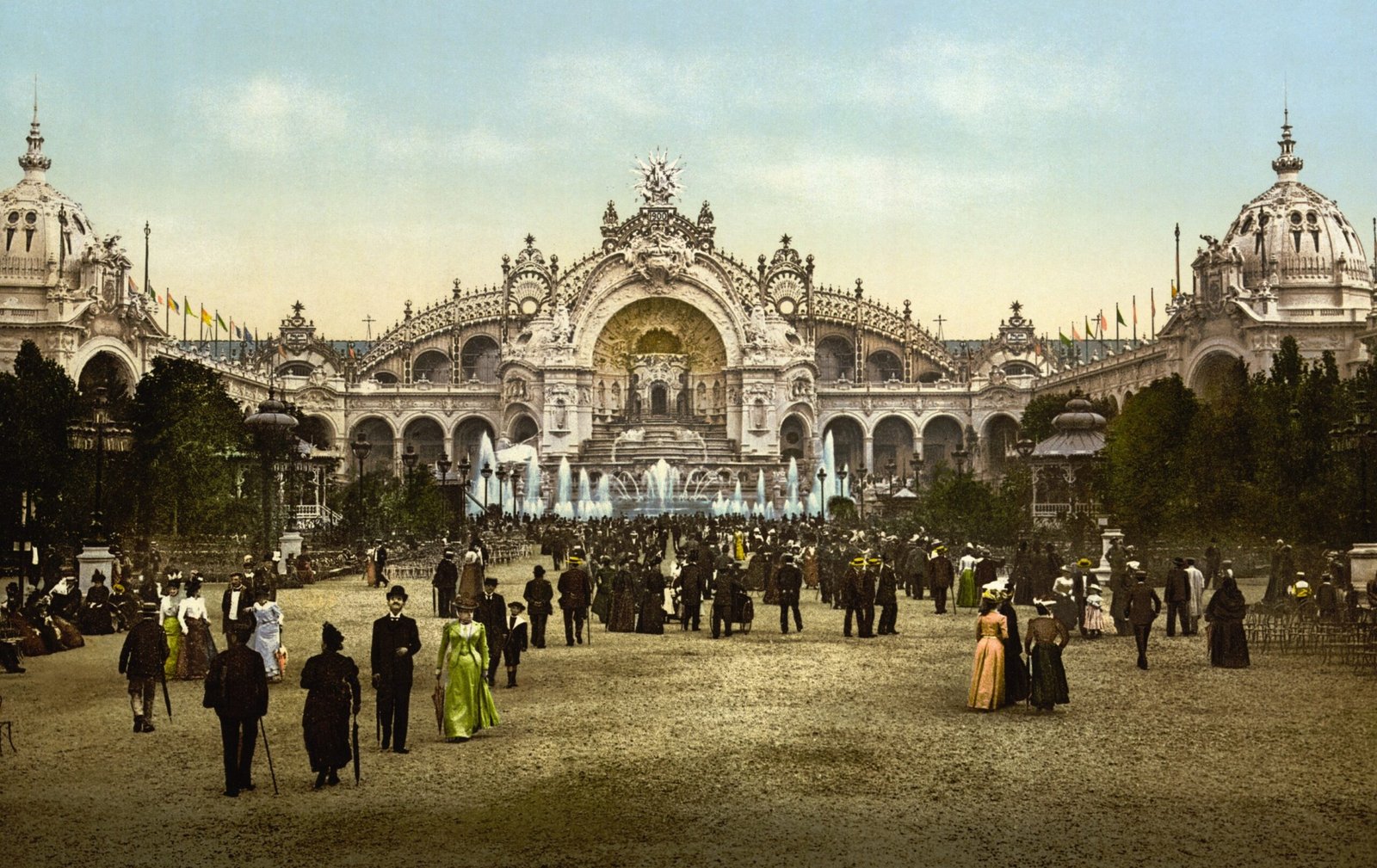
The Palace of Electricity made this visible. Thousands of lamps turned night into spectacle, while vast water installations demonstrated control over natural forces.

Much of the exhibition was temporary. Yet what remained, the Grand Palais, Petit Palais, Pont Alexandre III, Gare d’Orsay and the Paris Métro  became permanent elements of the city. The exposition did not simply showcase progress. It reshaped Paris.

Within this framework, horology occupied Classe 96 in Groupe XV.

For a manufacturer from a small valley in the Bernese Jura, this was the largest possible stage and Longines used it to present not an exception, but a system.

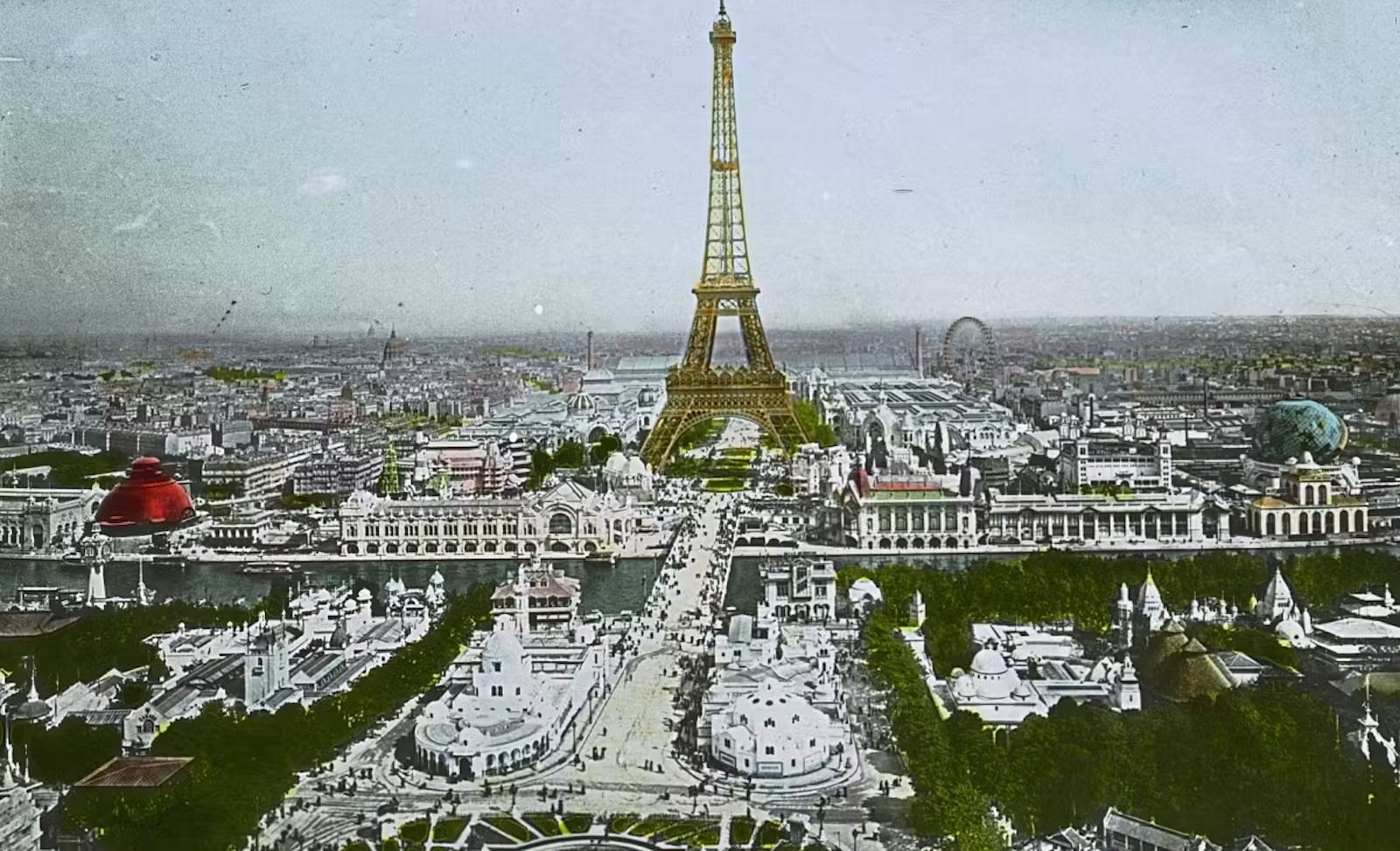
Aerial colour photograph of the Exposition Universelle Paris 1900 — view from the Trocadéro toward the Eiffel Tower, with the Champ de Mars and the exhibition buildings spread across both banks of the Seine. The Grande Roue de Paris Ferris wheel is visible at the right edge. The Globe Céleste appears as a blue sphere to the right of the tower.
The Palais de l’Électricité and the Château d’Eau, Exposition Universelle Paris 1900. Visitors promenade before the facade in Belle Époque dress. The illuminated fountain in front of the palace circulated 100,000 litres of water per minute. Colour photochrom print.
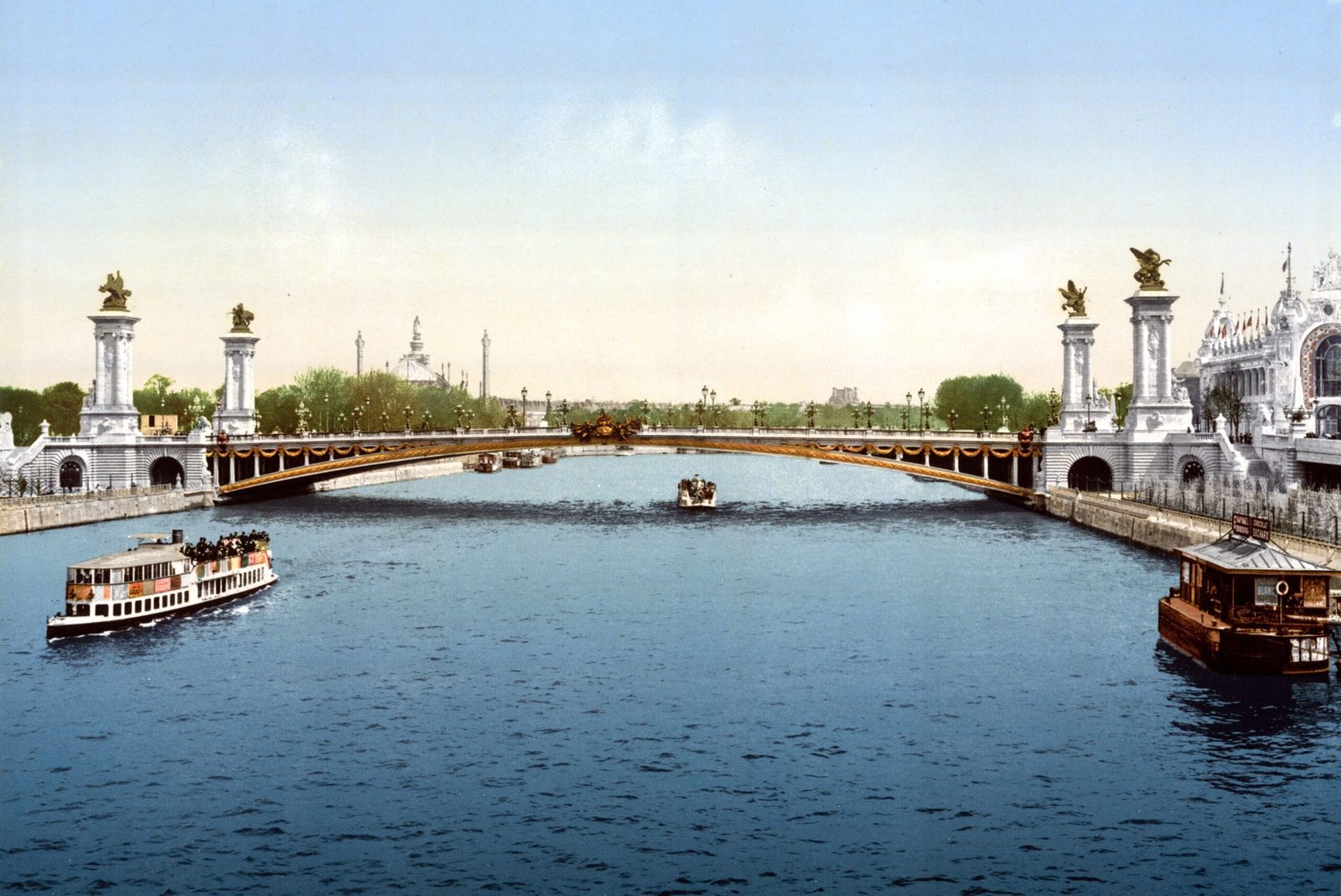
The Pont Alexandre III, constructed for the 1900 Exposition and named after the Russian Tsar — seen here with Seine river traffic and the exhibition buildings beyond. The bridge survived the fair and stands in Paris today. Photochrom print, P.Z. series.
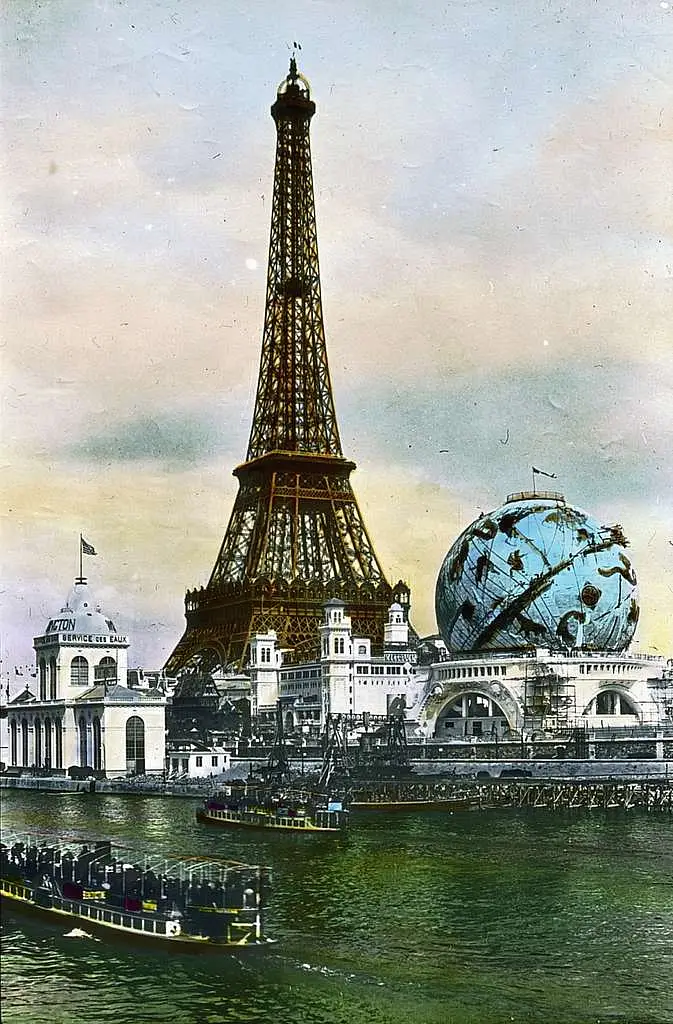
The Eiffel Tower and the Globe Céleste seen from the Seine, 1900. The Globe Céleste — a 46-metre rotating globe showing the constellations — was one of the most distinctive structures of the fair. A staircase inside allowed visitors to ascend through its interior. Photograph, 1900.

Movement No. 565606 does not stand alone. It belongs to a structured series of twelve movements, with serial numbers 565601 through 565612, all of which were entered at Neuchâtel in 1900. Of the twelve, eleven appear in the Observatory documentation; No. 565604 is not recorded, for reasons that remain unclear from the surviving sources.

The distribution of entries across the different tableaux the classification categories was deliberate. Nine of the twelve movements were registered in Tableau B, the most demanding class: Nos. 565601, 565602, 565605, 565606, 565607, 565608, 565609, 565611, and 565612. Two were registered in Tableau D (Nos. 565603 and 565610). This is not the distribution of movements gathered haphazardly from production. It reflects a considered decision about where the series would be tested and what would be demonstrated.

What strikes anyone who works through the documentation is a single name that appears, without exception, on every registration entry for the twelve movements: A. Vuille-Roulet, recorded as the regulator responsible for the adjustment of the movements in Saint-Imier. Arnold Vuille-Roulet was the person responsible for bringing each of these twelve movements to the standard required for Neuchâtel submission. His name is the fingerprint of a system.
And yes, he was not an independent artisan occasionally preparing exceptional pieces for observatory submission. By 1900, he had already been working at Longines for more than a decade, having joined the manufacture in 1888 during the expansion of precision chronometer production for the American railway market.

Over the following decades, he became one of the central figures of Longines’ observatory program, preparing large numbers of precision chronometers for the trials at Neuchâtel and Kew-Teddington. In 1924 he would receive the Prix Guillaume the highest distinction awarded to a precision regulator in Switzerland.

What appears in the Observatory registers of 1900 is therefore not the isolated work of a gifted individual, but evidence of an emerging institutionalized precision department inside the Longines manufacture itself.

Switzerland in Paris

Switzerland did not build a national palace at the Exposition Universelle of 1900. While other nations presented themselves through monumental architecture imposing facades, symbols of state power rendered in stone and iron Switzerland chose a different approach. It presented itself as it actually was: distributed, precise, and organised without centralised spectacle.

Switzerland did not need a grand building to explain itself. The decentralised structure of the Swiss presentation mirrored the structure of the Swiss watch industry itself.

What Switzerland achieved here was not the projection of power, but the articulation of identity. Other nations emphasised monumental scale and state power. Switzerland emphasised organisation, decentralised industry and recognisable national identity.

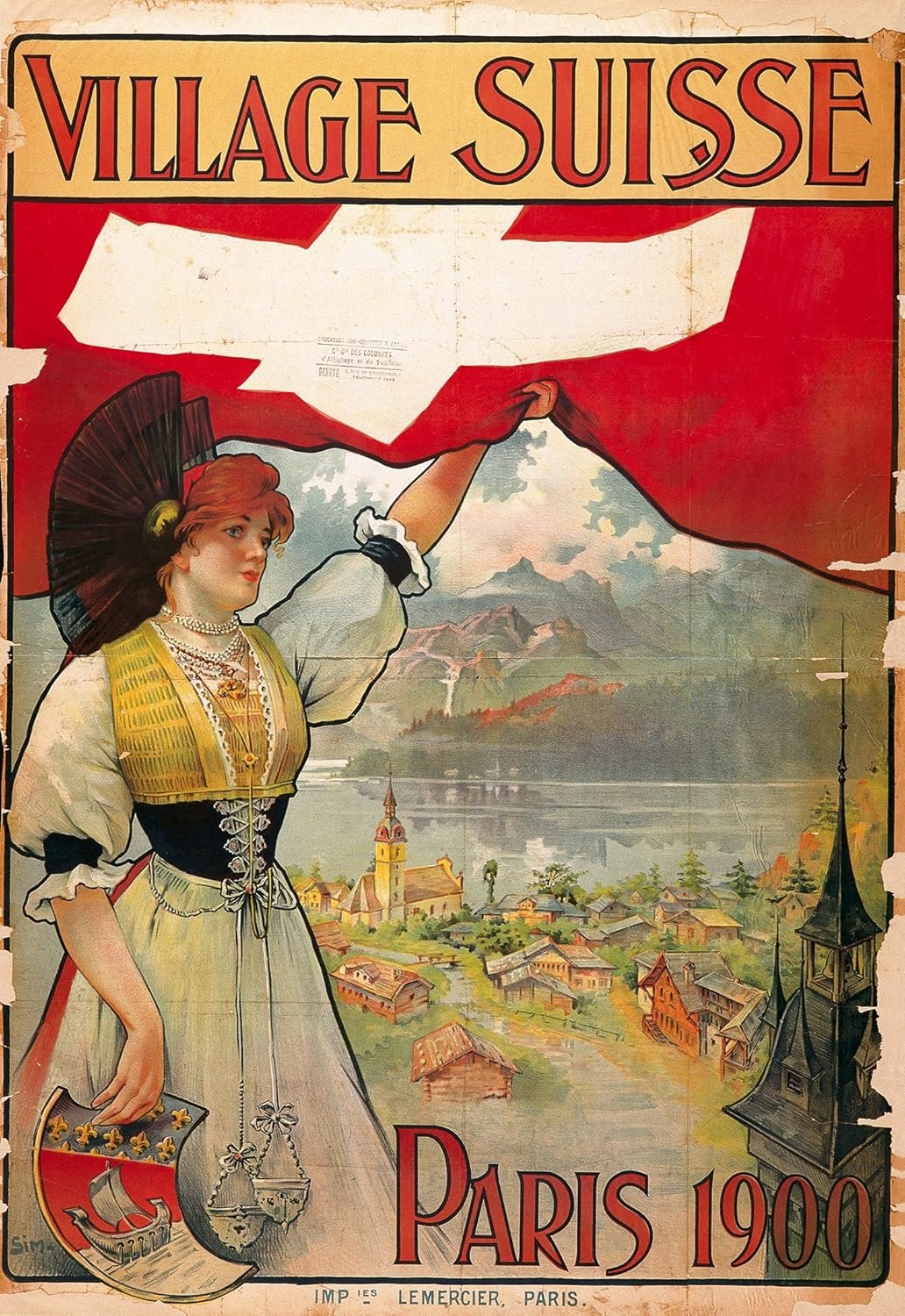
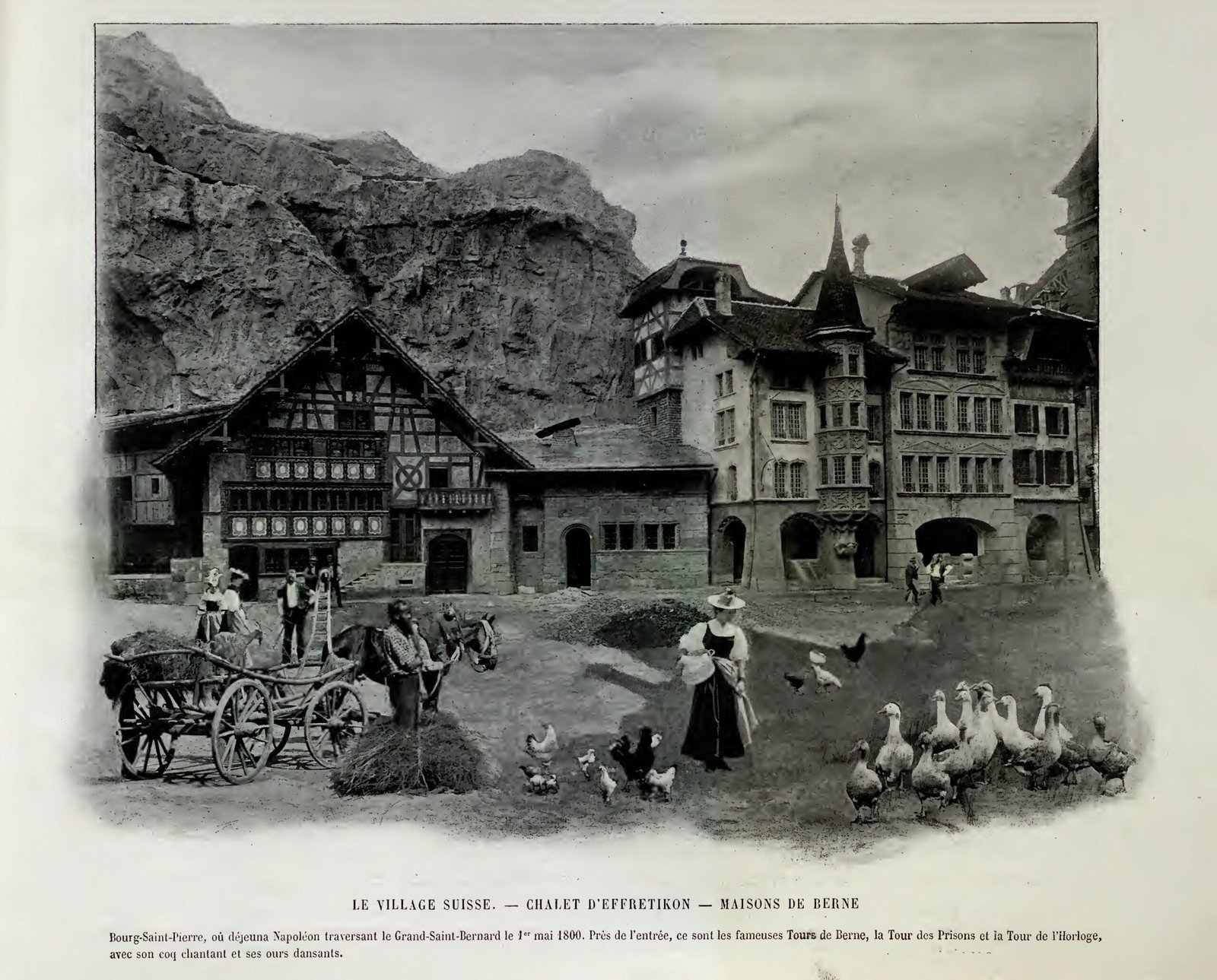
Alongside this industrial presence, Switzerland created the Village Suisse, a constructed Alpine landscape designed to make national identity tangible. Artificial mountains rose thirty metres high, a waterfall cascaded through the site, and thirty-five chalets formed a complete, inhabitable scene. Some of these structures were not replicas but real buildings, transported and reassembled piece by piece. The effect was deliberate: not representation, but reconstruction.

The village operated outside the formal classification system of the exhibition, yet it drew enormous attention. Visitors were not directed there. They went because they wanted to. In a setting dominated by industrial display, it offered something different: coherence, familiarity, and a sense of place.

The scale of this becomes clear when set against the audience. Fifty million visitors attended the exposition. Even a fraction of that number exceeded the entire population of Switzerland at the time. In a single season, more people encountered Switzerland, its landscape, its architecture, its self-image than ever before.

This was not a secondary effect of participation. It was the result of a deliberate strategy, to make the country legible not through abstraction, but through form.

Village Suisse — Paris 1900. Lithograph poster, Imp. Lemercier, Paris.
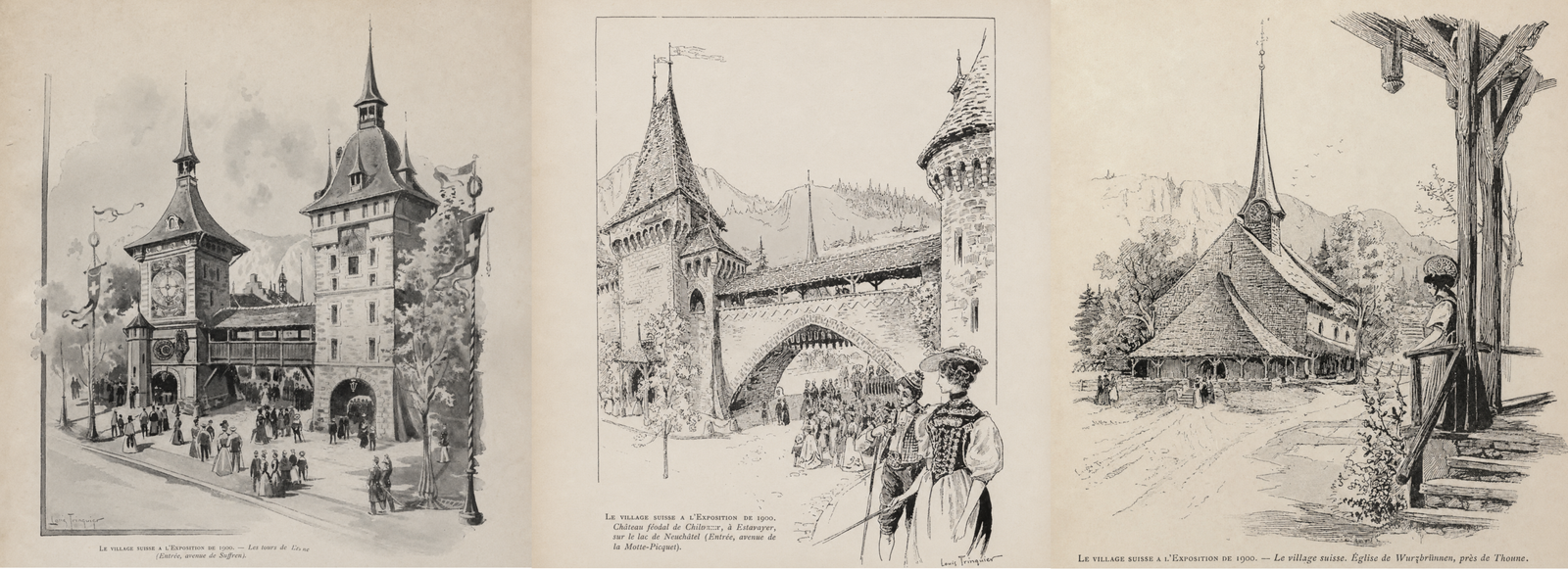
Le Village Suisse at the Exposition Universelle, Paris 1900. Illustrations from “L’Exposition de Paris (1900)”, Encyclopédie du Siècle, Tome Premier, showing reconstructed Swiss architectural scenes: the entrance towers, the feudal-style Château de Chillon at Estavayer, and the church of Wurzbrunnen near Thun.
Le Village Suisse — Chalet d'Effretikon and Maison de Berne. The artificial rock face, 30 metres high, is visible in the background. Period photograph, 1900.
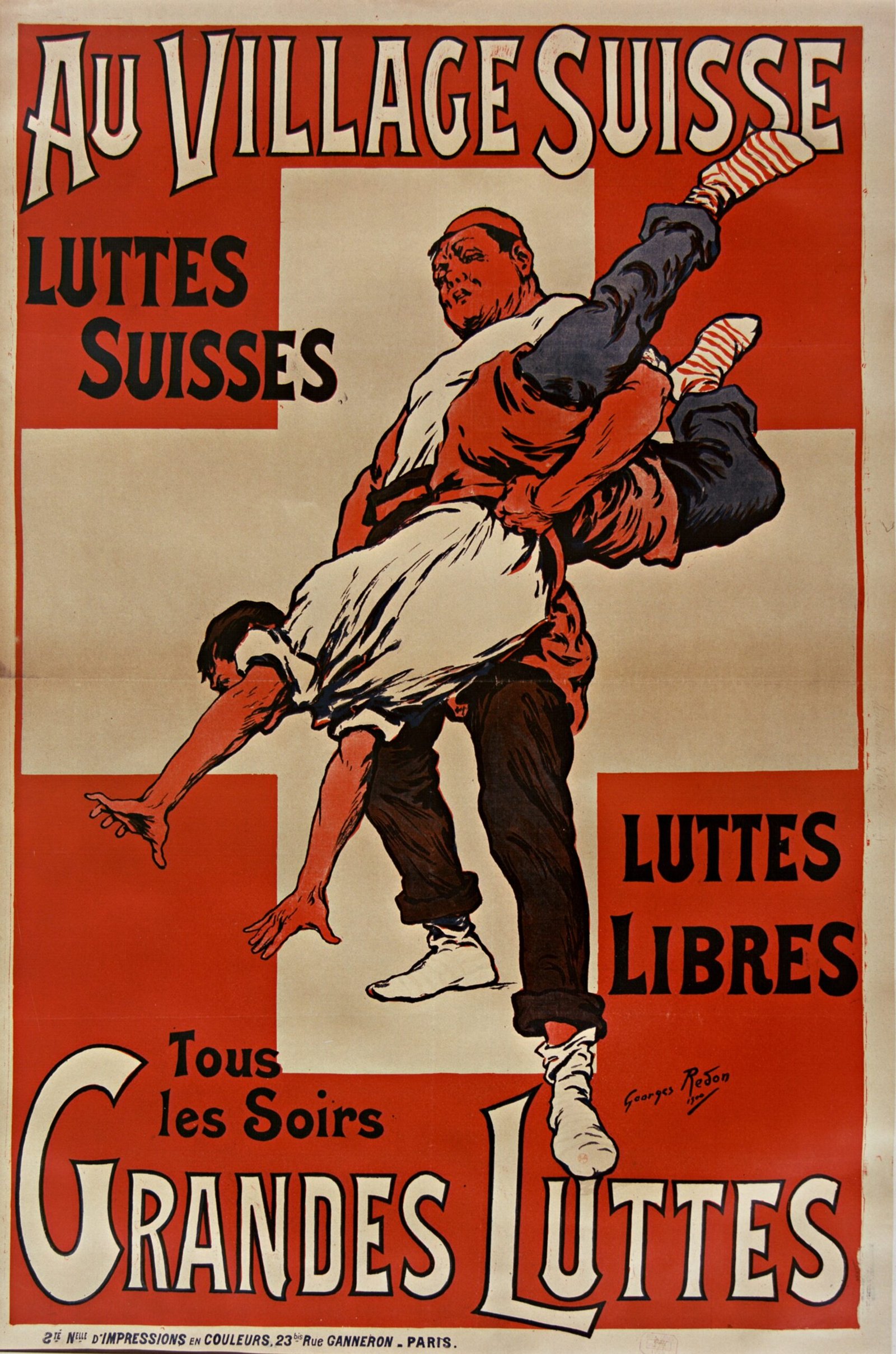
"Au Village Suisse — Luttes Suisses / Luttes Libres — Grandes Luttes — Tous les Soirs." Poster advertising the nightly wrestling evenings at the Village Suisse.

Precision at Scale

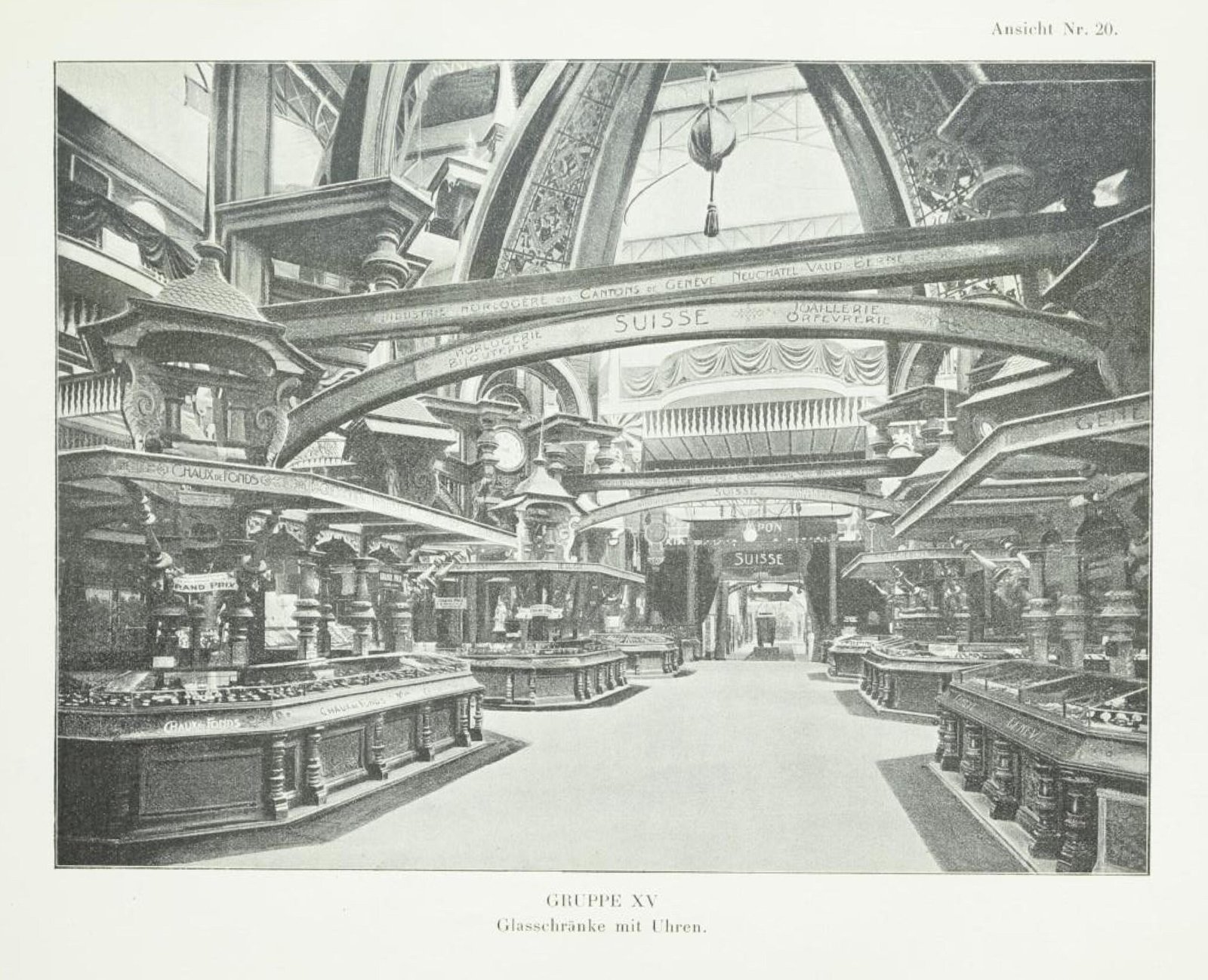
The formal Swiss watchmaking presence was located within the Palais on the Esplanade des Invalides. There, the Salon de l’horlogerie Suisse brought together around 100 manufacturers within a single, deliberately structured exhibition space.

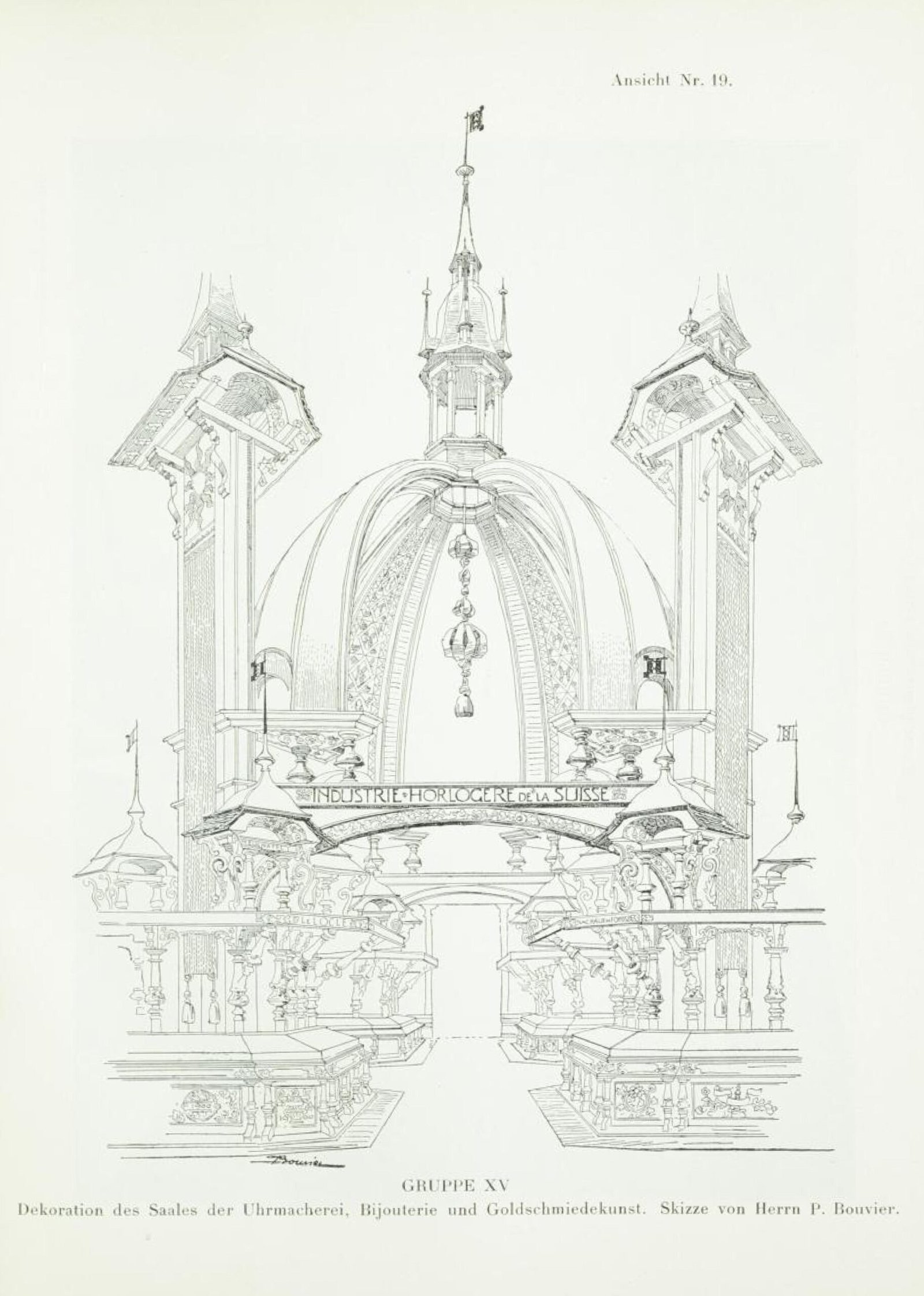
Architect's sketch for the Swiss watchmaking pavilion (Groupe XV — Industrie Horlogère de la Suisse), designed by P. Bouvier. From the Swiss General Commissariat Administrative Report, 1901.
Designed under the direction of P. Bouvier, the layout combined central pavilions with glass showcases and wall displays — a setting that expressed exactly what it demonstrated: coordination, organisation, and control.

The Salon de l'horlogerie Suisse — Groupe XV, Glasschränke mit Uhren. The Swiss watchmaking hall at the Esplanade des Invalides, Paris 1900. Approximately 100 Swiss watchmaking companies occupied 1,050 square metres under this openwork dome. From the Swiss General Commissariat Administrative Report, 1901.
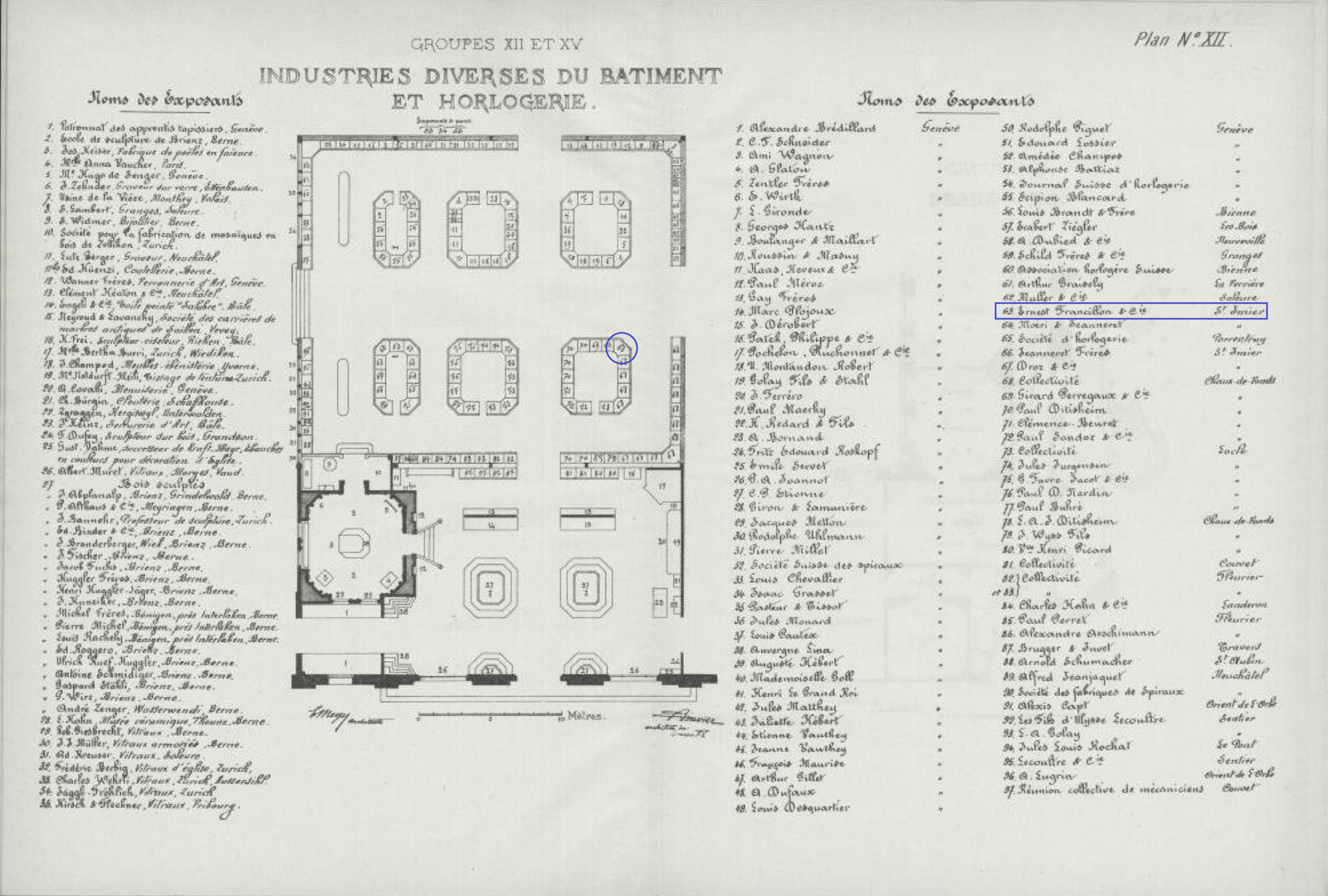
Plan of the Swiss exhibition section for Groups XII and XV, “Industries diverses du bâtiment et horlogerie”, Paris 1900. Ernest Francillon & Cie., St-Imier — Longines — is identified in the exhibitor list as No. 63.

At the time, Switzerland’s watch industry was both dominant and fragmented. Around 700 companies employed roughly 25,000 workers in a country of just three million people. Watches were the second most important export after textiles, accounting for about ten percent of foreign trade, with annual production of around ten million pieces.

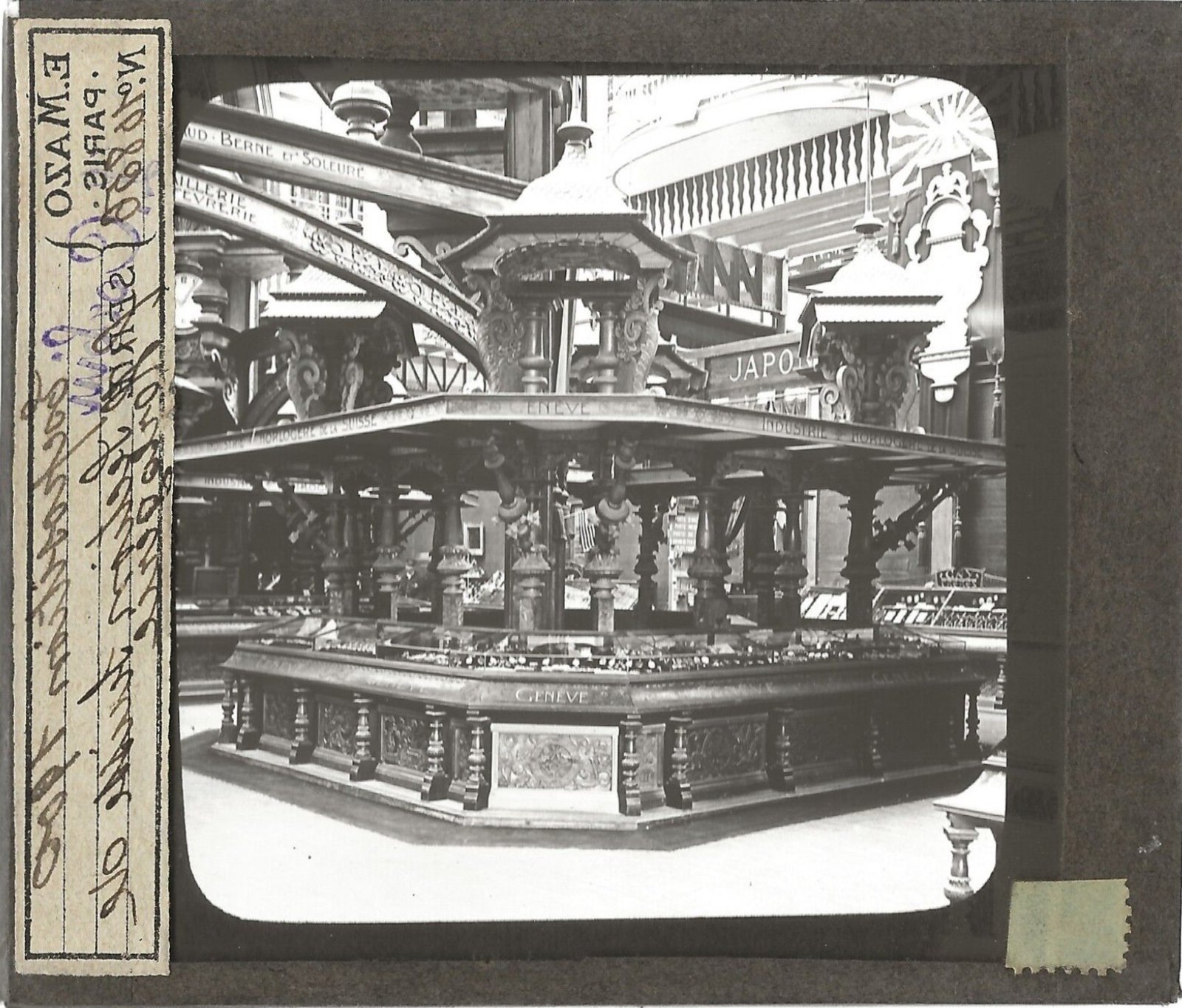
Original glass lantern slide by E. Mazo, Paris — Section Suisse / Horlogerie, Classe 96, Paris 1900. The octagonal display case at the centre foreground is labelled "Chaux-de-Fonds / Horlogerie / Bijouterie".

Switzerland controlled the global market, but through a structure built on small workshops, distributed production, and individual expertise.

This exposed a tension.

Precision had been proven. But could it scale?

The rise of American manufacturing made the question unavoidable. The challenge was no longer to produce an exceptional watch, but to achieve the same level of precision consistently, in quantity, and under controlled conditions independent of individual skill.

Paris became the stage on which this industrial claim had to be demonstrated publicly not through isolated masterpieces, but through accumulated observatory performance across multiple years and multiple testing institutions.

Switzerland’s presence answered it structurally. The distributed exhibition reflected the nature of its industry, while the watchmaking salon showed that it could organise and present itself as a coherent whole.

Within this framework, individual manufacturers had to go further.

They had to prove that reproducibility was real.

Longines occupied a distinct position. By 1900, its Saint-Imier manufacture operated at a scale that was exceptional within Switzerland, enabling something the broader industry struggled to demonstrate convincingly: consistency.

The answer Longines brought to Paris was not a single exceptional chronometer.

It was a system and that was the point.

Why Longines Won

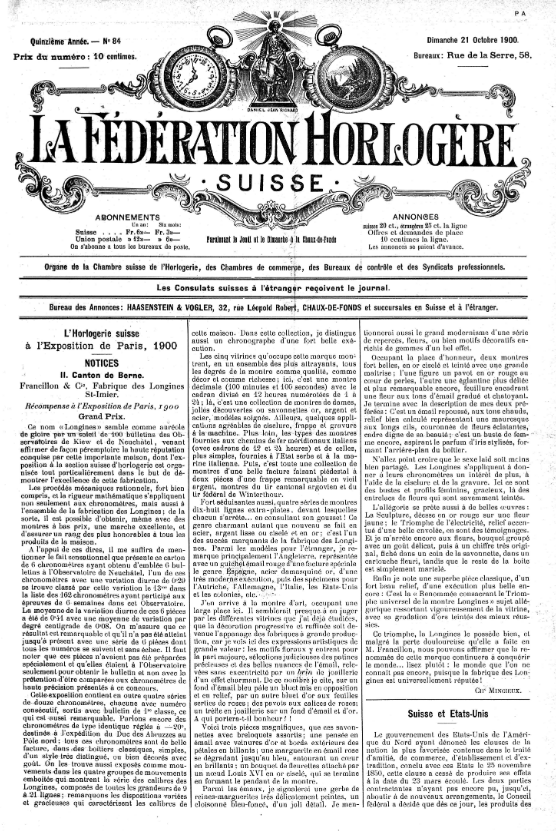
The Rapports du Jury International for the 1900 Exposition do not make for easy reading. They are documents of institutional caution, careful in their formulations, reluctant to single out individual manufacturers by name where a general commendation will serve. But when La Fédération Horlogère Suisse reported on the Swiss watch section in its edition of 21 October 1900, a different register emerged entirely. The language is not that of a committee: “The name Longines seems surrounded by a halo of glory, illuminated by a sun of one hundred Observatory bulletins from Kew and Neuchâtel.”

That is a sentence worth reading slowly. One hundred Observatory bulletins accumulated across multiple years, multiple observatories and multiple chronometer series.

The jury was not rewarding a performance. It was acknowledging a record.

La Fédération Horlogère Suisse, 18 August 1900 — the prize list for the Swiss watchmaking section at Paris, Groupe XV, Classe 96 Horlogerie. Ernest Francillon & Cie., St-Imier, is listed under Grands Prix.
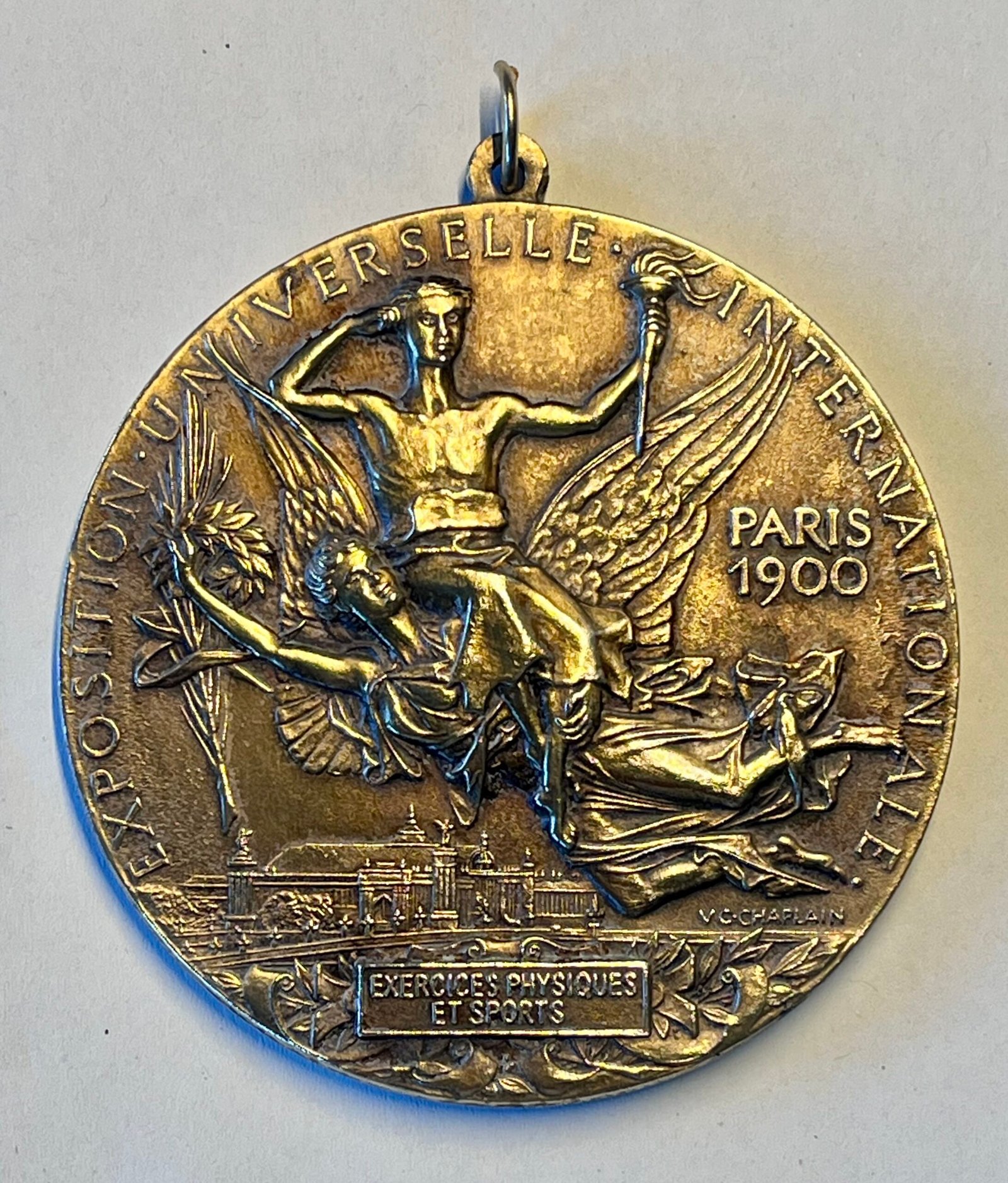
Official prize medal of the Exposition Universelle Internationale, Paris 1900 — reverse. Designed by J.-C. Chaplain, the medal shows an allegory of progress above the exposition grounds, with a winged genius bearing a torch and a second figure reaching toward a laurel branch. The cartouche below identifies the award category as “Exercices physiques et sports” (“Physical Exercises and Sports”). Gilt bronze. Although this example belongs to a different exhibition category and was not awarded to Longines, it illustrates the official medal type used for awards at the 1900 Exposition. (Collection: Guido Hamacher)
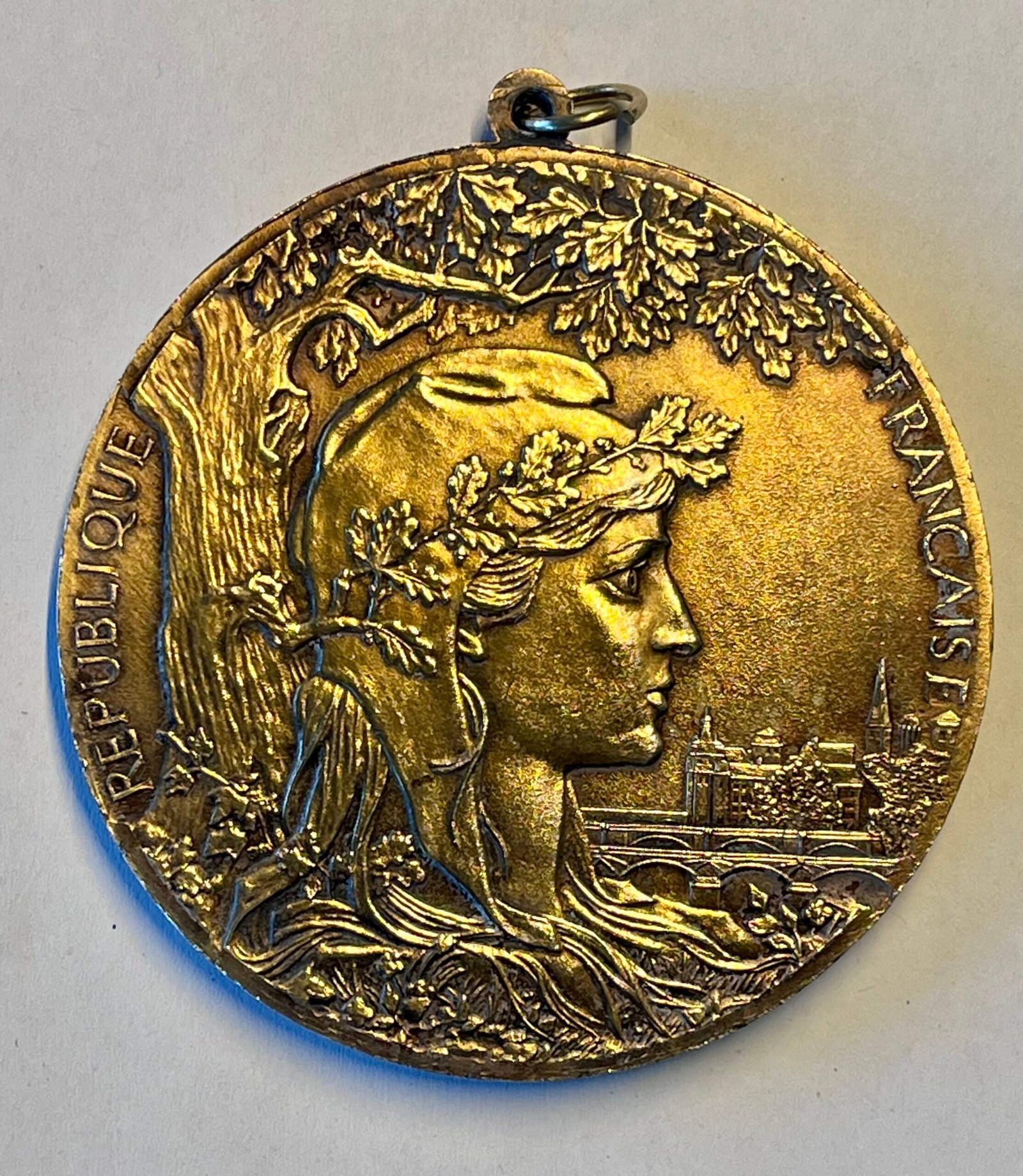
Obverse of the same official prize medal of the Exposition Universelle Internationale, Paris 1900. Marianne, personification of the French Republic, is shown wearing an oak-leaf crown, with the Paris cityscape and the Seine in the background. Inscribed “REPUBLIQUE FRANÇAISE”. (Collection: Guido Hamacher)
La Fédération Horlogère Suisse, 21 October 1900 — the full report on the Longines exhibit at Paris, including the passage: "Le nom Longines semble entouré d'une auréole de gloire, illuminé d'un soleil de cent bulletins d'Observatoires de Kew et de Neuchâtel."

The same report described the philosophy behind the Longines exhibit: “The exhibition of this important house in the Swiss watch section is organised with the particular aim of demonstrating the excellence of its manufacture.” And further: “Mechanical procedures well understood, and mathematical rigour, are applied not only to the chronometers but to the entire production.”

That last point is the one that mattered most to the jury. The Grand Prix was not given to Longines because they had built one chronometer that outperformed all others. The competitive landscape of the 1900 exposition included manufacturers who had done exactly that: they sent individual pieces of extraordinary precision, regulated to their absolute limits, the horological equivalent of a concert performance rather than a working instrument. The jury understood the difference.

What Longines exhibited was something harder to achieve and more industrially significant: four series of twelve chronometers each, all bearing consecutive movement numbers, all holding first-class Neuchâtel bulletins, all demonstrating that what was true of one movement was true of the next and the one after that. This was the argument for industrial reproducibility: the proposition that precision was not an accident of a gifted hand on a particular day, but the predictable outcome of a system.

Alongside the four series, the Longines exhibit included marine chronometers, decimal watches, an 18-ligne extra-flat series, ladies’ collections, and special commissions for the Italian railways, the Serbian state, and the Duke of Abruzzi’s North Pole expedition. The range was itself an argument: this was not a workshop producing rare pieces for connoisseurs, but a manufacture capable of applying the same standard of accuracy across the full breadth of its output. The jury rewarded the system because only the system could have produced the evidence.

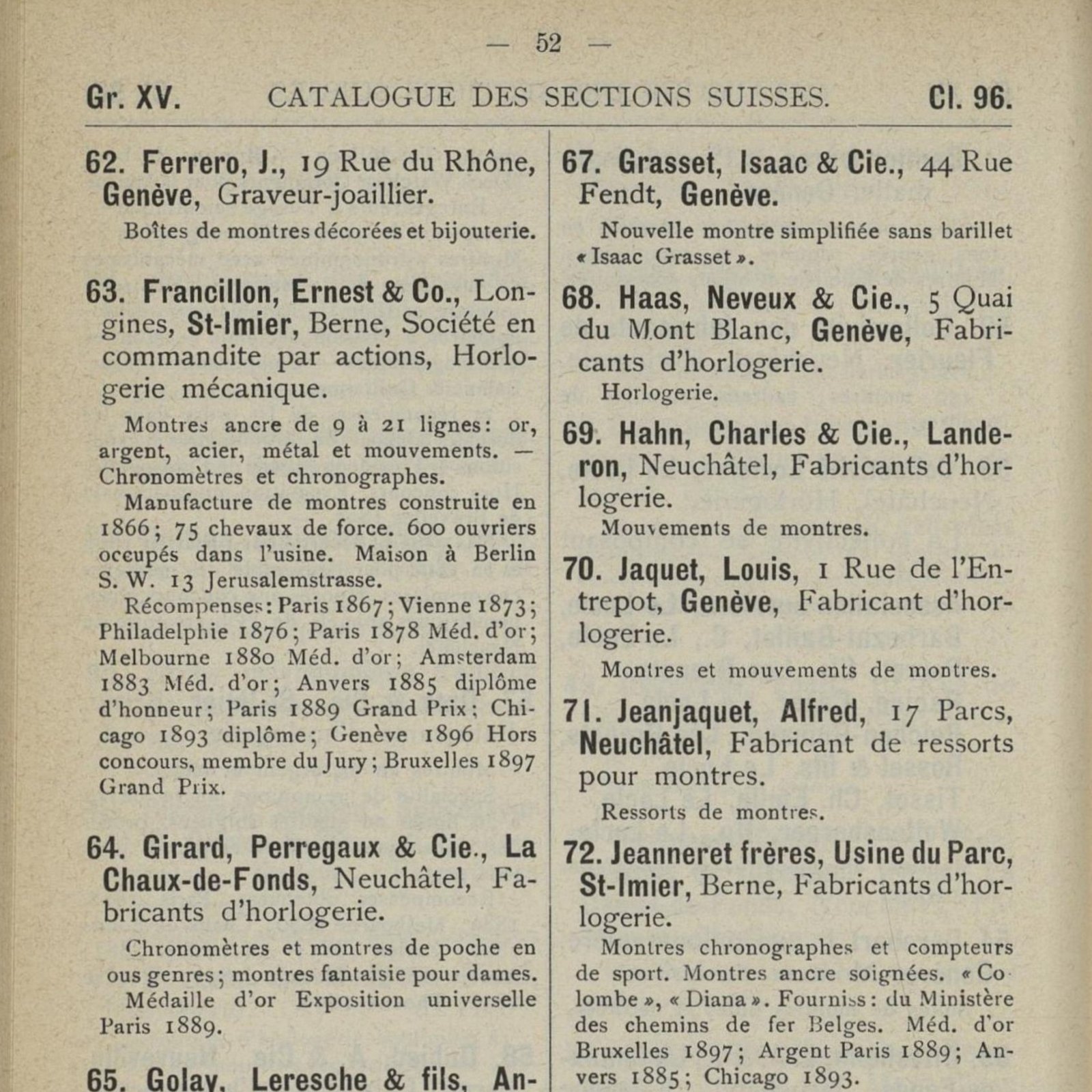
Entry No. 63 — Francillon, Ernest & Co., Longines, St-Imier — in the Catalogue des Sections Suisses, Classe 96, Horlogerie, Paris 1900. The entry lists the company's full range: Montres ancre de 9 à 21 lignes, or, argent, acier, métal et mouvements. Chronomètres et Chronographes. Awards listed include Paris 1889 Grand Prix, Genève 1896
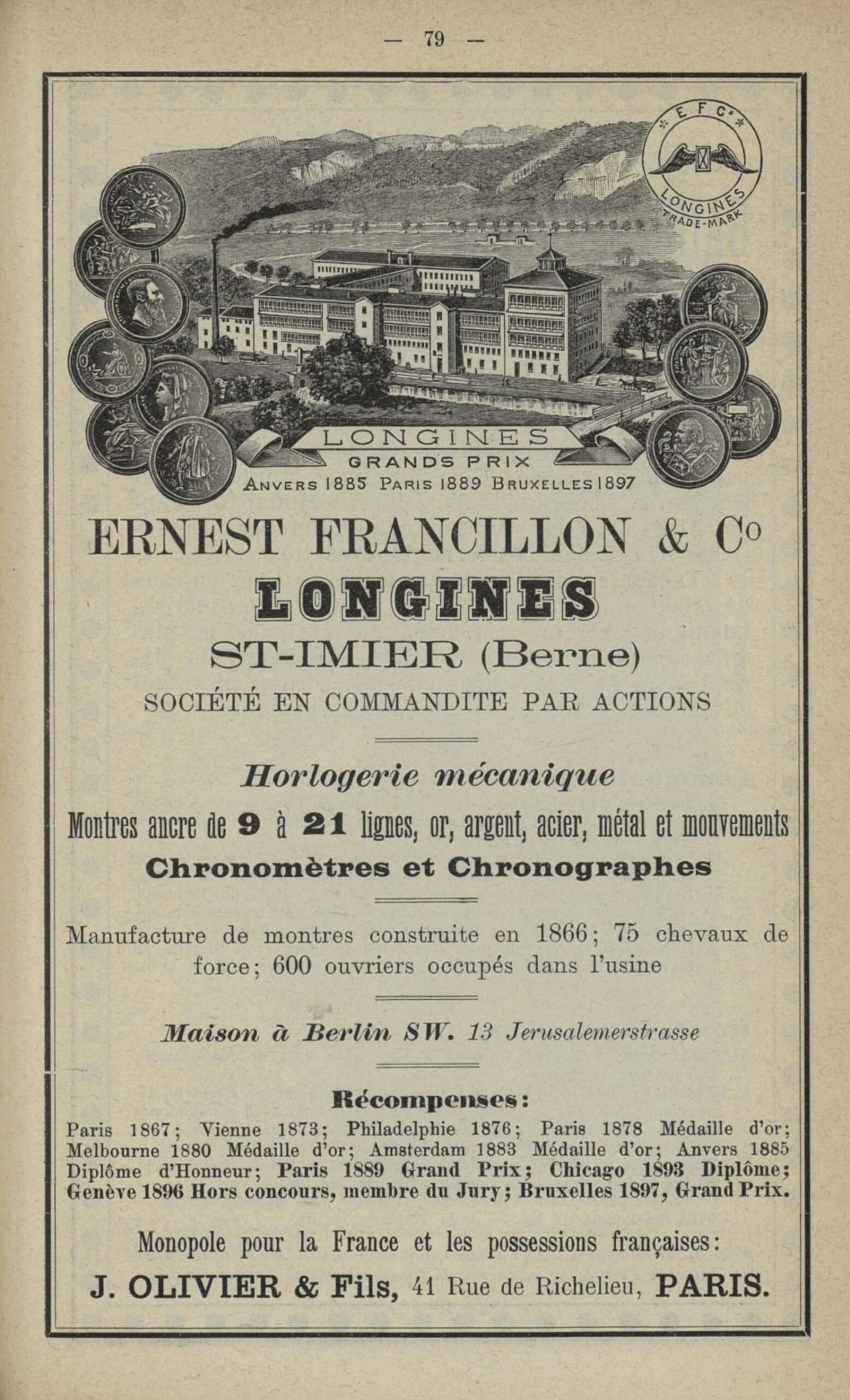
Ernest Francillon & Co. — Longines, St-Imier (Berne) — full-page advertisement in the official Swiss section catalogue, Paris 1900, page 79. The factory engraving is headed LONGINES — GRANDS PRIX — Anvers 1885, Paris 1889, Bruxelles 1897. The text notes: 600 ouvriers occupés dans l'usine.

What 565606 Carries

The chain of custody for this movement is, by the standards of pocket chronometers from 1900, unusually complete. It was registered at Neuchâtel in 1900, where it received its bulletin de marche. It was brought to Paris as part of the Longines Grand Prix exhibit. It was sold on 19 August 1902 roughly two years after the exhibition closed, to Ostersetzer, recorded in the Longines archives as the company’s representative for the Italian market in Milan. And then, for the better part of 125 years, it passed through hands and places unknown to us, until it appeared in a German auction catalogue in November 2025.

That it survived at all is not something to take for granted. Gold cases were frequently melted. Documents were discarded. The provenance that made a piece historically legible was separated from the object itself a hundred times over in the ordinary course of the twentieth century.

In horology, objects survive more often than their meaning.

I think about that sometimes: Vuille-Roulet preparing twelve movements in sequence, each one checked, adjusted, checked again. The 19AS calibre was not a difficult movement to regulate to a good standard; it was a proven design, and Longines had been working with it for years. But to bring twelve of them, consecutively numbered, to a standard suitable for Neuchâtel Classe B, consistently enough that the series as a whole presented the statistical profile it did, that required a kind of patient, methodical work that does not announce itself. It shows only in the numbers.

The engraving Grand Prix Paris 1900 was most likely added after the exposition and the awarding of the Grand Prix, before the watch entered commercial sale. Rather than a later collector addition, it appears to have formed part of Longines’ official post-exposition presentation of these chronometers.

Whoever bought this from Ostersetzer in 1902 received not just a certified chronometer but a piece that had been, in a literal sense, presented within an exposition attended by roughly fifty million people, as evidence of what Swiss watchmaking could do.

I did not acquire movement No. 565606 because it ranked 57th out of 64. I acquired it because of everything that rank sits within: the series, the regulator, the programme, the exhibition, the jury’s reasoning, and the fact that the documentation to reconstruct all of this had survived alongside the object itself. For a collector, that kind of coherence is not common. When it presents itself, you pay attention.

The watch is now in my collection, where it sits alongside pieces that taught me different things about Longines and about the period. What it teaches me, specifically, is something about the relationship between individual craft and industrial ambition how a company at the turn of the twentieth century understood that excellence at scale required a different kind of proof than excellence in a single instance. Vuille-Roulet’s name on twelve consecutive observatory entries is that proof. The jury in Paris saw it.

So, eventually, did I.

Certain images in this article are reproduced with the kind permission of Cortrie Spezial-Auktionen.

Guido Hamacher is a Longines collector and researcher based in Germany. He has worked closely with the Longines Brand Heritage Department for many years and has contributed historical research and collection items to the Longines Museum in Saint-Imier.