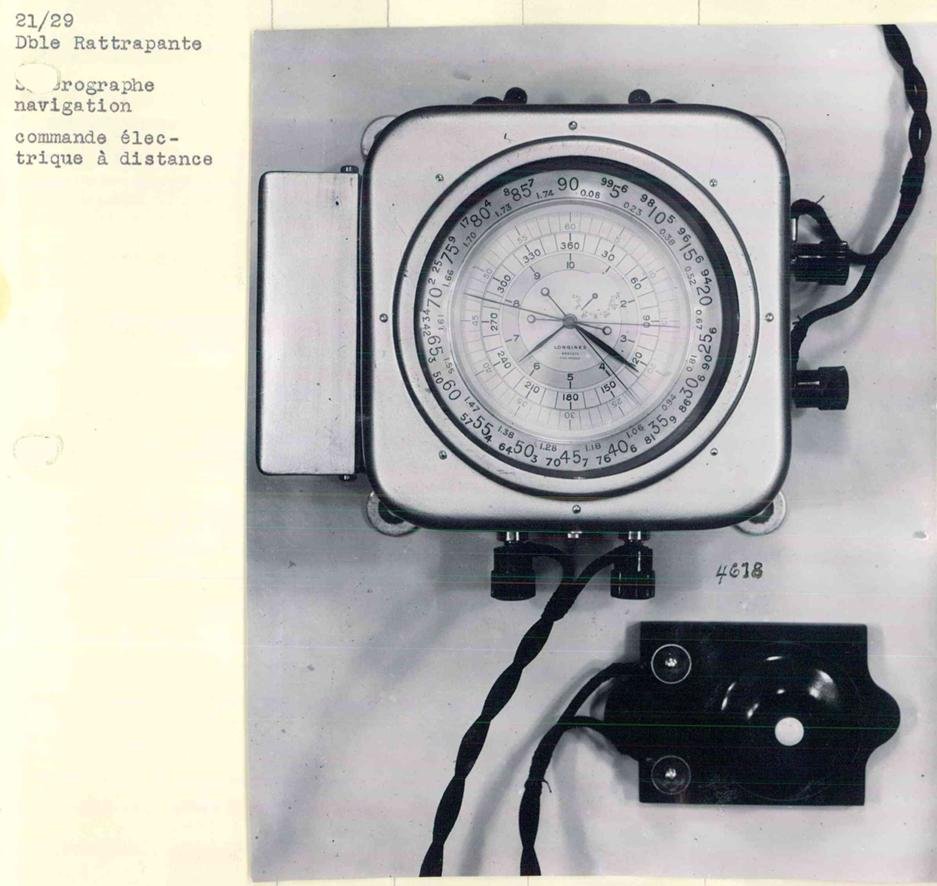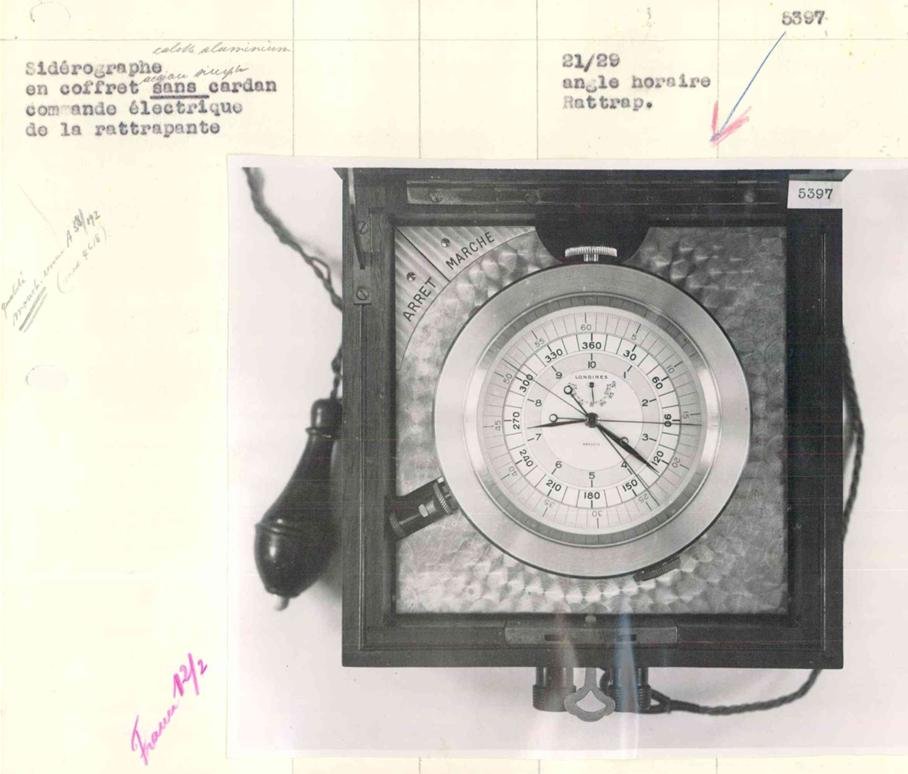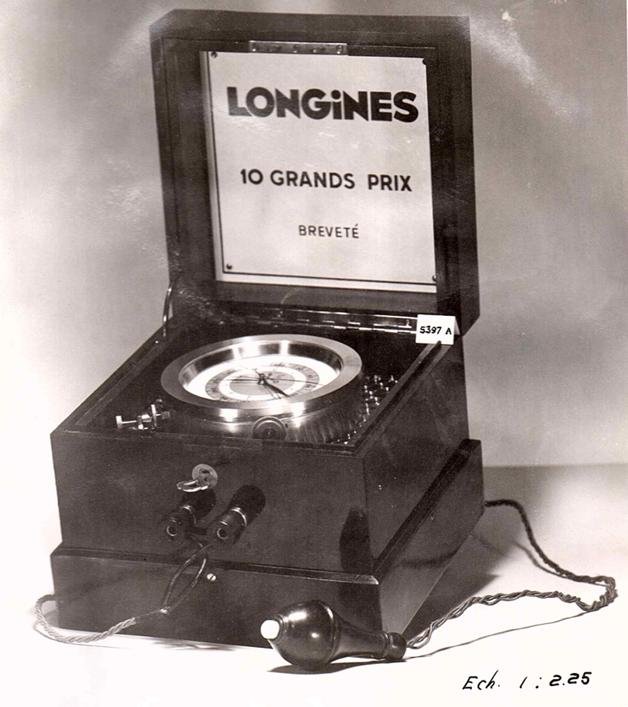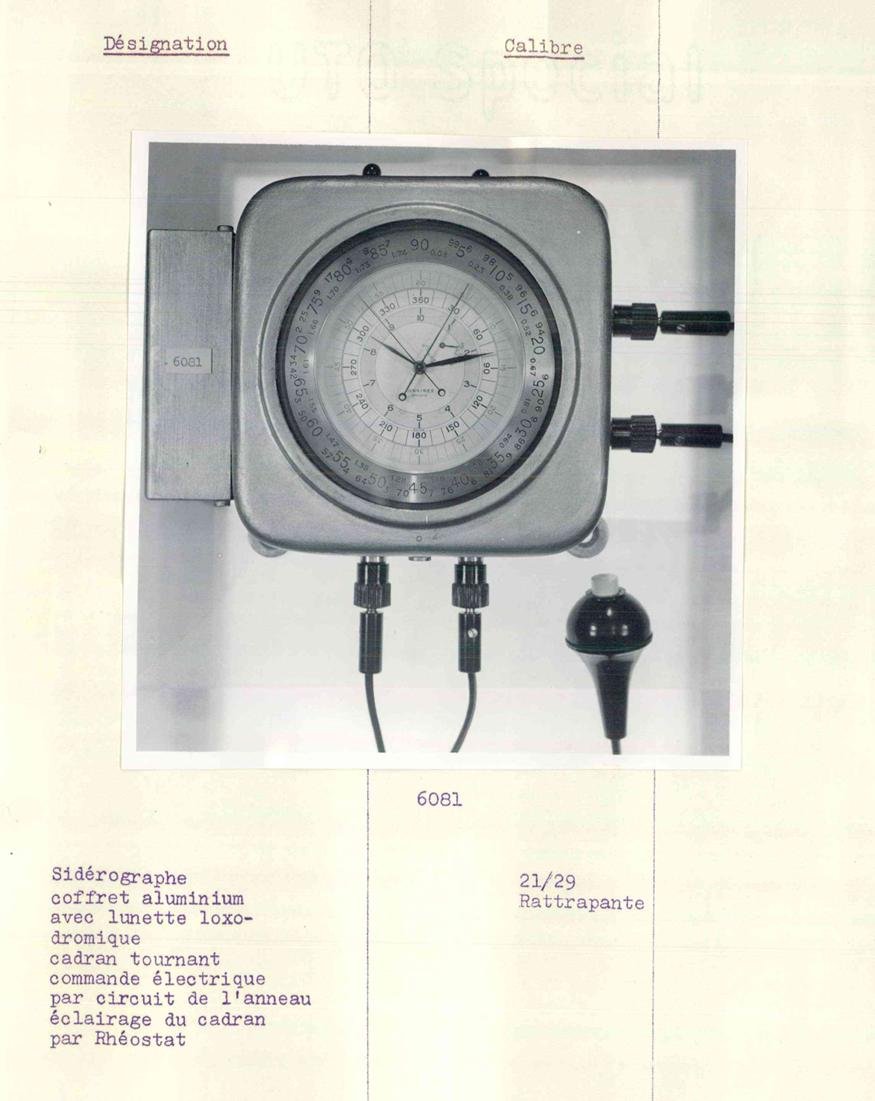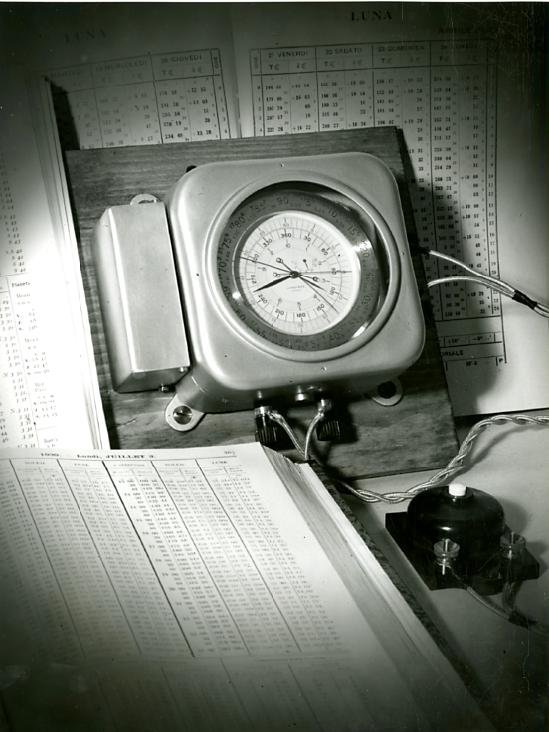


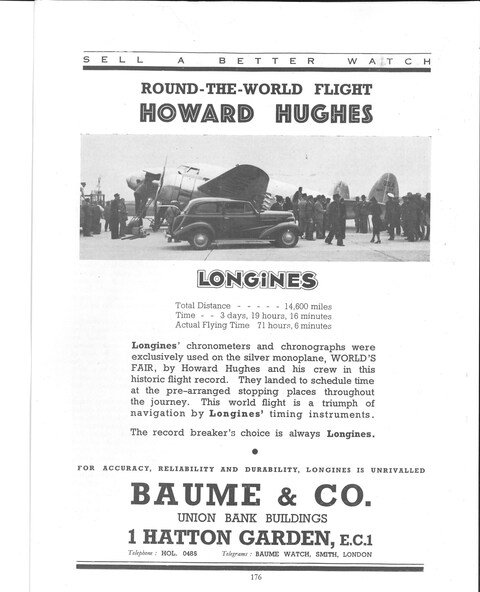
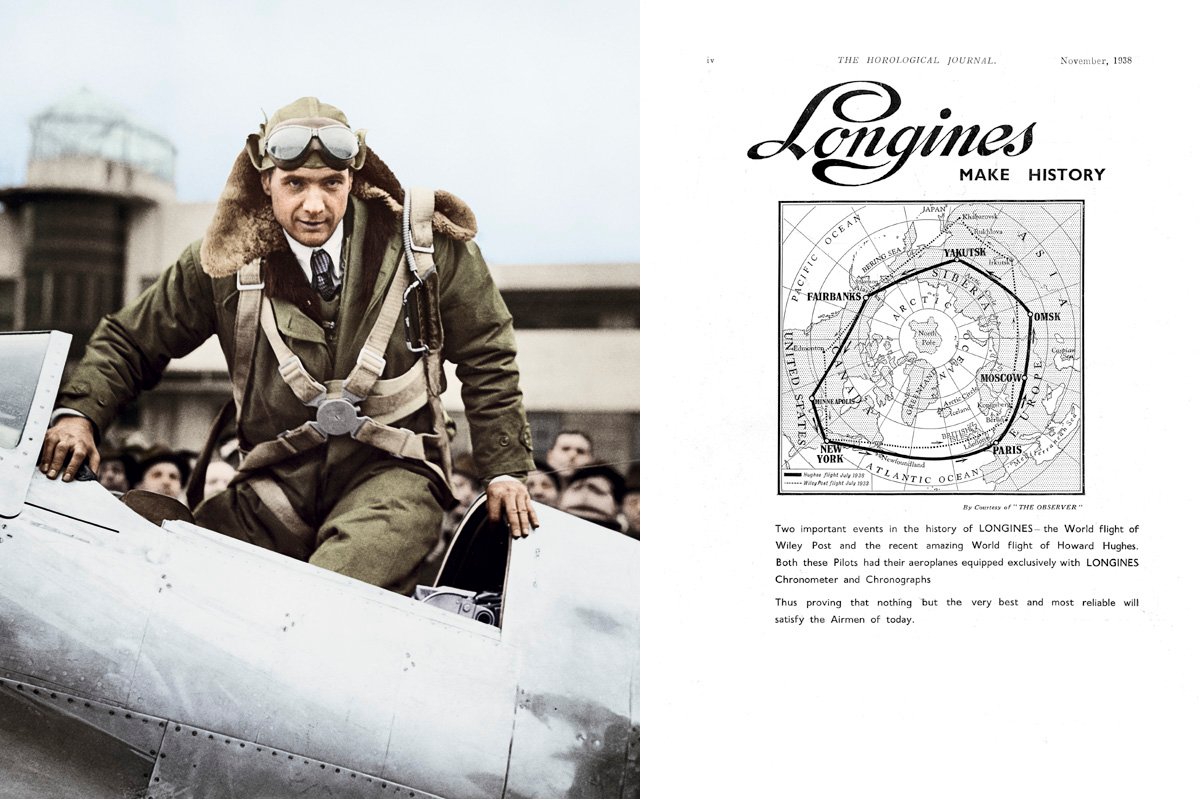
Before the Global Positioning System (GPS), before radar, before any of the electronic systems we now take for granted, long-range aviators and mariners found their way by the stars. A navigator would raise a sextant, locate a star, then reach for a pencil and begin converting the time on his chronometer into an angular value he could actually use. That conversion, hours and minutes into degrees and arc, was where mistakes crept in, and in a cockpit covering seven miles a minute it could be the difference between making landfall or ending up in the ocean. Aviators like Amelia Earhart were likely lost due to navigational problems.
Every navigation watch of the 1930s, including Longines’ own celebrated Weems and Lindbergh models, still spoke the language of civil time. They told you what hour it was. The rest, the laborious arithmetic of turning that hour into an angle, was left to the navigator and his calculations. Longines’ answer was groundbreaking. What if the watch itself spoke the language of the stars?
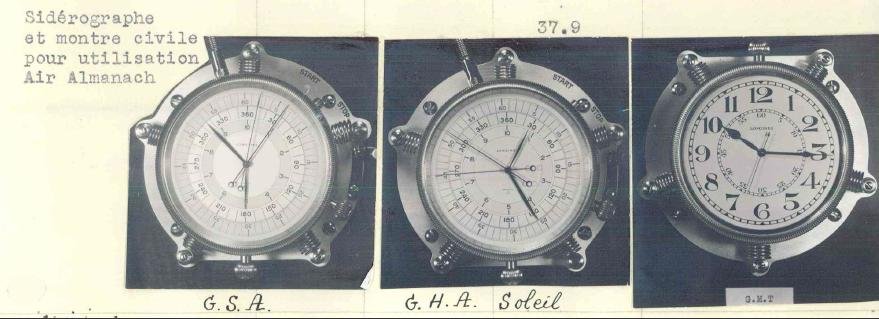
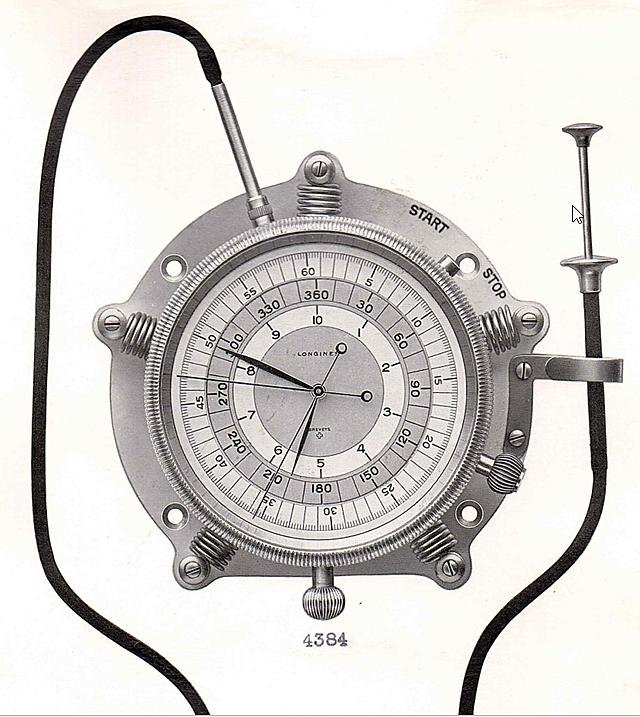
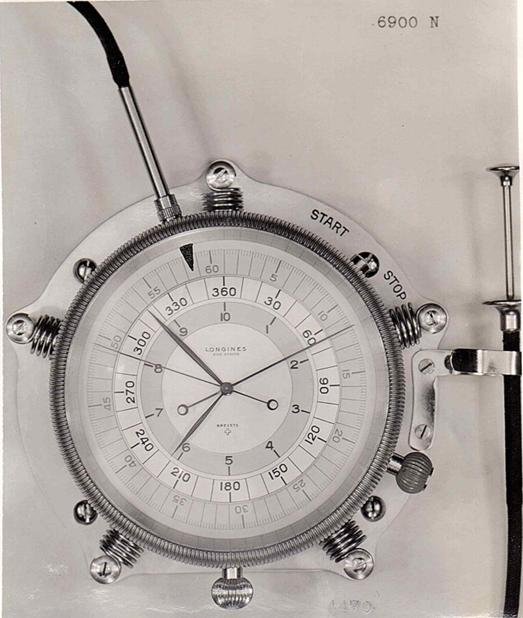
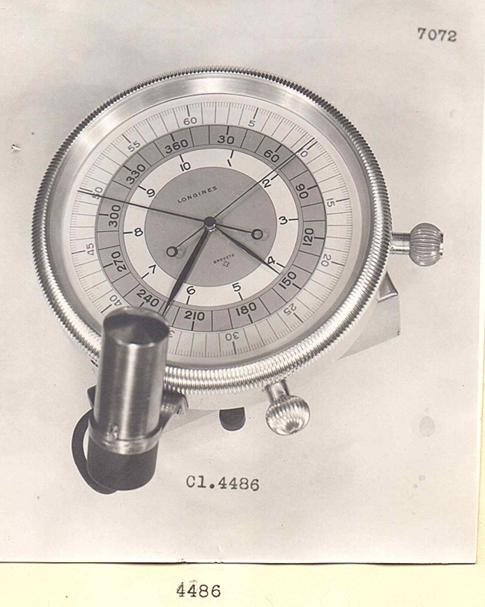
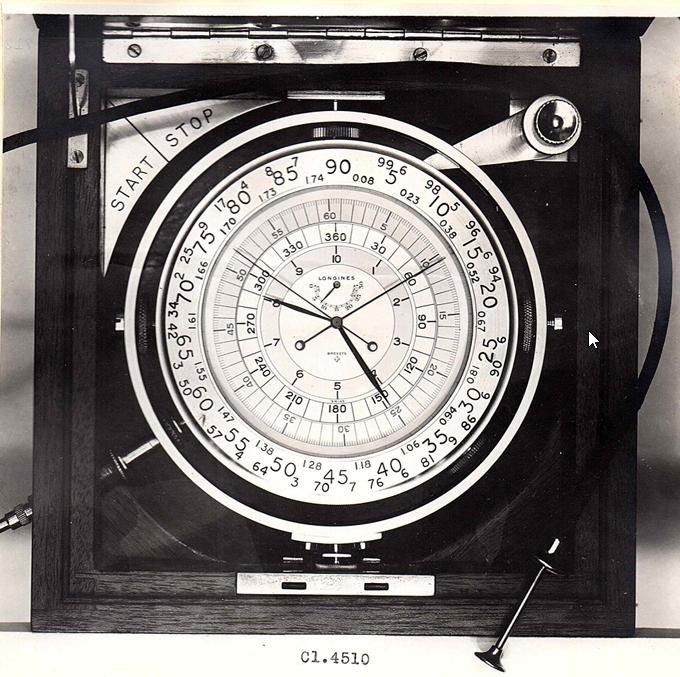
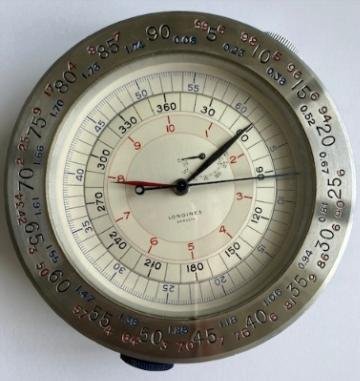
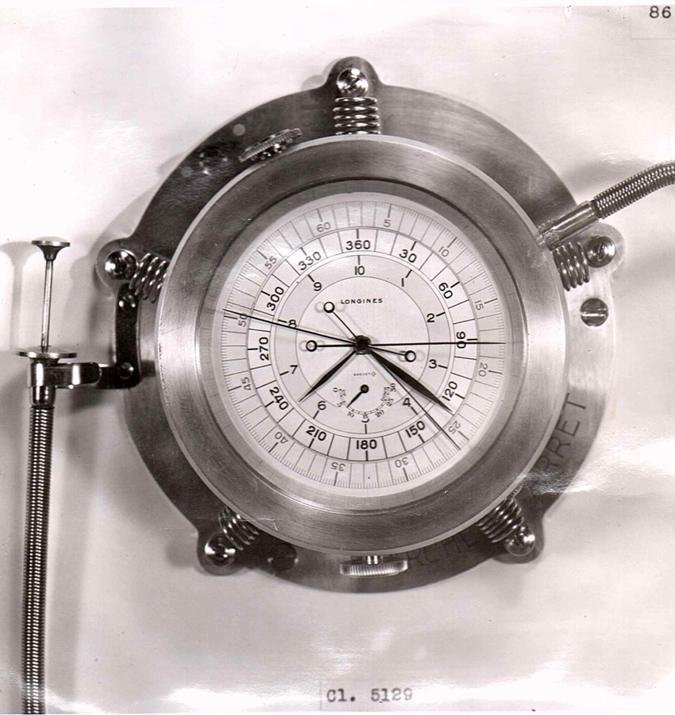
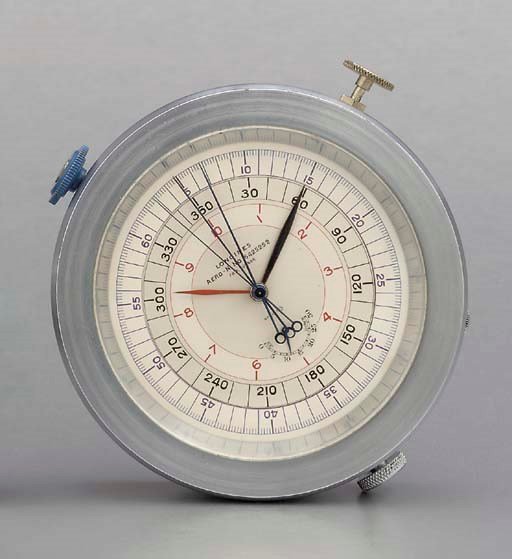
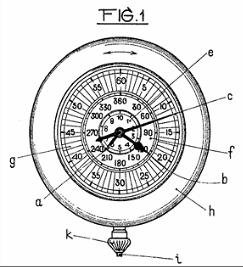
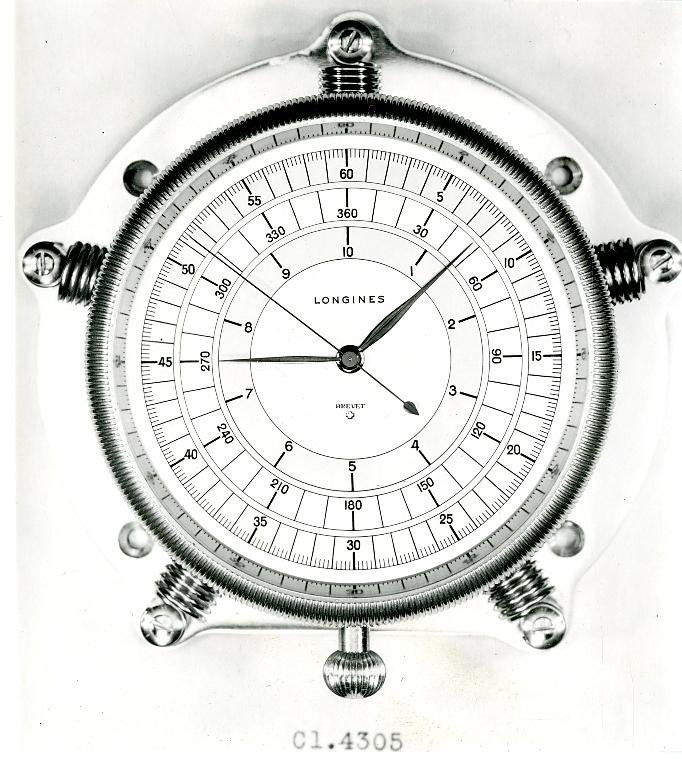
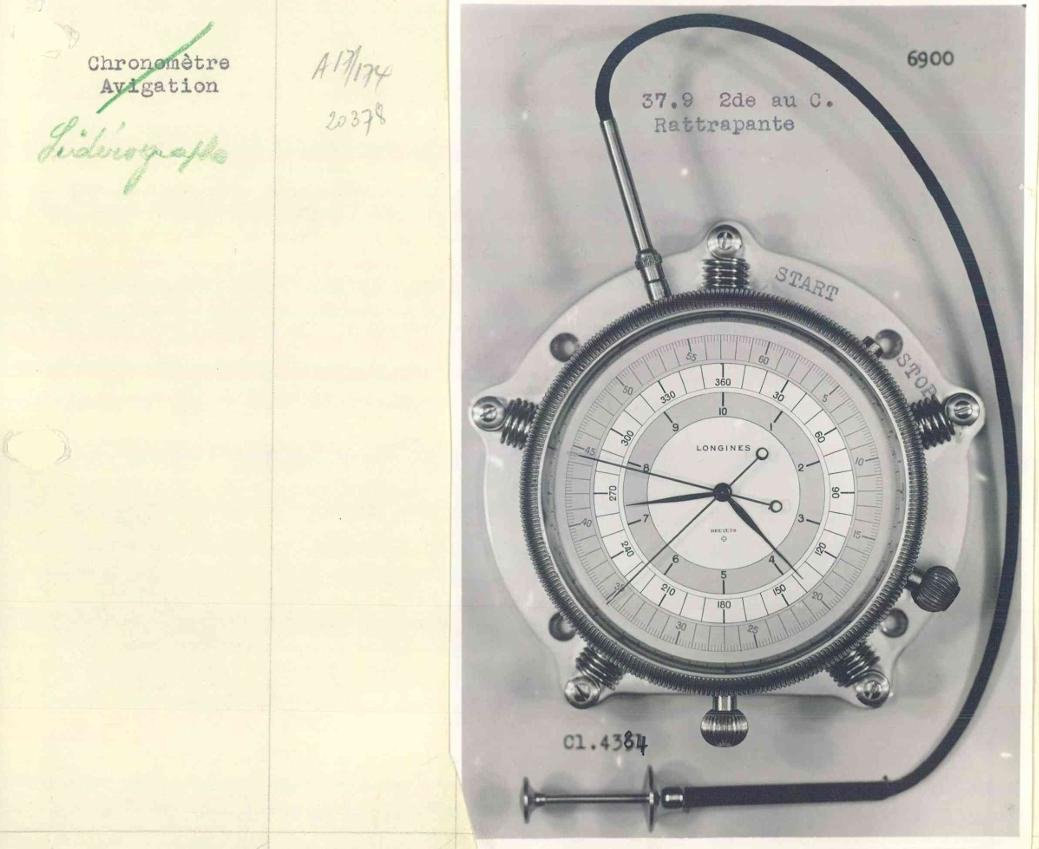
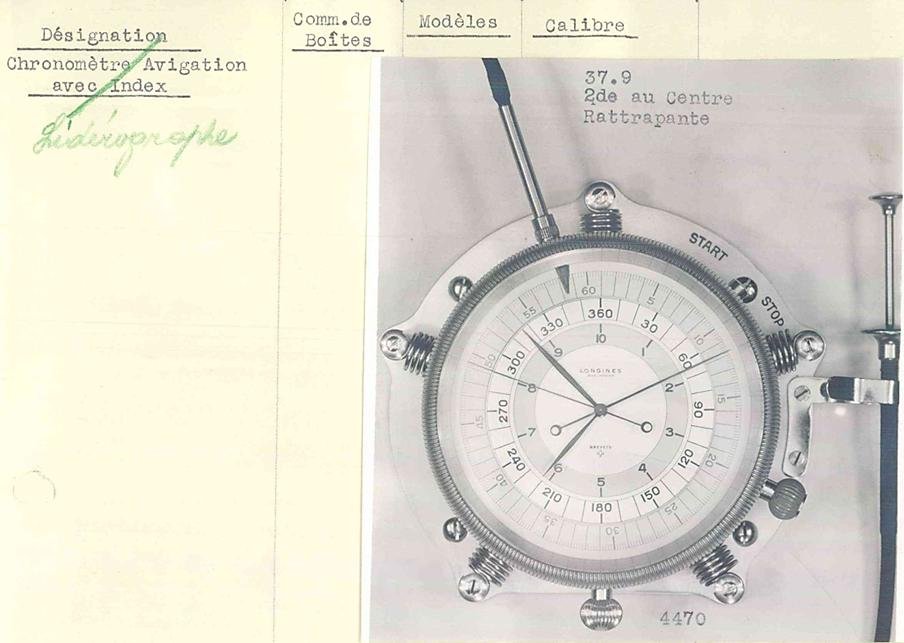
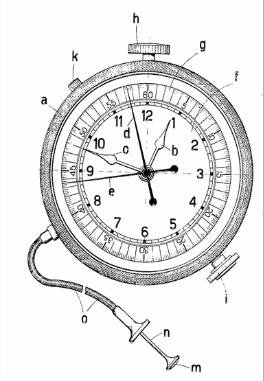
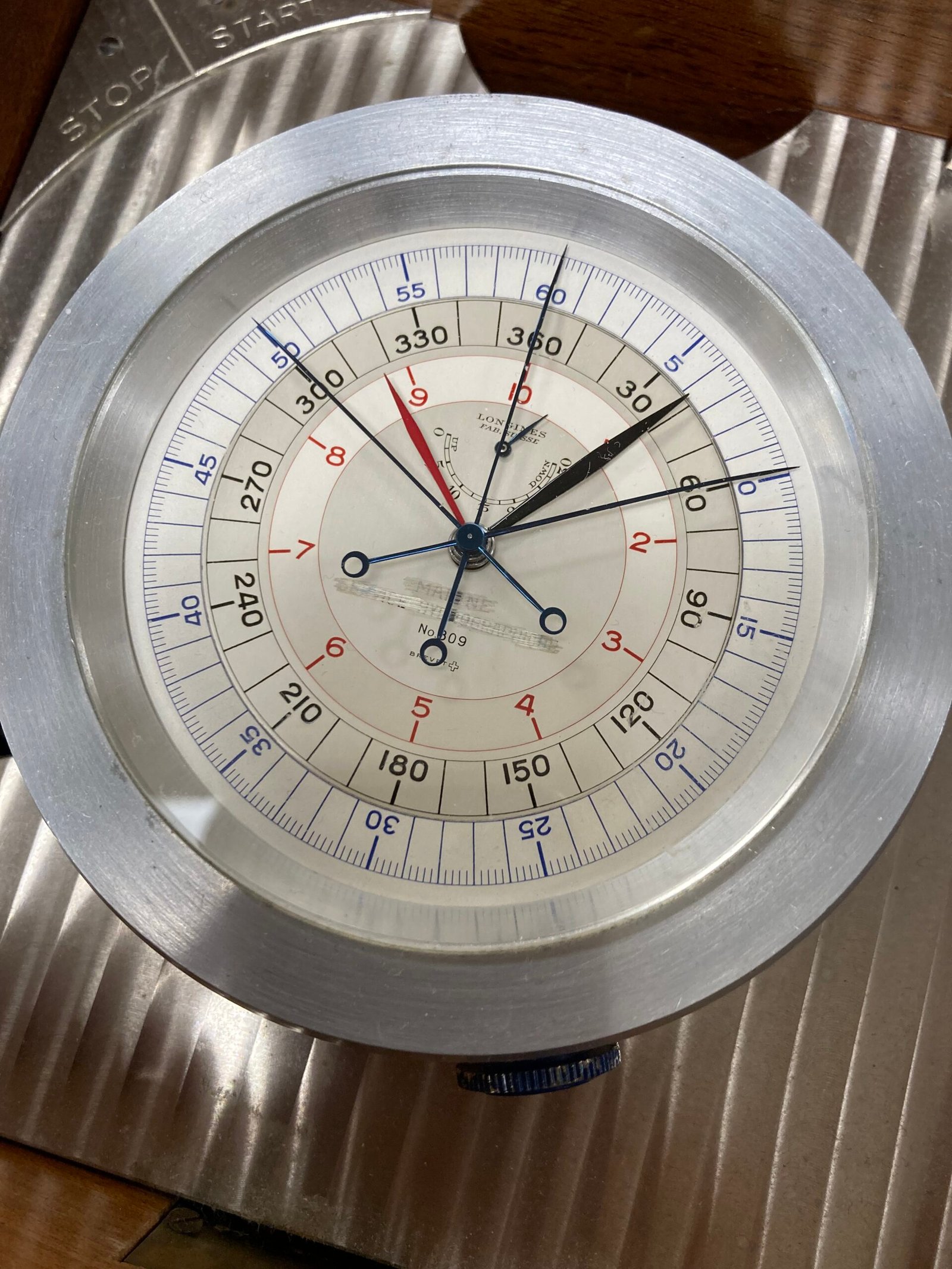
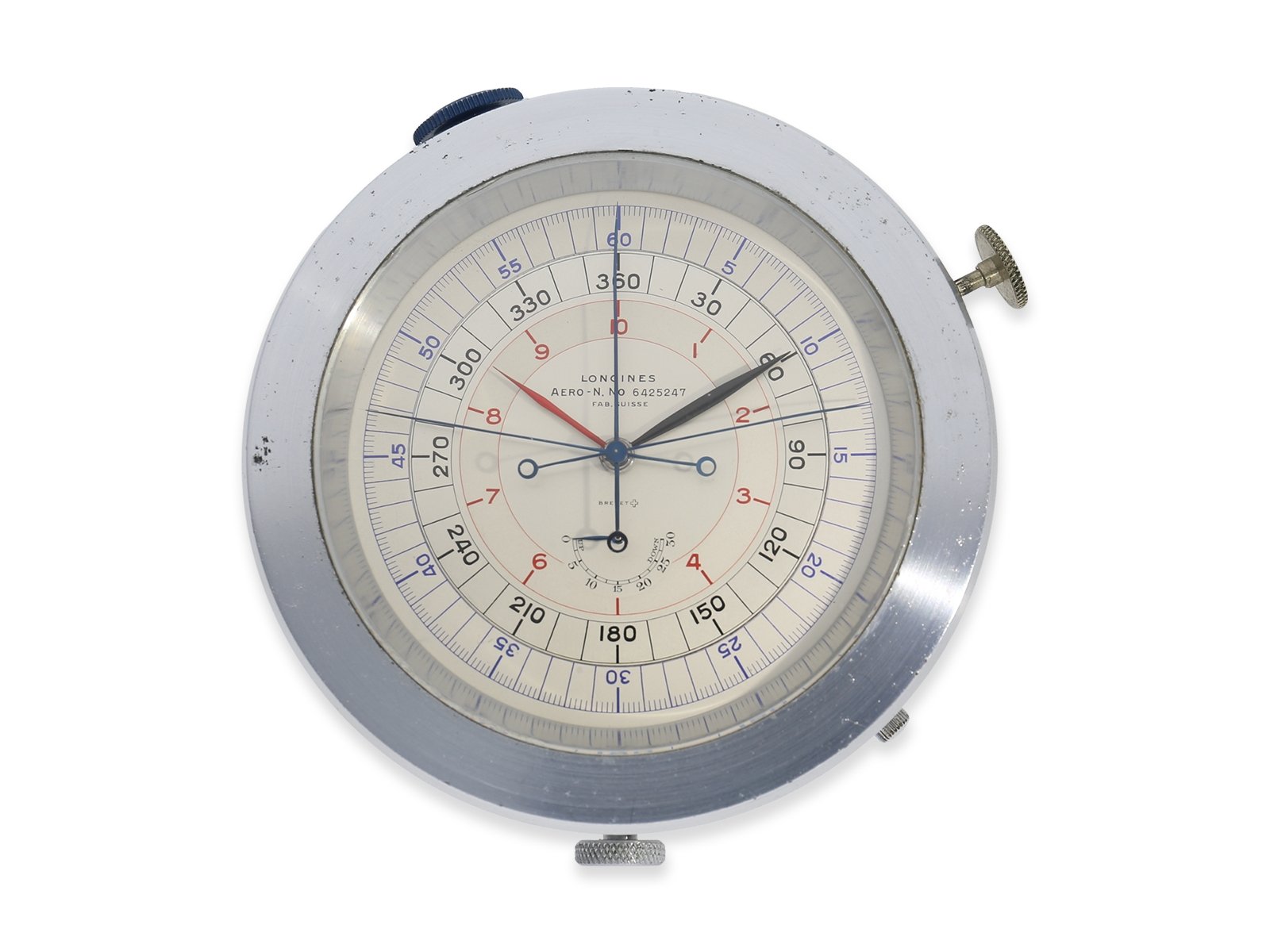
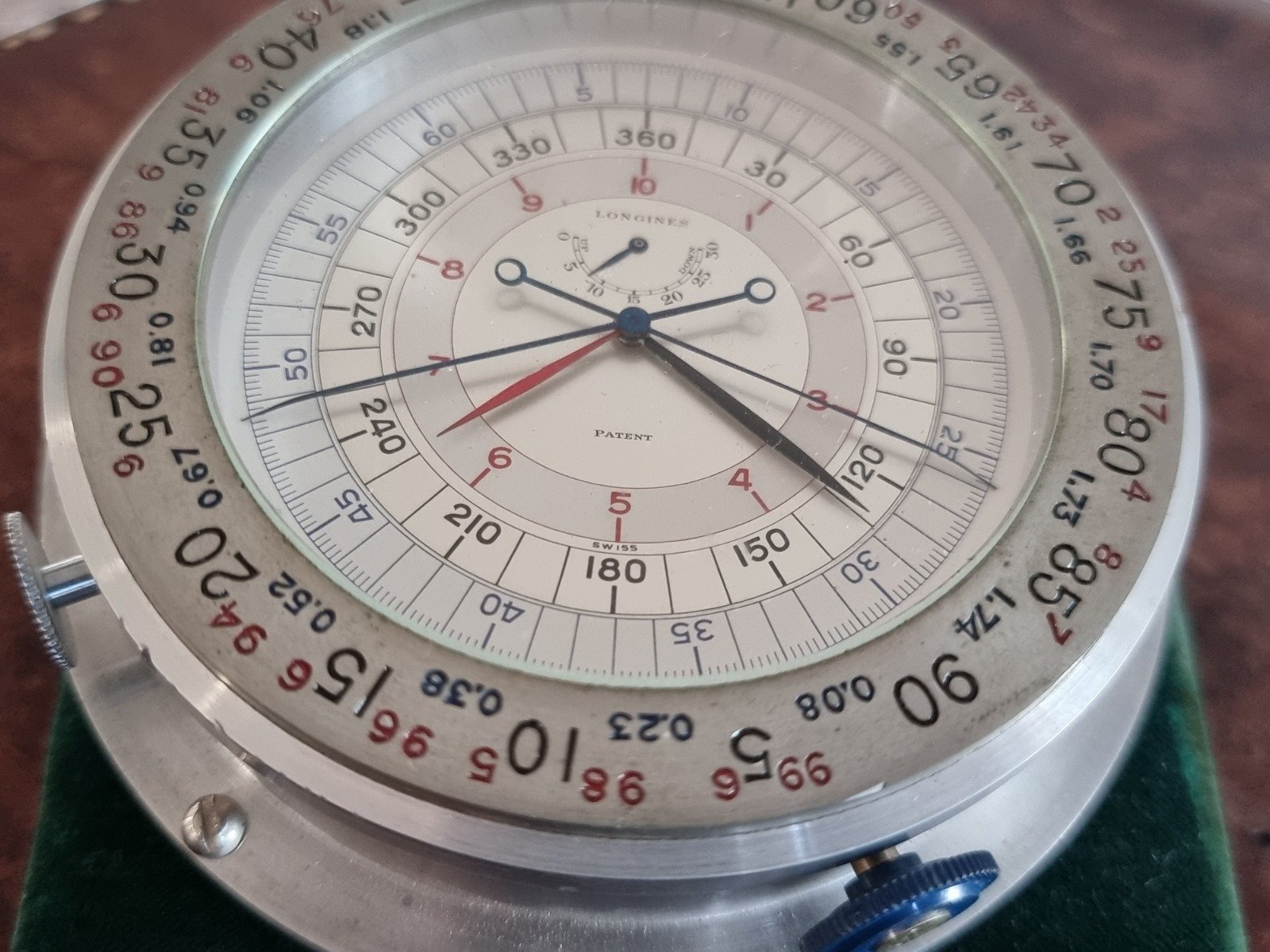
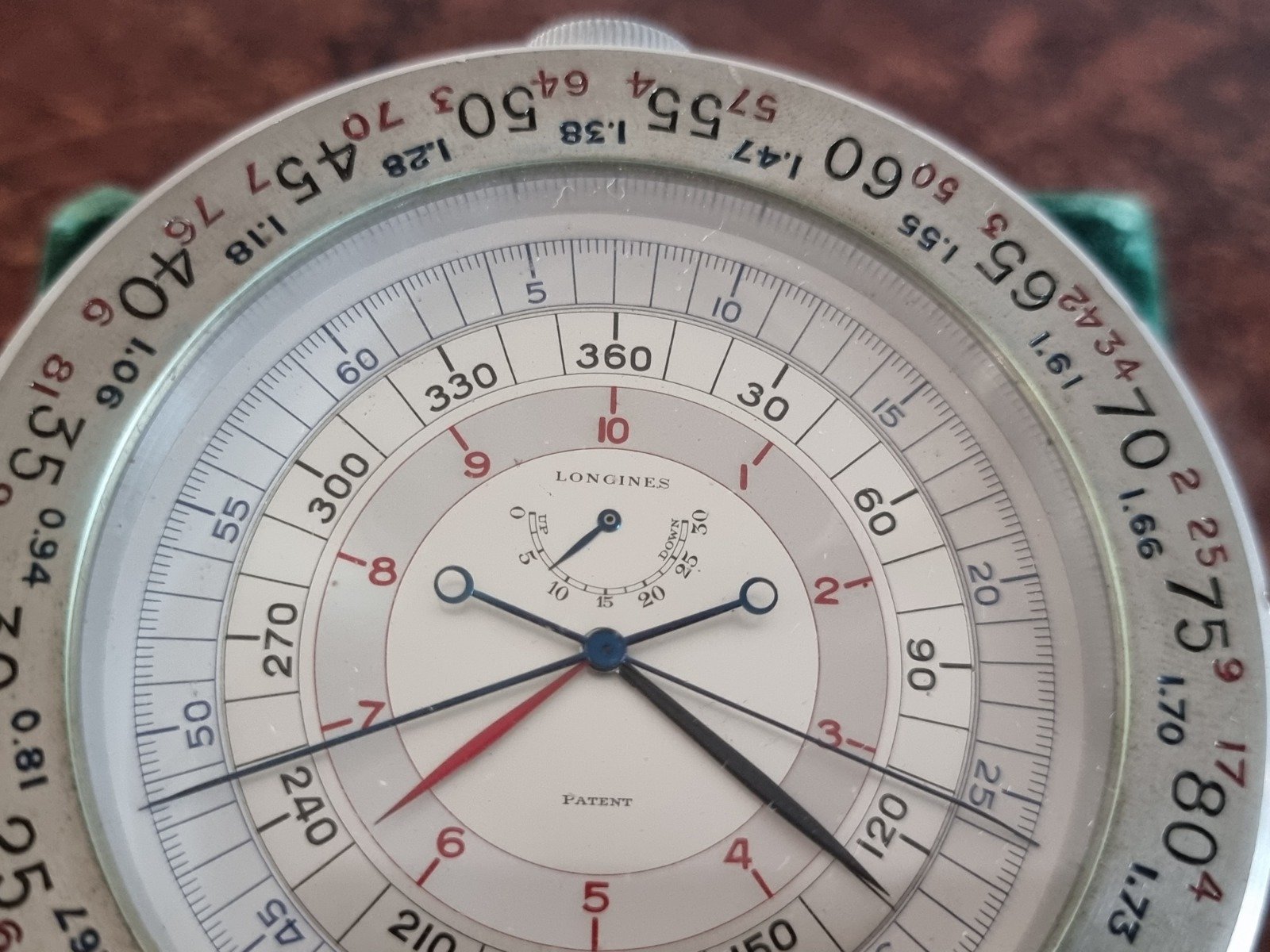
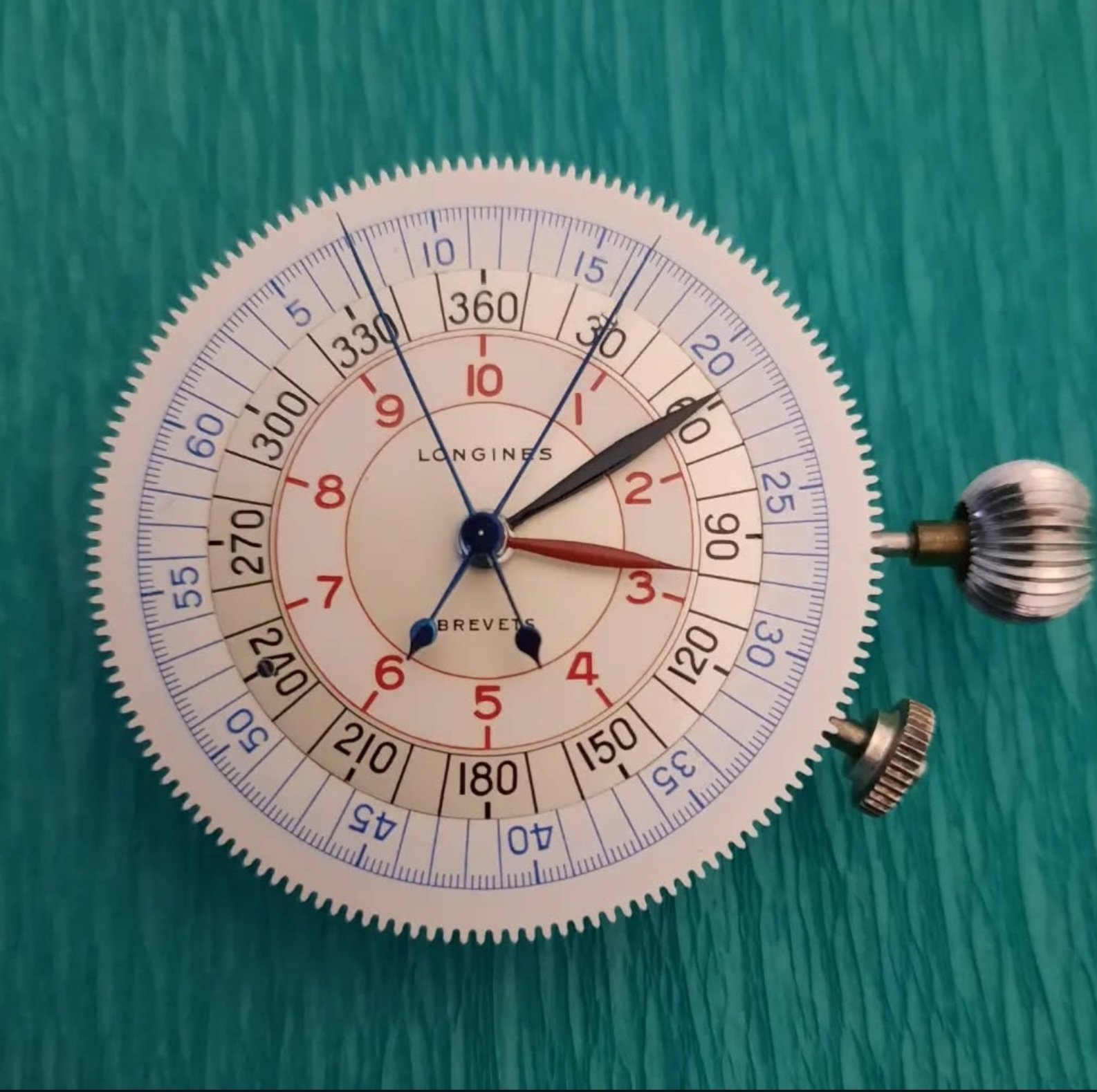
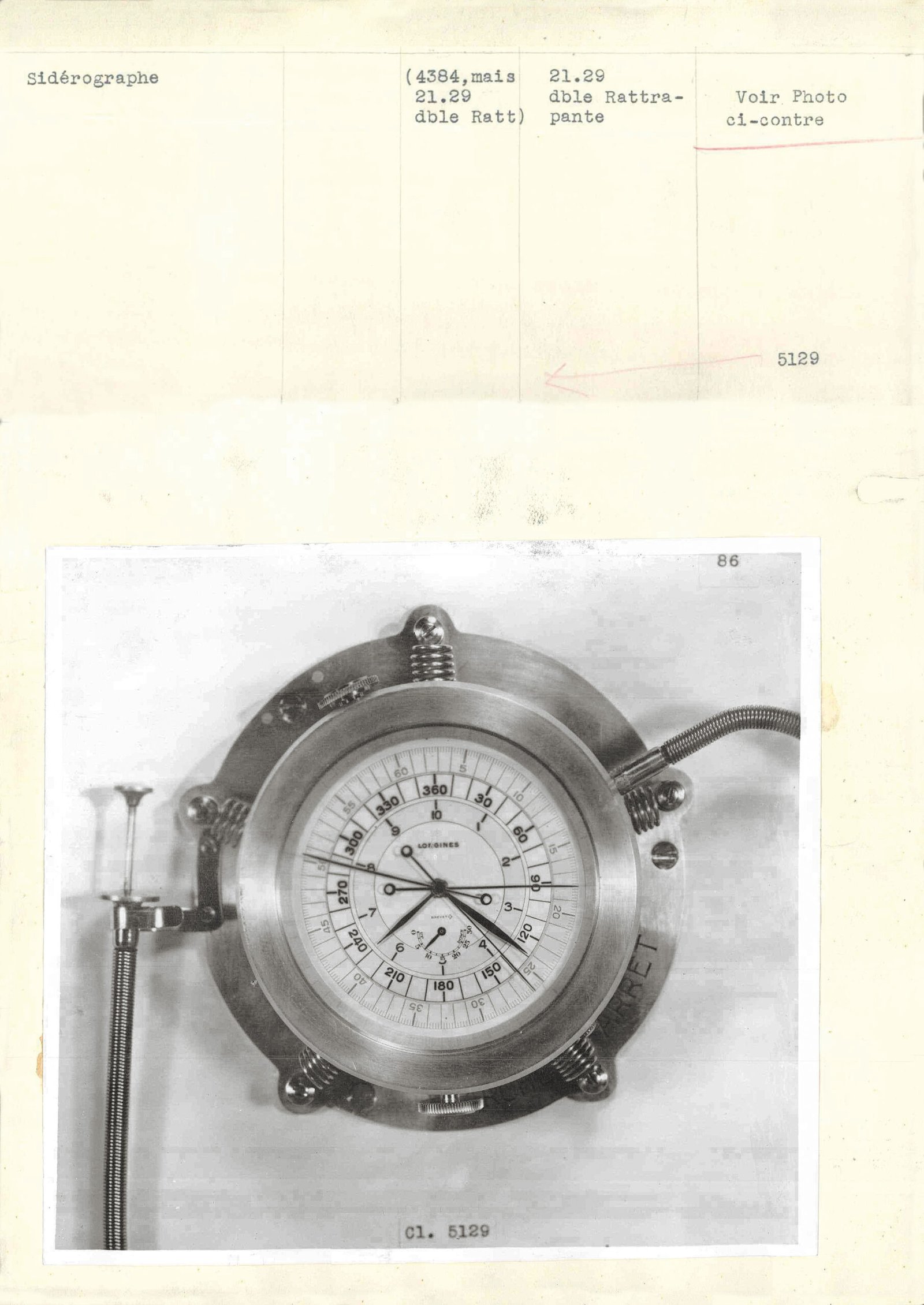
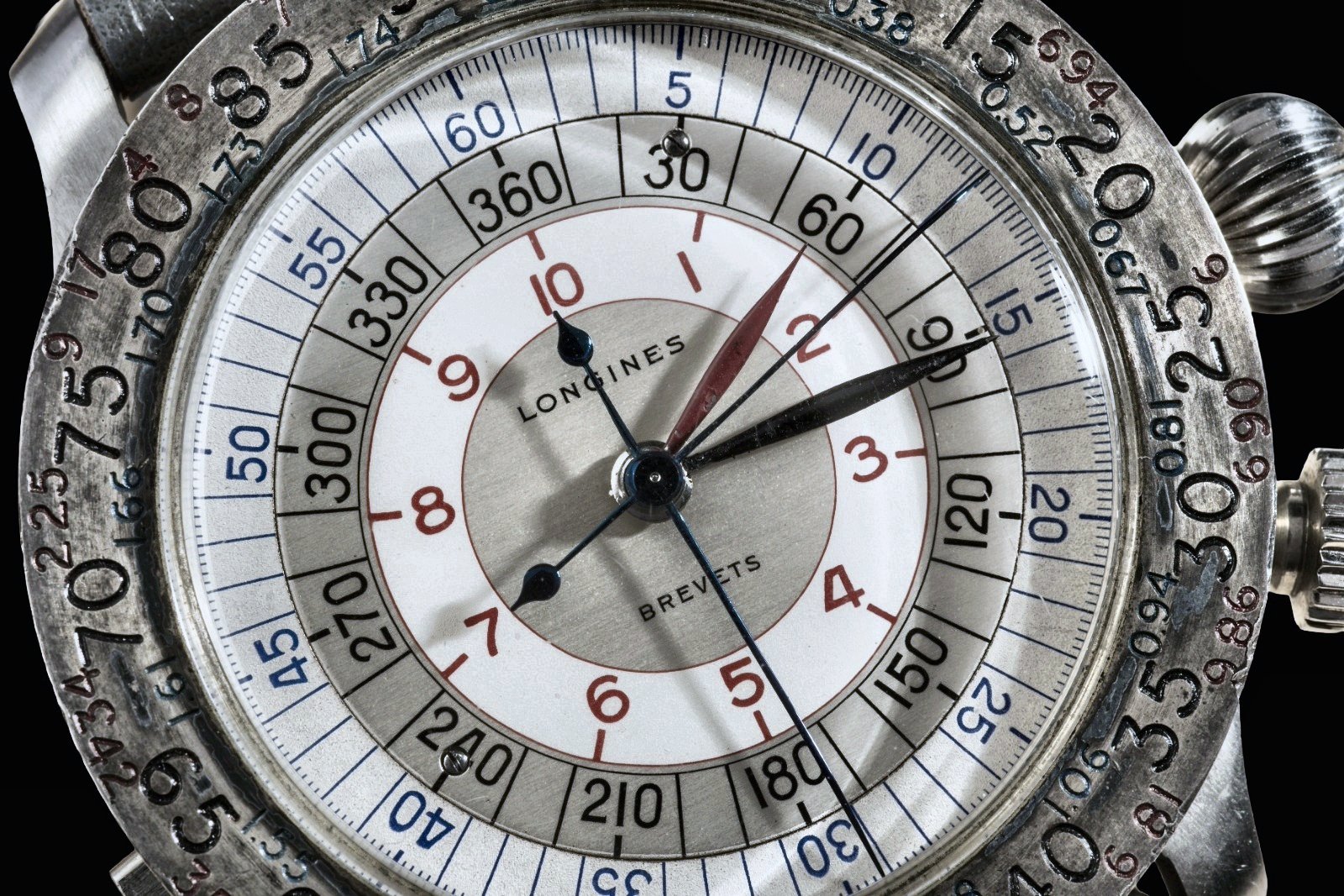
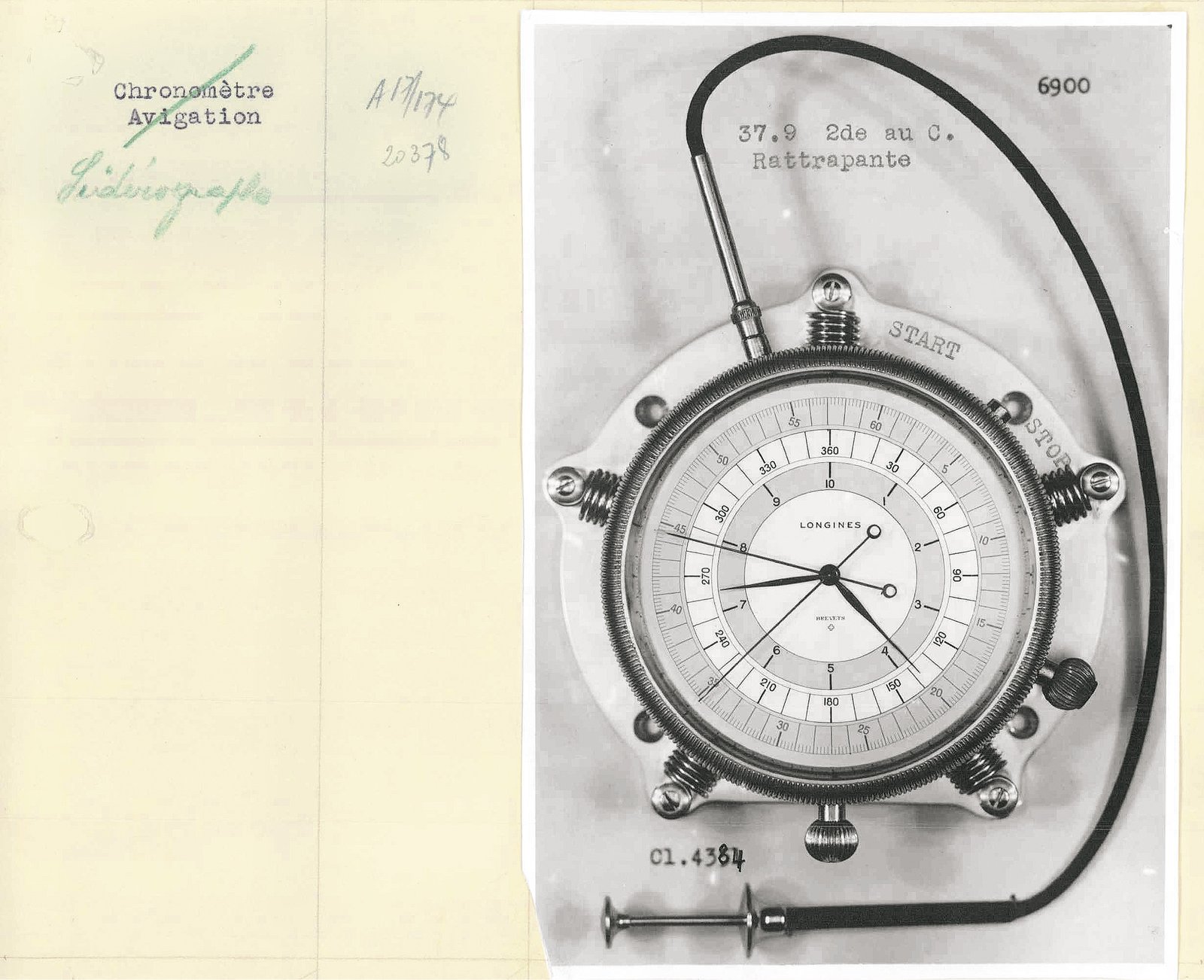
The result was the Siderograph, quietly unveiled in 1938 and quite unlike anything the Swiss watch industry had ever produced. It is not a watch in any conventional sense, as it does not tell the time. There is no hour hand, no minute hand, no twelve o’clock. Instead its dial is printed in degrees, and its movement is geared not to the twenty-four-hour solar day but to the slightly shorter sidereal day, the time the Earth takes to complete one rotation relative to the stars rather than the Sun. Three colour-coded hands sweep concentrically across the face: black, red and blue, displaying a single angular value, the Greenwich Sidereal Angle.
When a star met the horizon in the navigator’s sextant, a press of a button froze the blue hand in place while the movement kept running. That frozen reading, combined with the star’s known position from an almanac, gave the navigator’s longitude in one subtraction. No conversion was needed, no racing to finish the arithmetic in an aircraft flying hundreds of miles an hour. The entire chain of calculation that had plagued celestial navigation for centuries collapsed into a single mechanical reading.
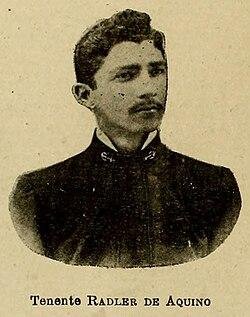
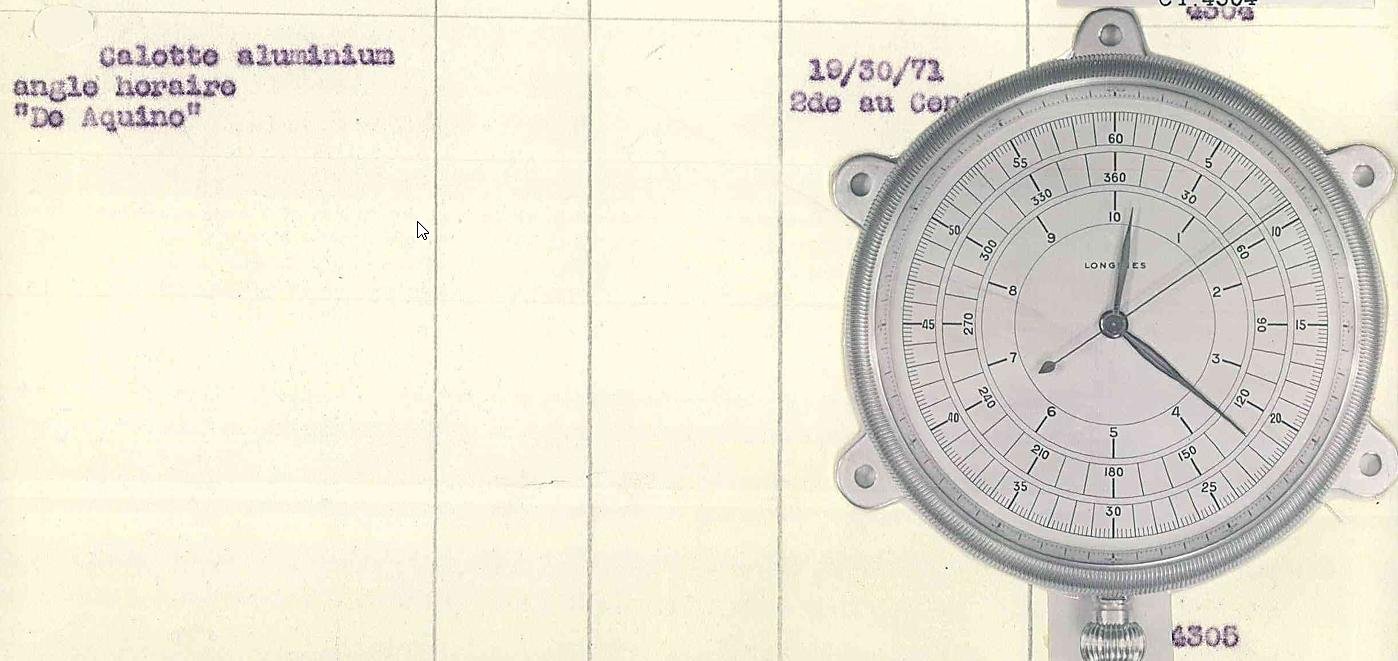
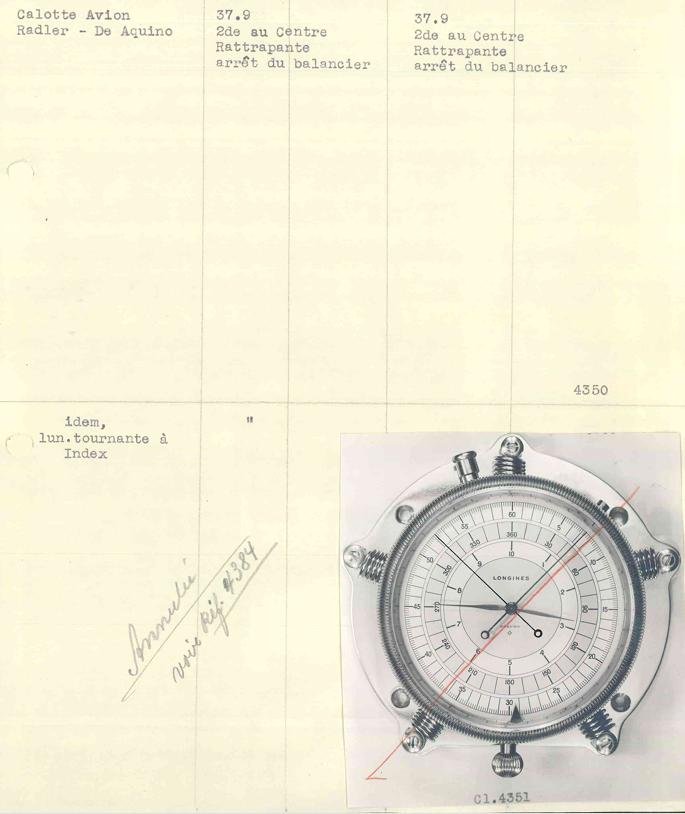
Very few Siderographs are known to the market, with only six known wrist-versions among them. Many of them were bespoke instruments, built for a specific military or scientific client. The originating commission, documented in the Chronique des Métiers de l’Industrie Horlogère (1948), came in 1937 from Captain Radler de Aquino of the Brazilian Navy, two years before the instrument’s public debut at the 1939 New York World’s Fair.
For the serious Longines collector, the Siderograph represents Longines at the absolute peak of its capabilities during the golden era of mechanical navigation.
The following article is an in depth evaluation of this unique instrument and I’d like to give a special thanks to Longines’ exceptional heritage department, without whom this article would not be possible, for providing me with unique access to Longines’ heritage archives, original patents, cliché images, and factory delivery records, including a documented consignment to Ostersetzer in Milan in May 1943 and wrist variants with serials 5,810,014 and 5,810,032.
Before the advent of GPS, long-range aviators and mariners lived (and in some cases died) by the angle, not by hours and minutes. Every celestial calculation was ultimately working toward a Greenwich Hour Angle, the one number that could place a navigator on the chart and tell them where on the planet they were.
Traditional navigation required laborious calculations: converting time into arc, referencing ephemerides, the printed astronomical almanacs that tabulate the positions of stars, planets, the Sun and the Moon in angular units and applying corrections. Tasks feasible for a ship’s navigator with the luxury of time, but daunting for a pilot in flight. Two developments converged to attempt a solution.
The first was new ephemerides, whereby international observatories (by 1935) had published tables giving star positions directly in angular units degrees, minutes, and tenths rather than in solar time. The angular language of the sky was now available on paper.
The second was that Longines, steeped in aerial chronometry, decided that if they could use their technical expertise to design an instrument that could take advantage of the new angular ephemerides, it would be invaluable to aviation.
Their answer was the Siderograph unveiled in 1938, arguably an engineering feat on a level of sophistication and construction unrivaled or attempted by any other manufacturer of the time. Gear the train to sidereal rate, print the dial in degrees and arc-minutes, and add a split-seconds hand to freeze the instant of the sight. Drive three nested hands so the instrument directly displays the Greenwich Sidereal Angle. Add a rattrapante so the navigator can capture the exact moment a star hits the sextant’s horizon. For rough conditions, add two rattrapantes to read the bisector, giving a mean reading that forgives the jolting motion from turbulence or rough seas. In some deck and cockpit instruments, they even went so far as to control the environment itself with a thermostated heater and gimbals, so the balance is isolated from the aircraft as much as possible.
The end result compresses the multi-step arithmetic to a single subtraction or addition of a co-right-ascension exactly where speed and accuracy matter most, in theory a revolutionary navigational instrument.
The Siderograph fascinates me because it sits at the junction of chronometry, astronomy, and engineering design; a purpose-built machine that encapsulates the final pre-electronic moment of celestial navigation. It bridged a brief, but historically significant gap, between the new angular ephemerides and the arrival of radio navigation that would render both celestial fixing and the Siderograph obsolete within a decade.
In the decade between Lindbergh’s 1927 crossing and the outbreak of World War 2, aviation’s pace of change was extraordinary. Flight speeds doubled, ranges extended well beyond shore-based radio beacons and military planners on both sides of the coming conflict began to seriously grapple with the demands of long-range navigation over open ocean. The bubble sextant had introduced celestial fixes to the cockpit and purpose devised air almanacs had followed. The procedures to complete the calculations now existed. The bottle neck was human, the speed and reliability at which a trained navigator could execute them.
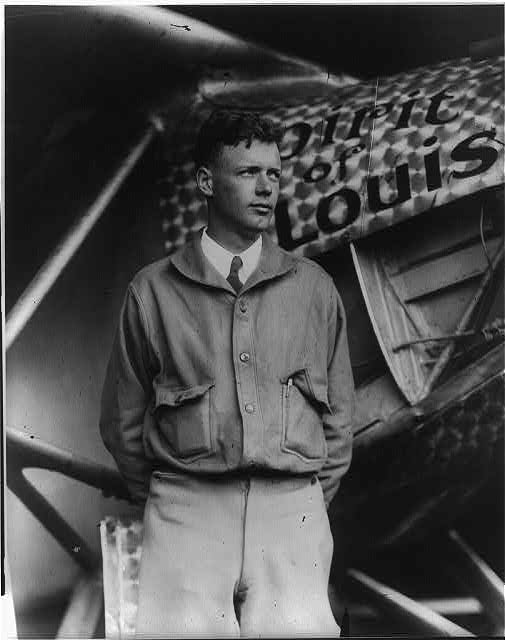
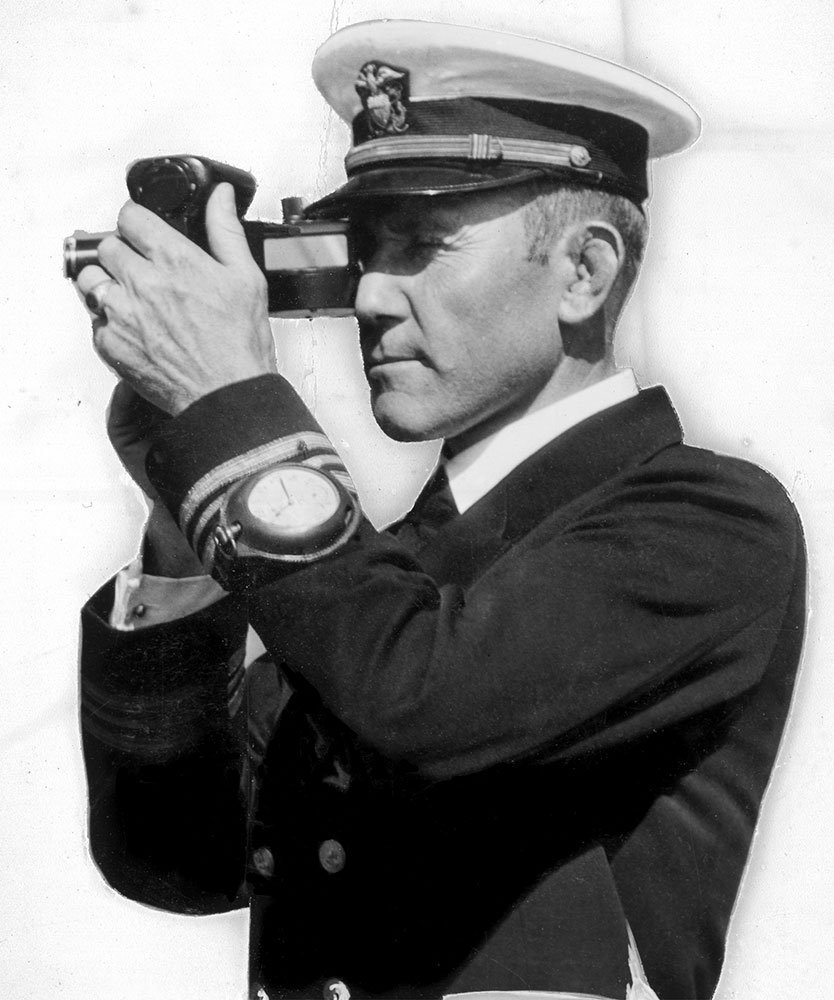
Longines had worked closely with two of the era’s leading navigation practitioners. Philip Van Horn Weems, a naval officer, aviator, and navigation reformer collaborated with Longines on the Second-Setting Watch, devising a rotating seconds track allowing pilots to synchronise precisely to a radio time signal without having to stop the movement and compromise the watch’s accuracy. Charles Lindbergh, fresh from his 1927 Atlantic crossing, worked with Longines on the Hour Angle Watch, it built on the Weems to create a more sophisticated watch whose dial helped convert civil time into an angular hour angle for celestial calculations. Both were genuine, revolutionary advances. Neither went far enough, still leaving the conversion from time to angle in the navigator’s hands.
What follows is a detailed examination of the Siderograph, how it was conceived, how it worked, who used it, and why the handful of surviving examples occupy a unique position in the history of mechanical horology. It draws on the Longines patents, internal brochures, period trade publications and factory delivery records, including consignments traced through Longines’ heritage archives to clients from the French Aéronavale to the Italian Navy.
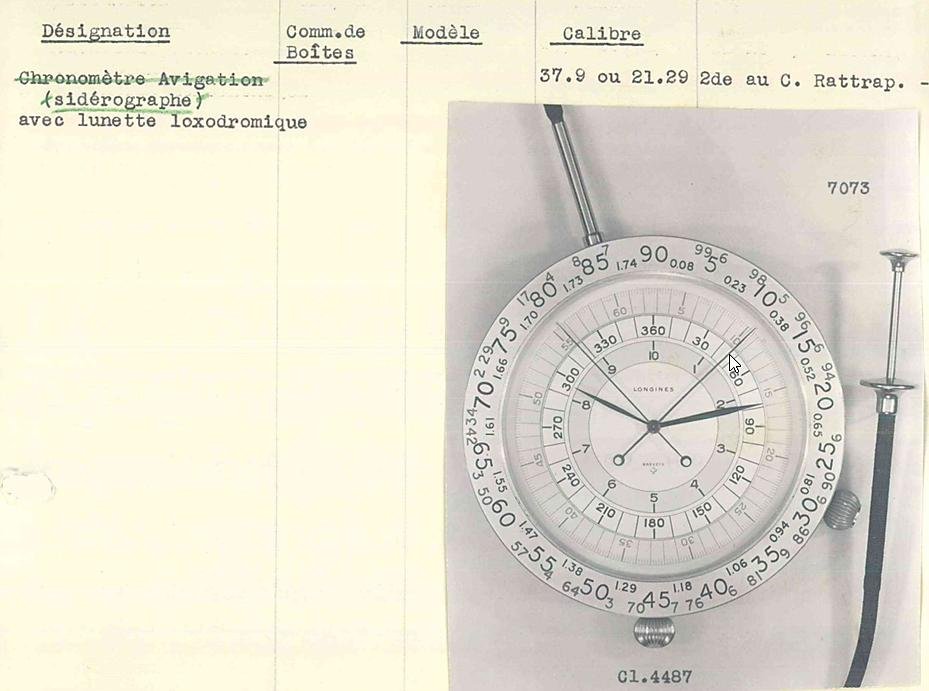
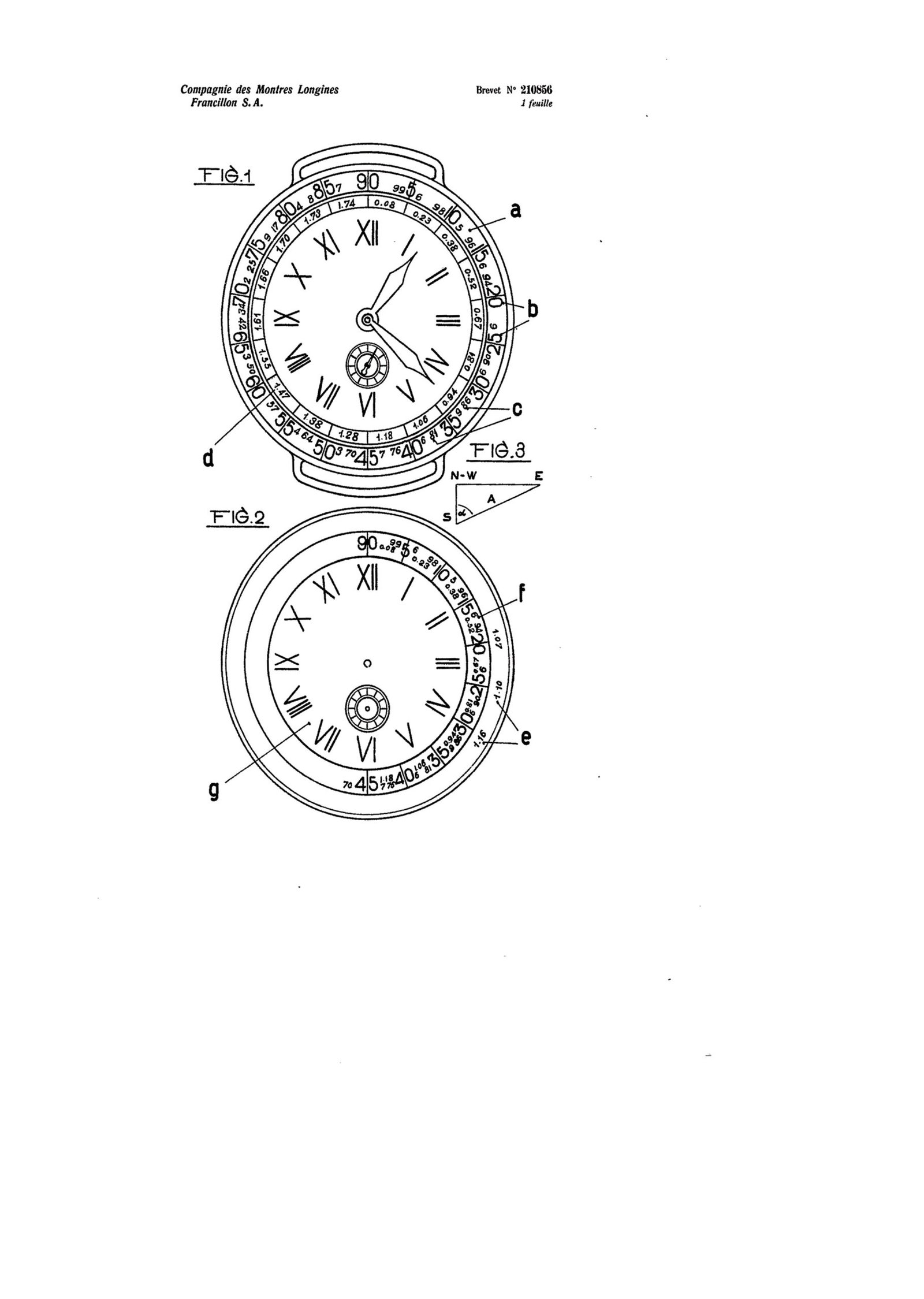
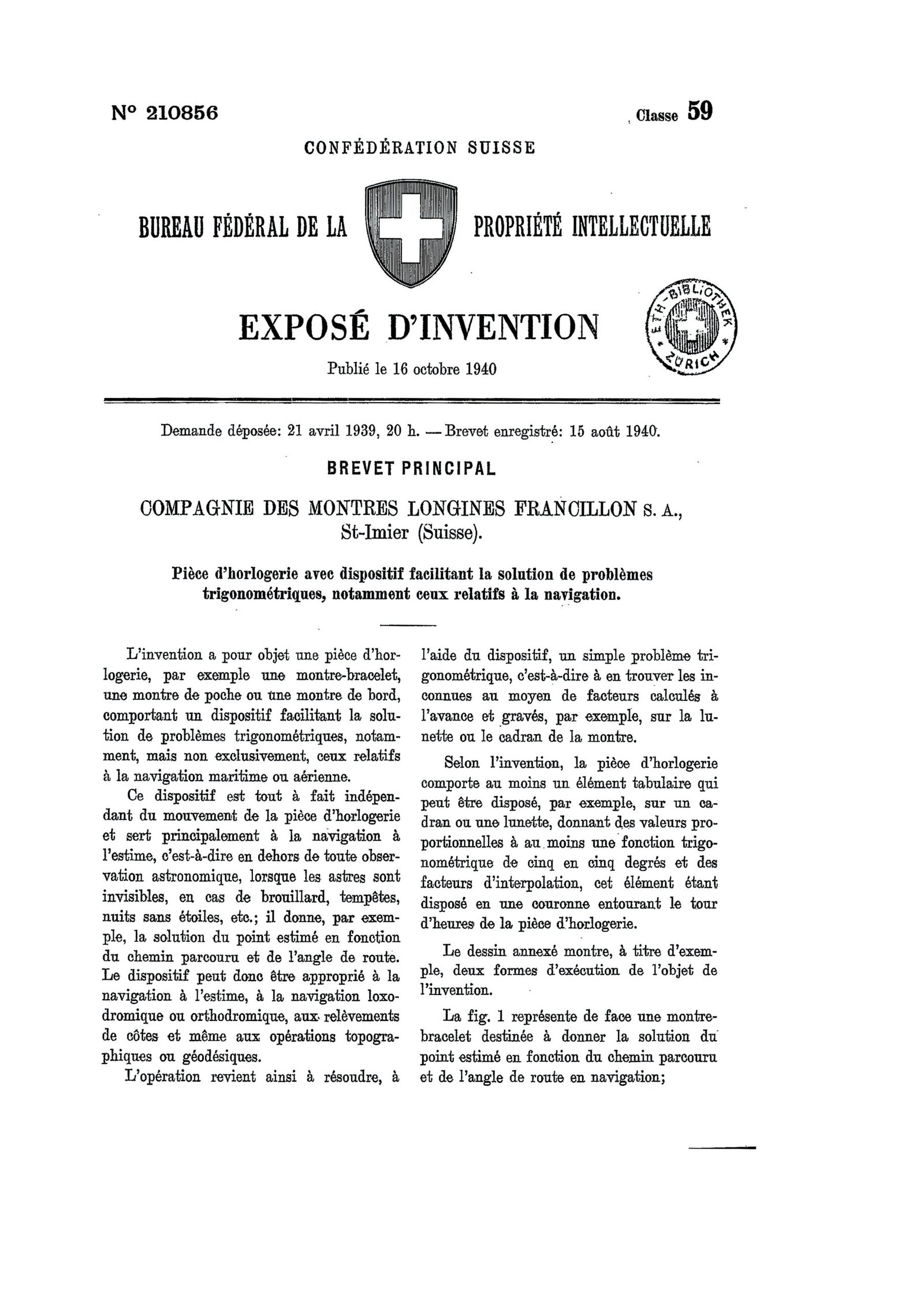
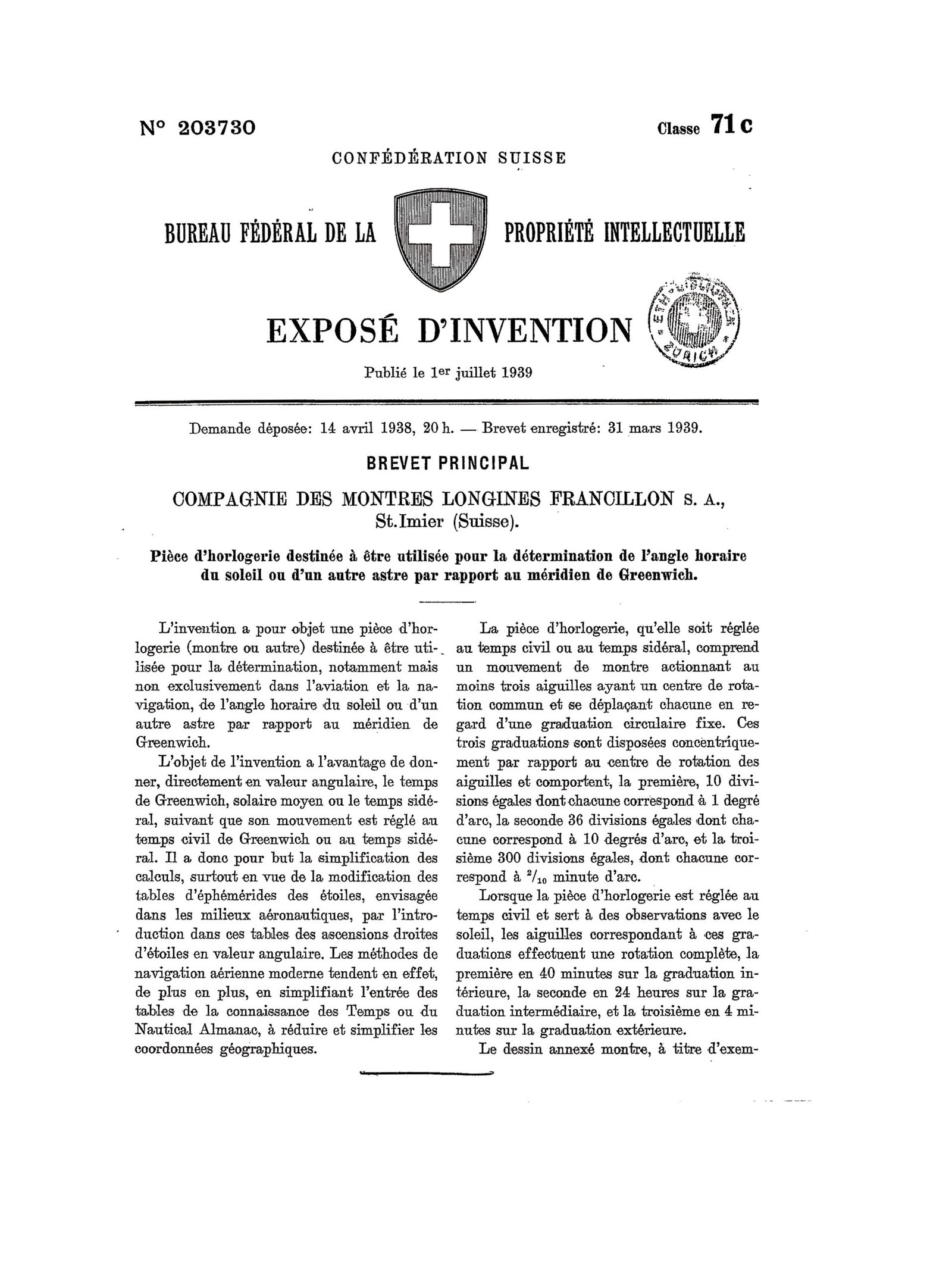
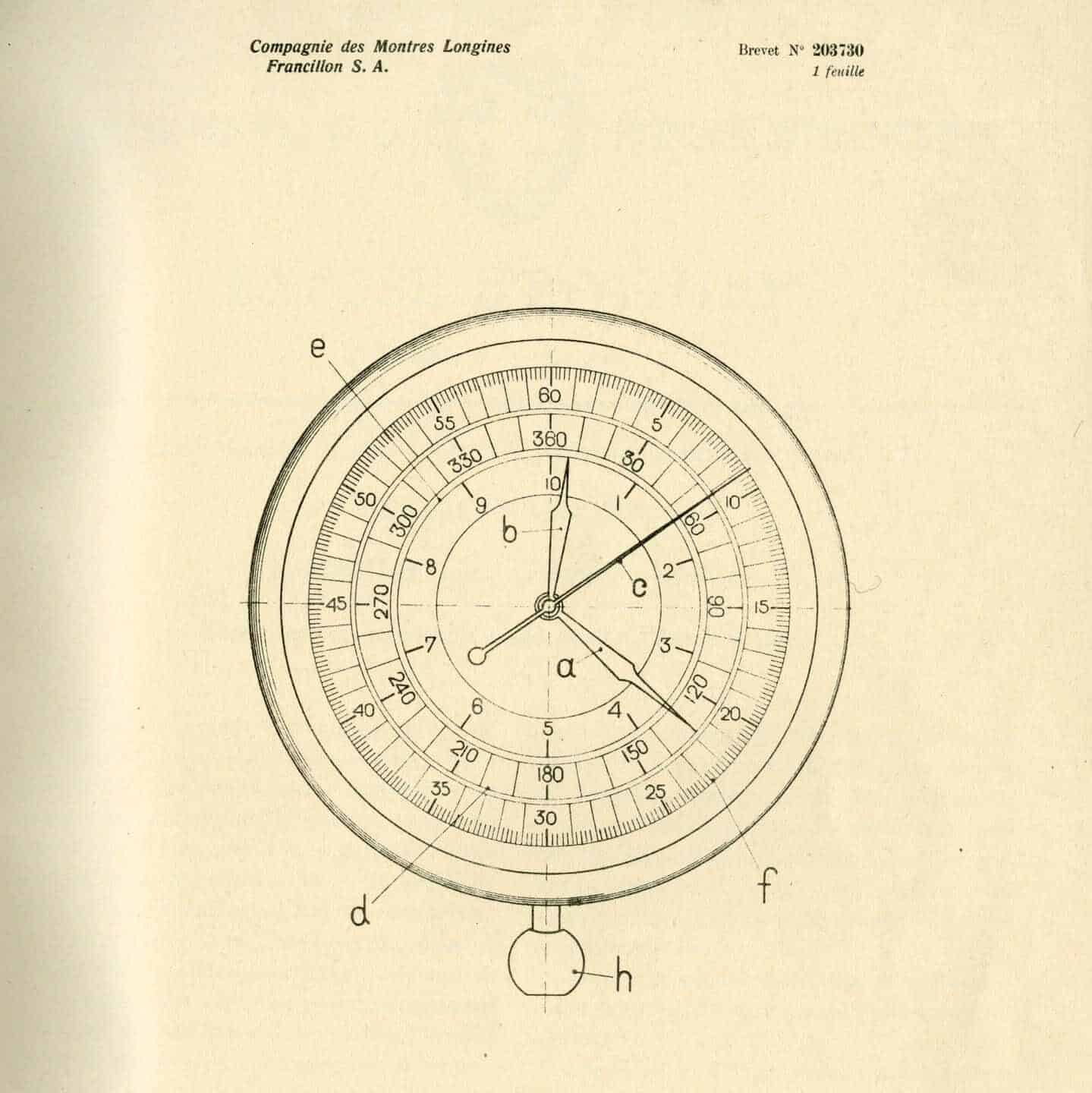
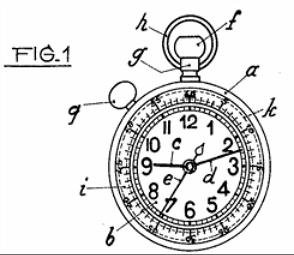
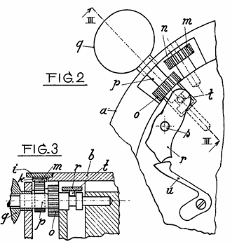
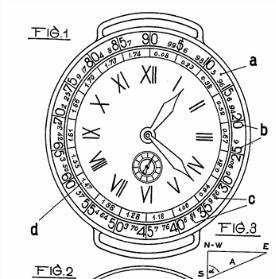
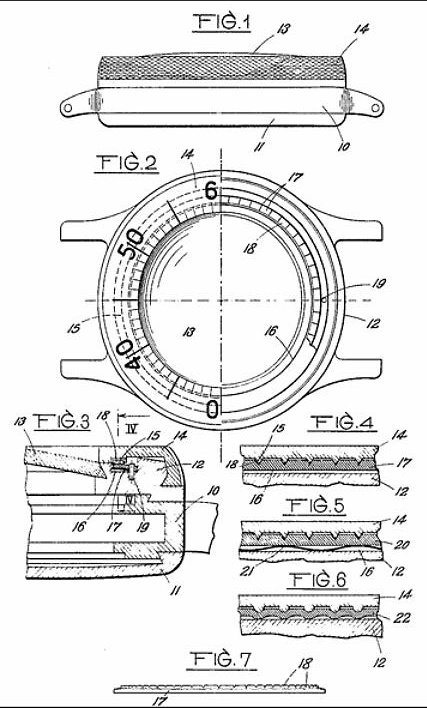
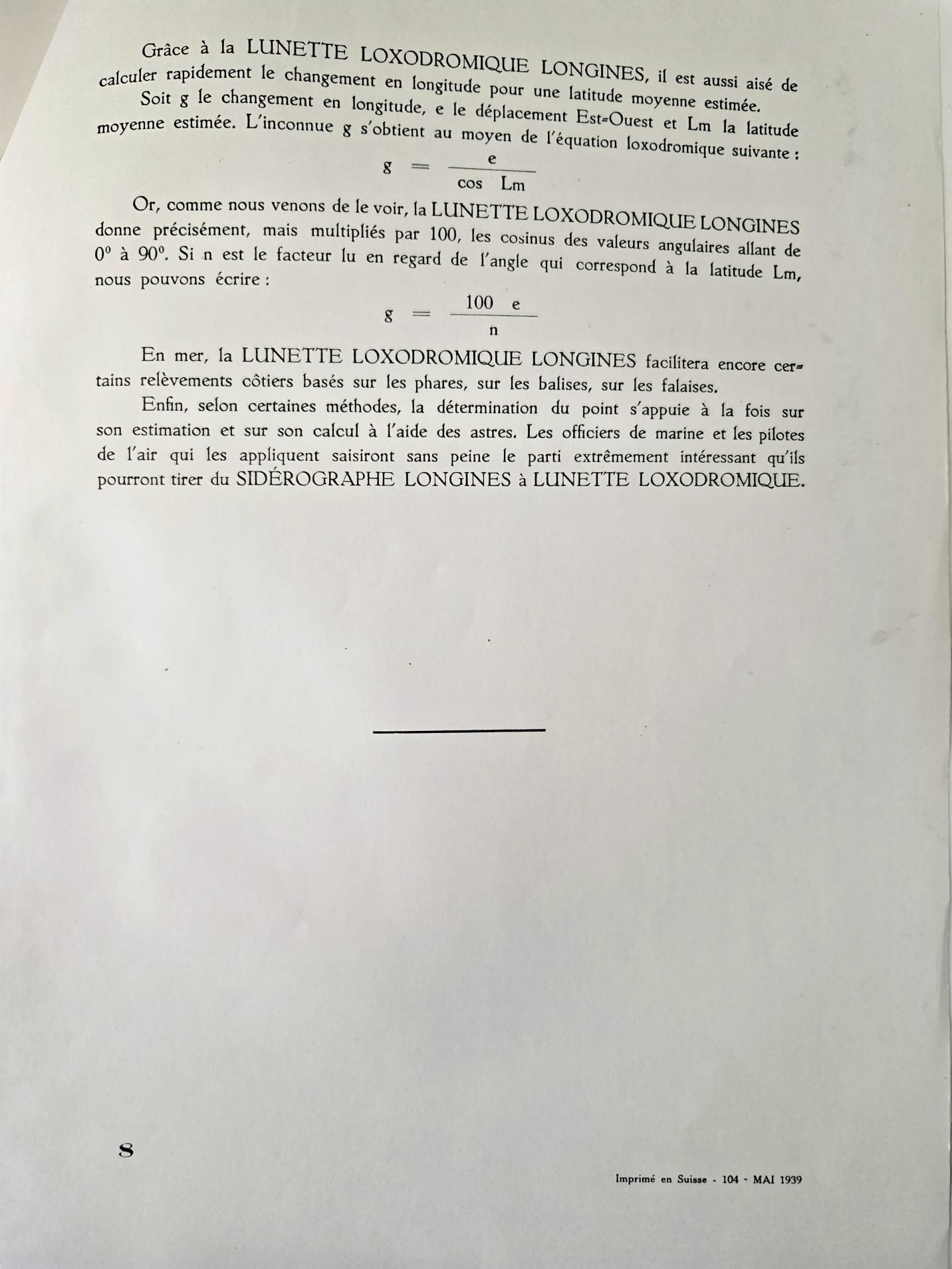
Longines filed two patents to protect the invention. Swiss patent CH 203730 (filed 14 April 1938, published 1 July 1939) defines the sidereal, triple-scale display as a watch movement driving three coaxial hands against three concentric scales, exactly what became the Siderograph. Swiss patent CH 210856 (filed 21 April 1939) covered a special rhumb bezel: a rotating ring with trigonometric scales to aid dead-reckoning when star sightings were impossible. In 1939 Longines also trademarked the names “Siderograph” and “Sidérographe Aviation/Navigation”, a move assertive enough to force Breguet to market a similar device under the name Sidéromètre instead.
After 1943 – LORAN (Long Range Navigation) – changed the calculus entirely. Developed in the United States from 1940 and operational across the North Atlantic by early 1943, it was a radio-based system that allowed ships and aircraft to fix their position by measuring the difference in arrival time between signals from pairs of land-based transmitters. Crucially it required no clear sky, no sextant, no almanac, and no arithmetic, just a receiver.
By 1945, 75,000 LORAN receivers were deployed and the system covered the Atlantic and most of the Pacific. Where the Siderograph had eliminated the arithmetic of celestial navigation, LORAN eliminated the need for celestial navigation altogether. The Siderograph did not fail, technological advances merely eclipsed it and made it effectively obsolete. Surviving examples migrated to laboratories, schools, and storage. The wrist variant never became a catalogue line.
Naming. Period French uses Sidérographe (accent often omitted in export texts). English circulars retain Siderograph. The rhumb accessory is consistently Lunette Loxodromique.
Sidereal time is the natural clock of the stars. Unlike solar time which tracks the Sun and forms the basis of the civil clocks we use every day, sidereal time tracks the Earth’s rotation relative to the distant stars. Because the Earth is also orbiting the Sun, a sidereal day is approximately four minutes shorter than a solar day: 23 hours, 56 minutes, and 4 seconds. The stars therefore rise and set slightly earlier each night and a clock geared to sidereal rate stays in step with them.
By late 1938 the first Siderographs were leaving Saint-Imier. Longines designated them Aero-Navigational instruments, signing dials Longines Aero-N. No. XXXXX a serial convention that underlined their status as individual technical apparatus rather than catalogue watches. Each was built in collaboration with a specific military or scientific client. Specifications varied with the client’s need: heated and gimballed aluminium capsules for cockpit and bridge use, simpler open-cased instruments for observatory and laboratory work, sextant-mounted versions for in-line celestial fixing, and a small run of wrist examples produced in 1942–43. In its marketing, Longines was unambiguous about the ambition: period advertising positioned the Siderograph as enabling star navigation entirely independent of radio signals what would later be recognised as a precursor to satellite-based positioning systems.
With ephemerides tabulated in angular units for the Sun, Moon, planets, and bright stars, a navigator using the Siderograph can reduce a sight directly by subtracting a star’s Right Ascension (RA) from the dial’s reading, dispensing with the need to make a time-to-angle conversion. The Siderograph is in essence a special-purpose mechanical computer, built for a narrow but critical task: expressing the Greenwich Sidereal Angle with enough resolution (0.2 arc-minutes) and with a capture mechanism that maps precisely to how celestial sights are actually taken. Longines described it as the “Weiterentwicklung und Perfektionierung der Stundenwinkeluhren” the evolution and perfection of the hour-angle watch, meaning the Lindbergh.
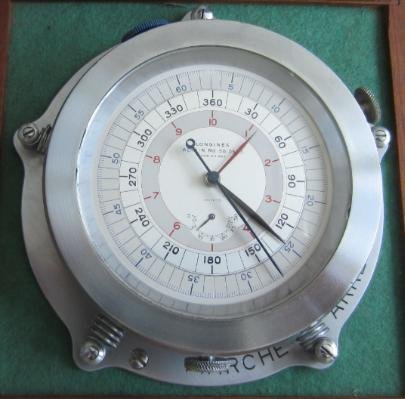
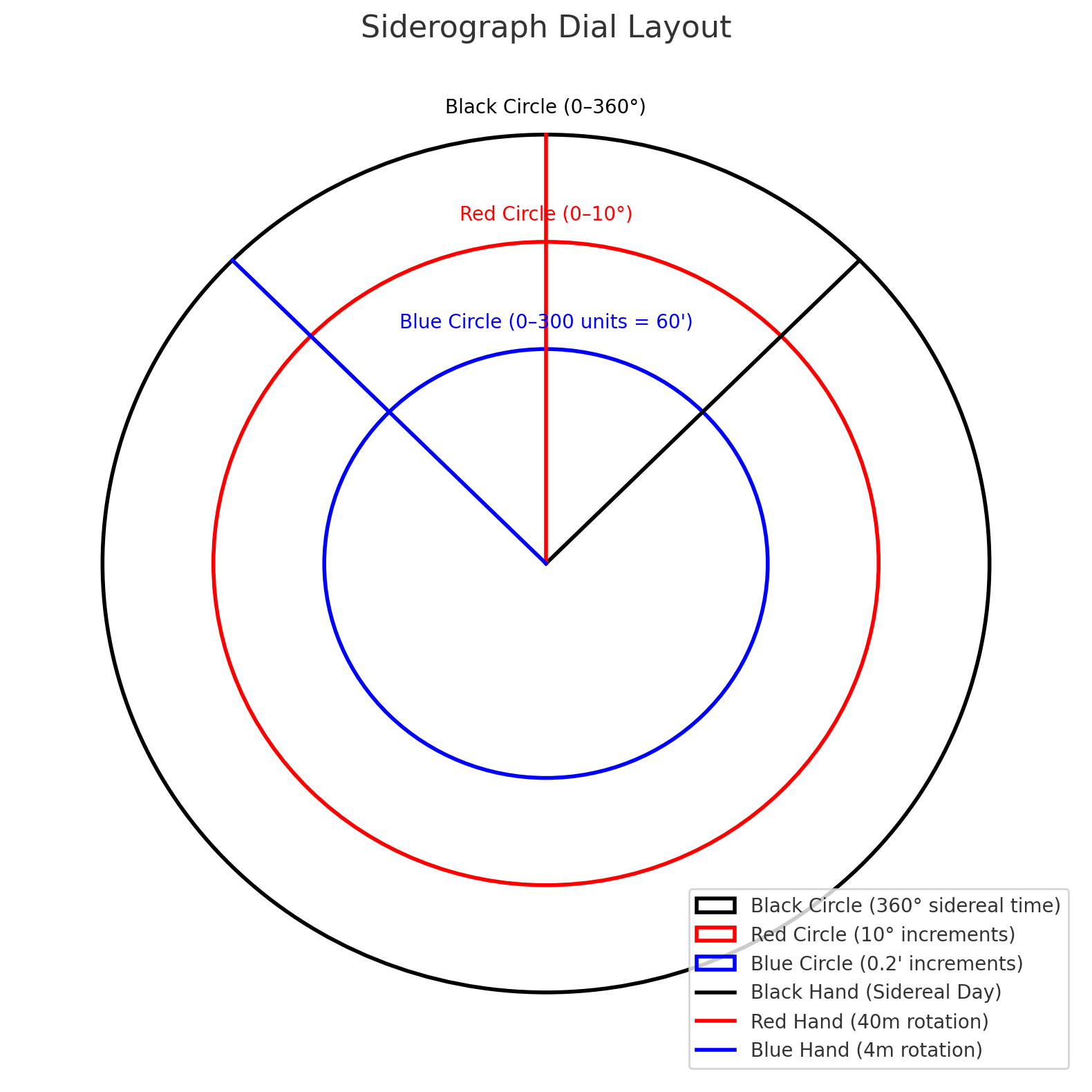
The tri-colour dial is designed for error-elimination. Blue for arc-minutes, red for degrees within the current ten-degree window, black for the coarse 0–360° sweep. The hand speeds mirror the quantities they represent. The heated capsule is a laboratory instrument with a handle, designed to compensate for the metrology of steel expanding, oils thinning and fogging glass.
Quick breakdown:
The Siderograph displays Greenwich Sidereal Angle (GSA), the GHA of the vernal point, not civil time. With a body’s right ascension (RA) expressed in degrees, the reduction is immediate
:GHA(body) = GSA − RA(body) (mod 360)
(Many aeronautical tables of the period tabulate co-RA/versed ascension for the Sun; in those cases you add.) Mechanically, the inner dial ring rotates independently inside the fixed chapter, and that moving ring rather than the hands alone, is what you align to the sidereal reference before reading blue → red → black. This suppression of the HMS→angle conversion is the instrument’s defining mechanical achievement.
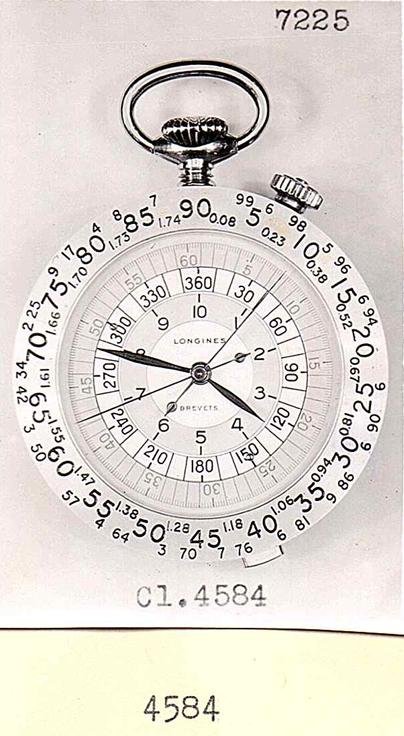
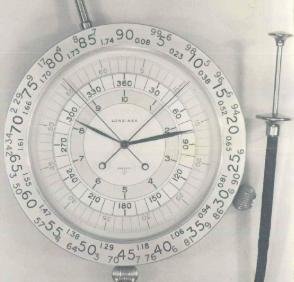
At first glance a Longines Siderograph dial is mystifying. There are no hour or minute numerals instead a geometric scale of degrees and fractions in three colours, each hand sweeping at a different rate. Longines described the standard dial layout in 1939 as follows:
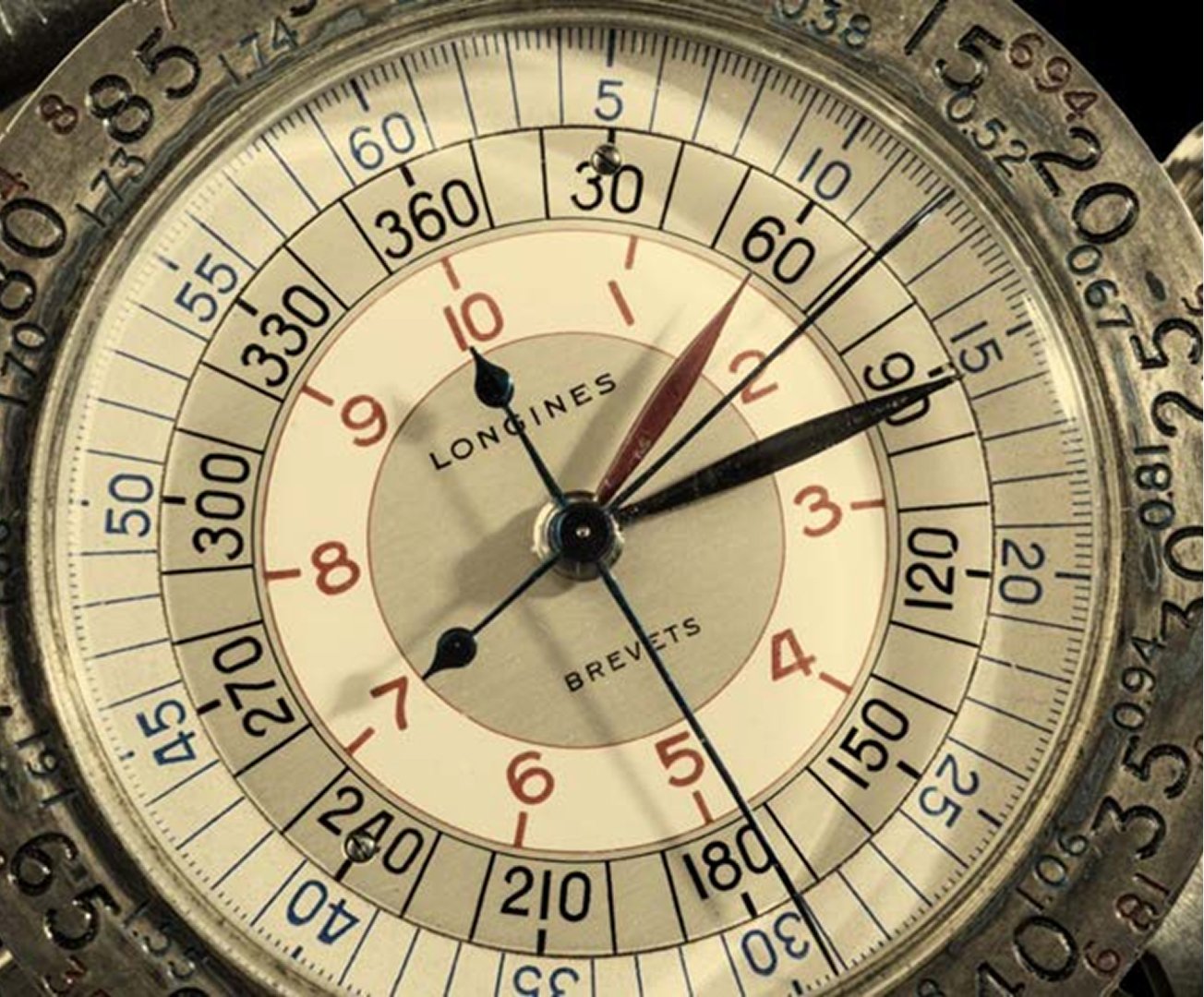
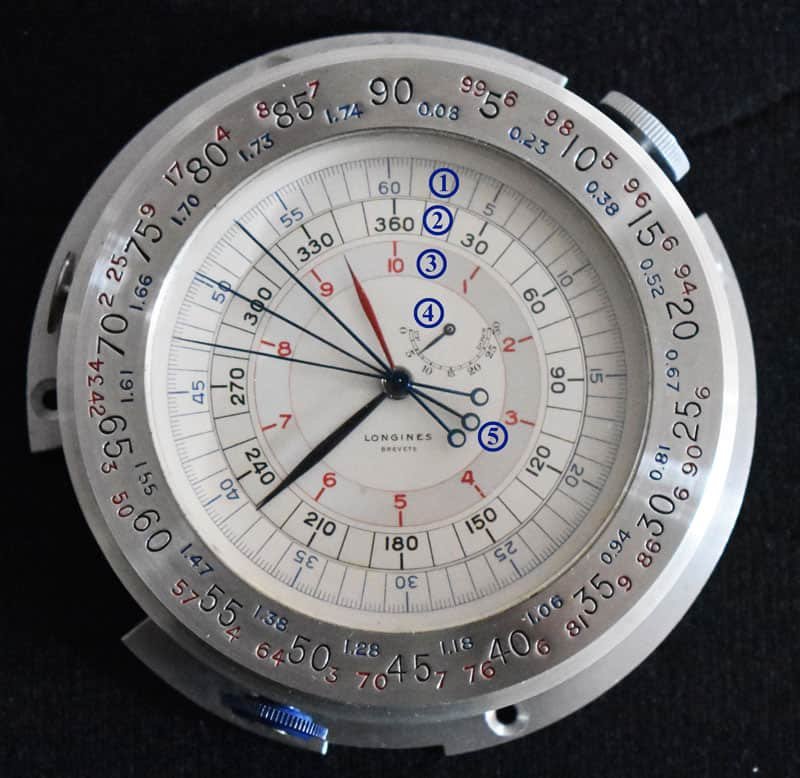
Black Circle (Middle Scale) – Marked 0° to 360° in 10° increments. The black hand makes one rotation in 23 hours 56 minutes one sidereal day moving continuously to indicate approximate sidereal time as an angle. This hand shows the Earth’s rotation relative to the stars: the hour angle of the vernal equinox. Set to 0° at Greenwich sidereal midnight, it reads current Greenwich sidereal time directly in degrees.
Red Circle (Inner Scale) – Subdivided into 10° units. The red hand rotates once every 40 minutes of sidereal time, corresponding to one 10° division of the black scale. It refines the black hand’s reading to the exact degree. As Longines noted, it “performs one revolution in the same interval the black pointer covers one division on the middle circle.” If the black hand lies between 130° and 140°, the red hand indicates precisely how many degrees (0–10) beyond 130°.
Blue Circle (Outer Scale) – Printed 0–60 (minutes of arc) with numerals every 5′. There are 300 hash-marks per degree; each tick = 0.2′ (12″). The blue hand makes one revolution per degree (~4 sidereal minutes). Read minutes 0–59.x at the index; tenths of a minute (~0.1′) are estimated by interpolation between the 0.2′ ticks.
When taking a reading, always read the blue hand first, it moves fastest. Then red, then black. Add the three values: a blue reading of 0.2′, red of 7°, black of 90° gives 97° 0.2′. The instrument indicates angular time to 0.1′ of arc, approximately 6 seconds of time.
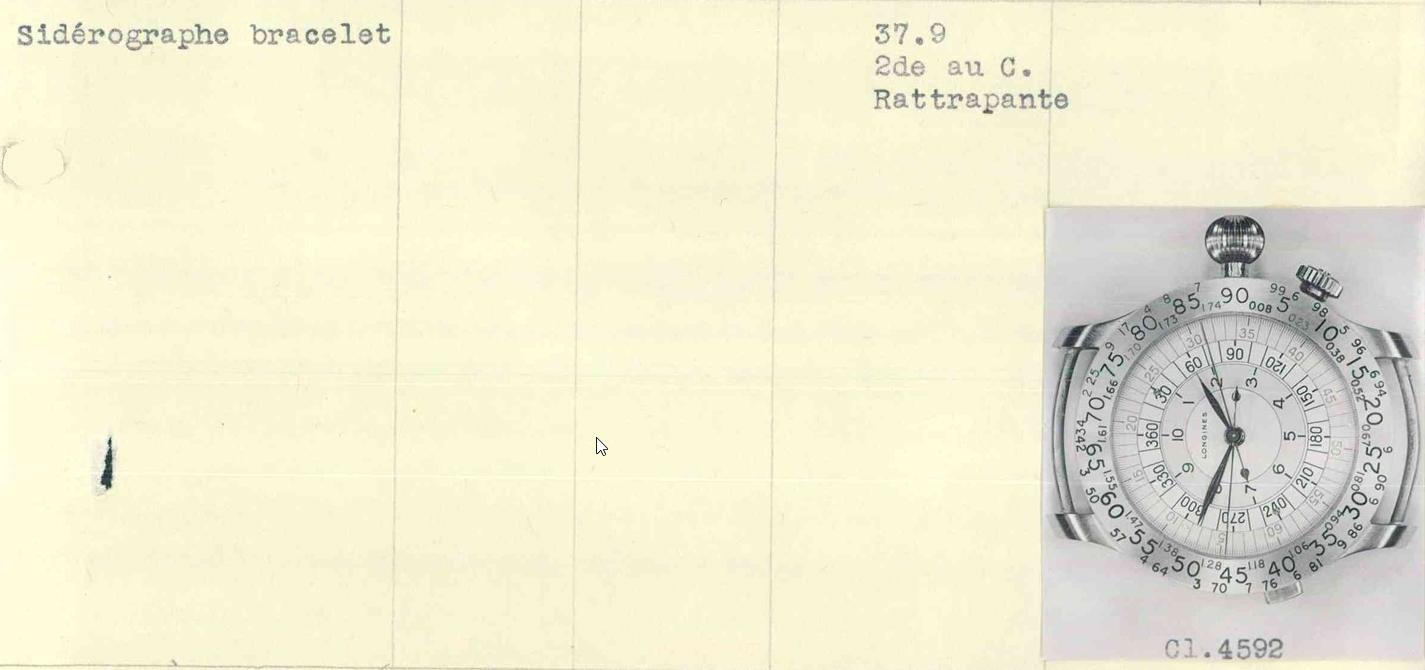
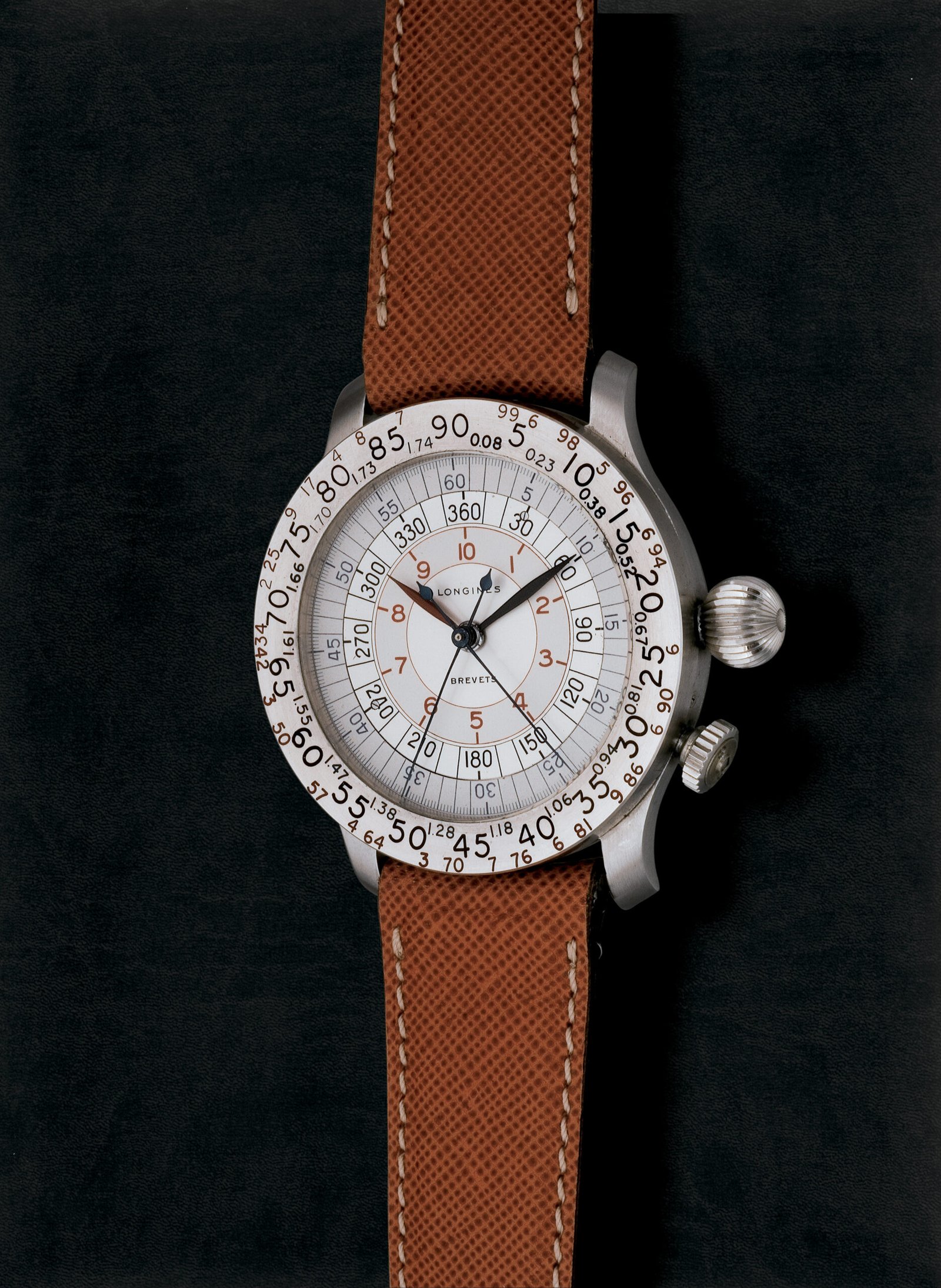
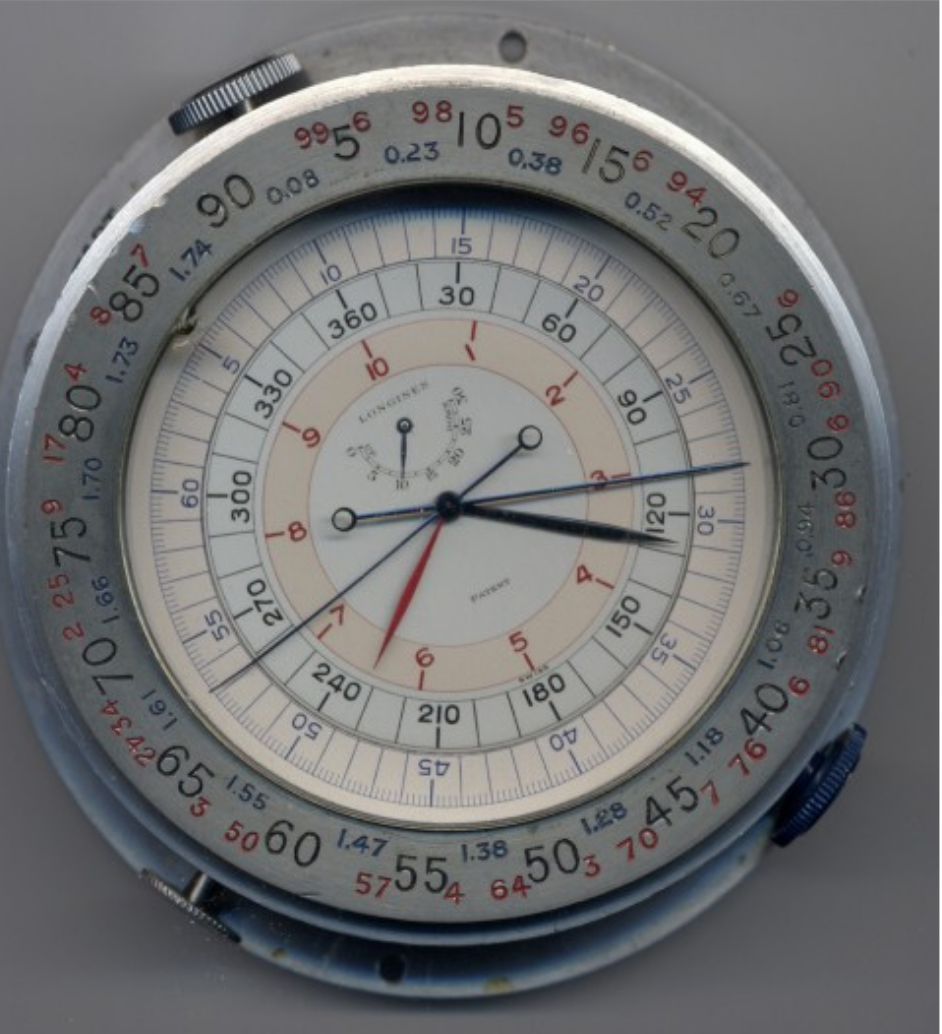
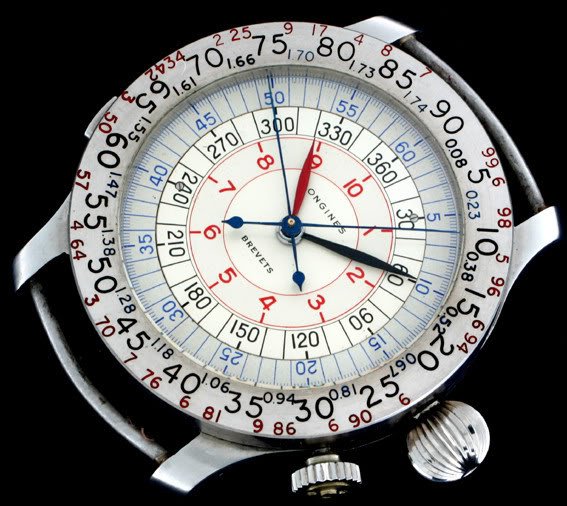
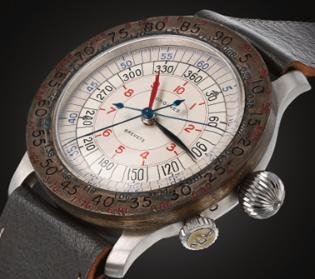
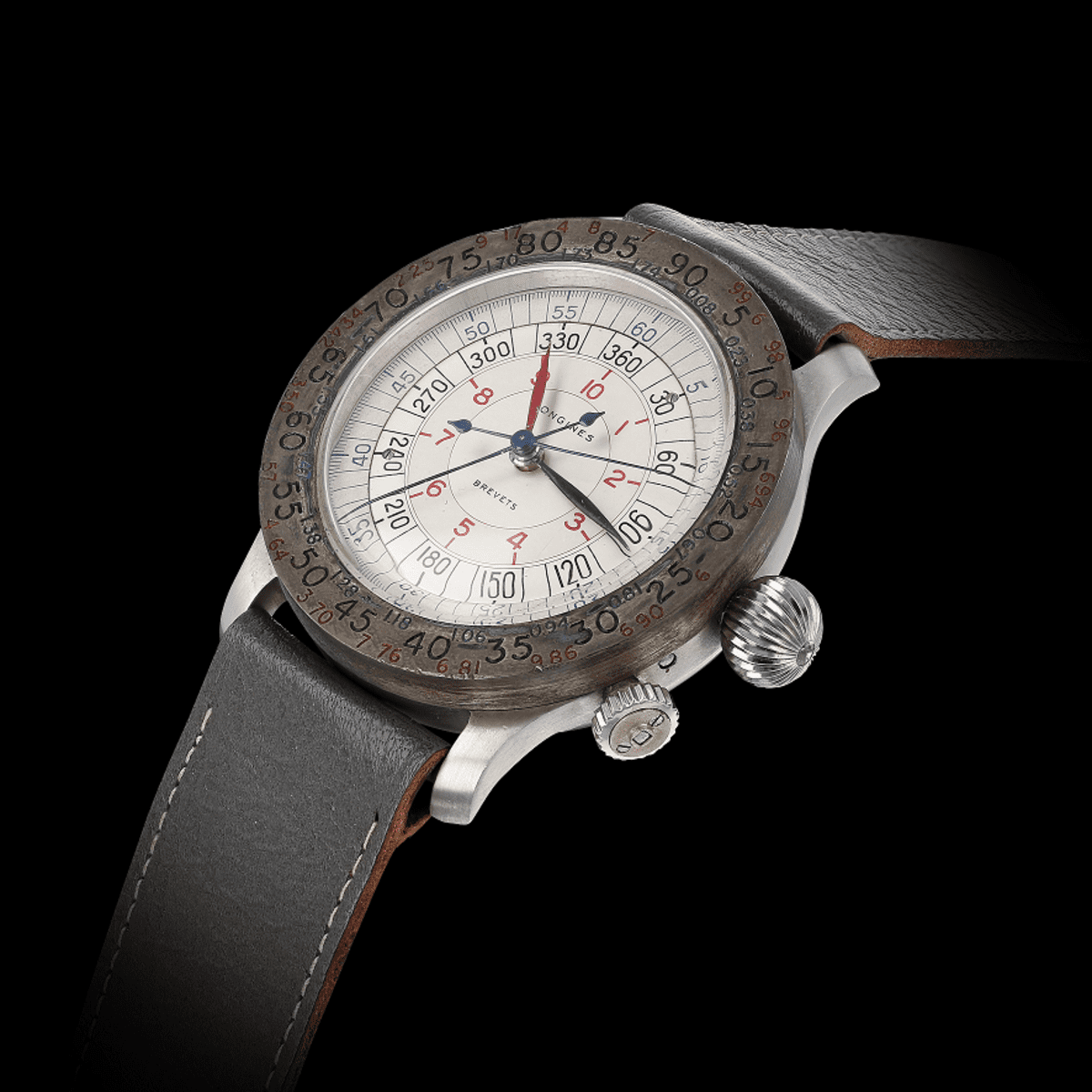
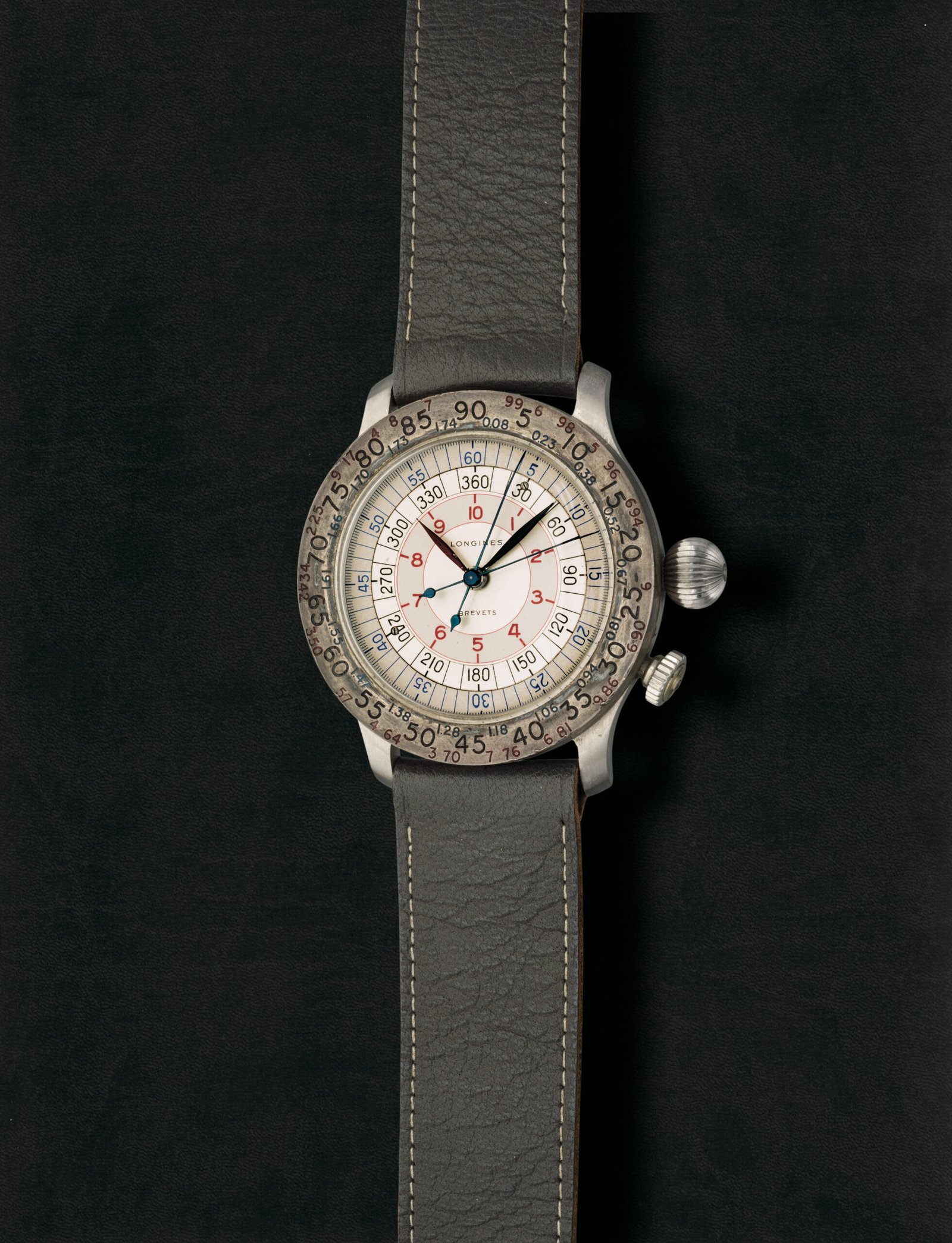
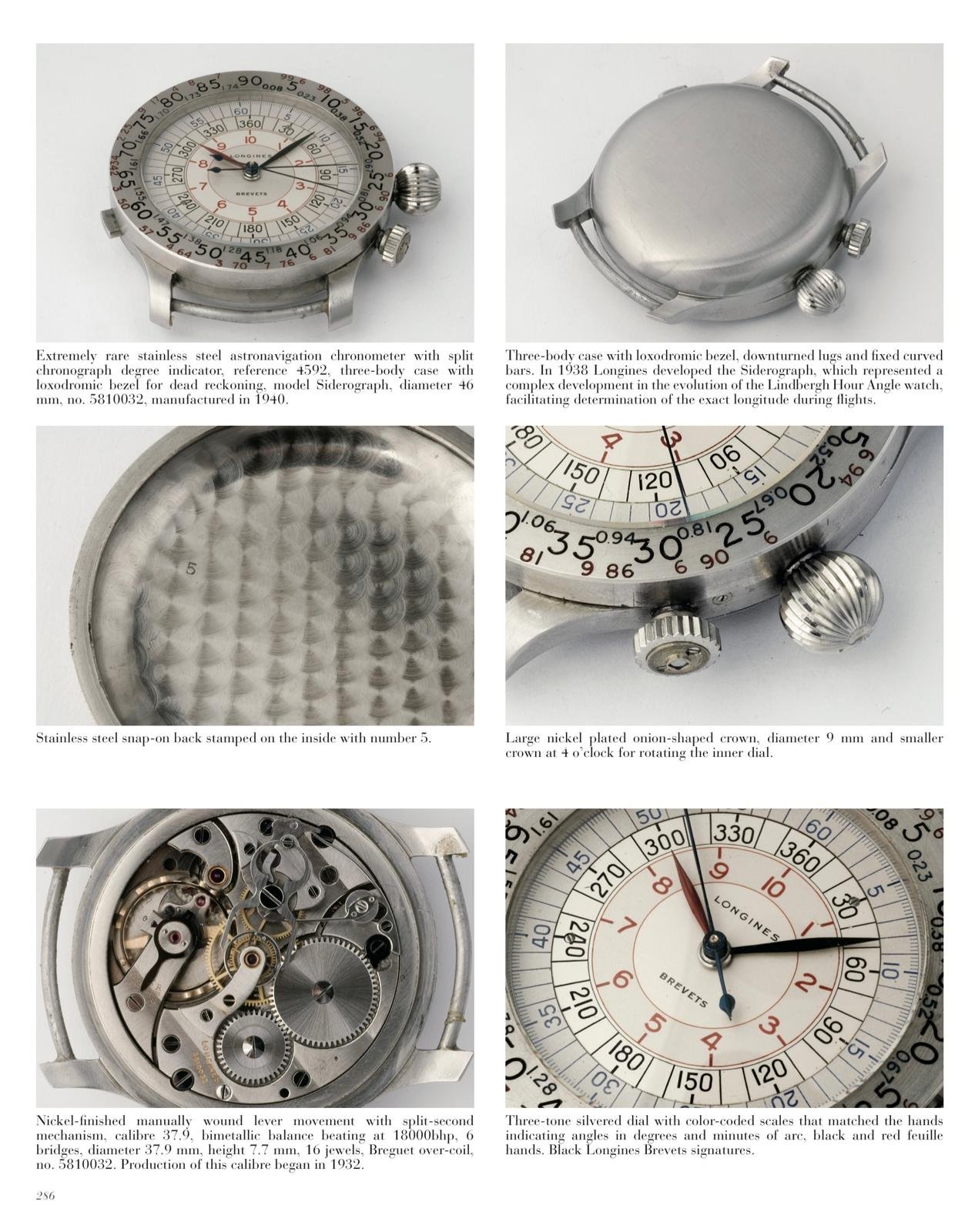
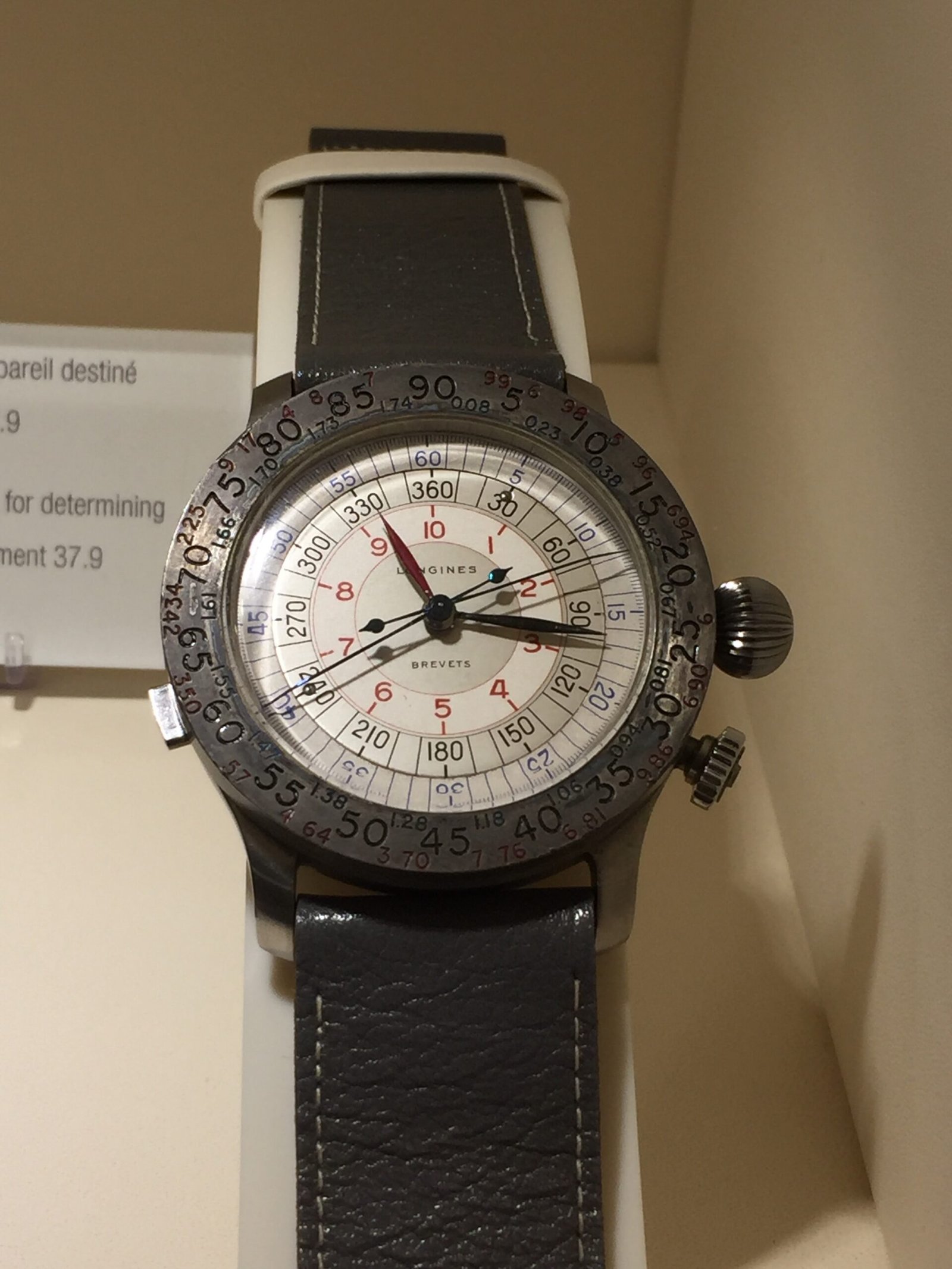
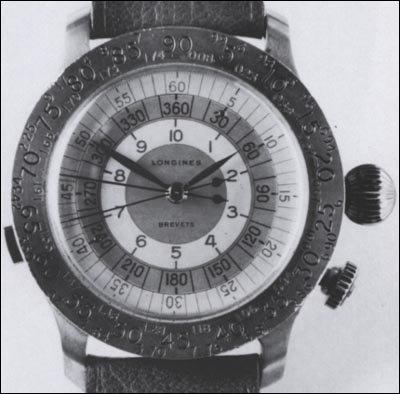
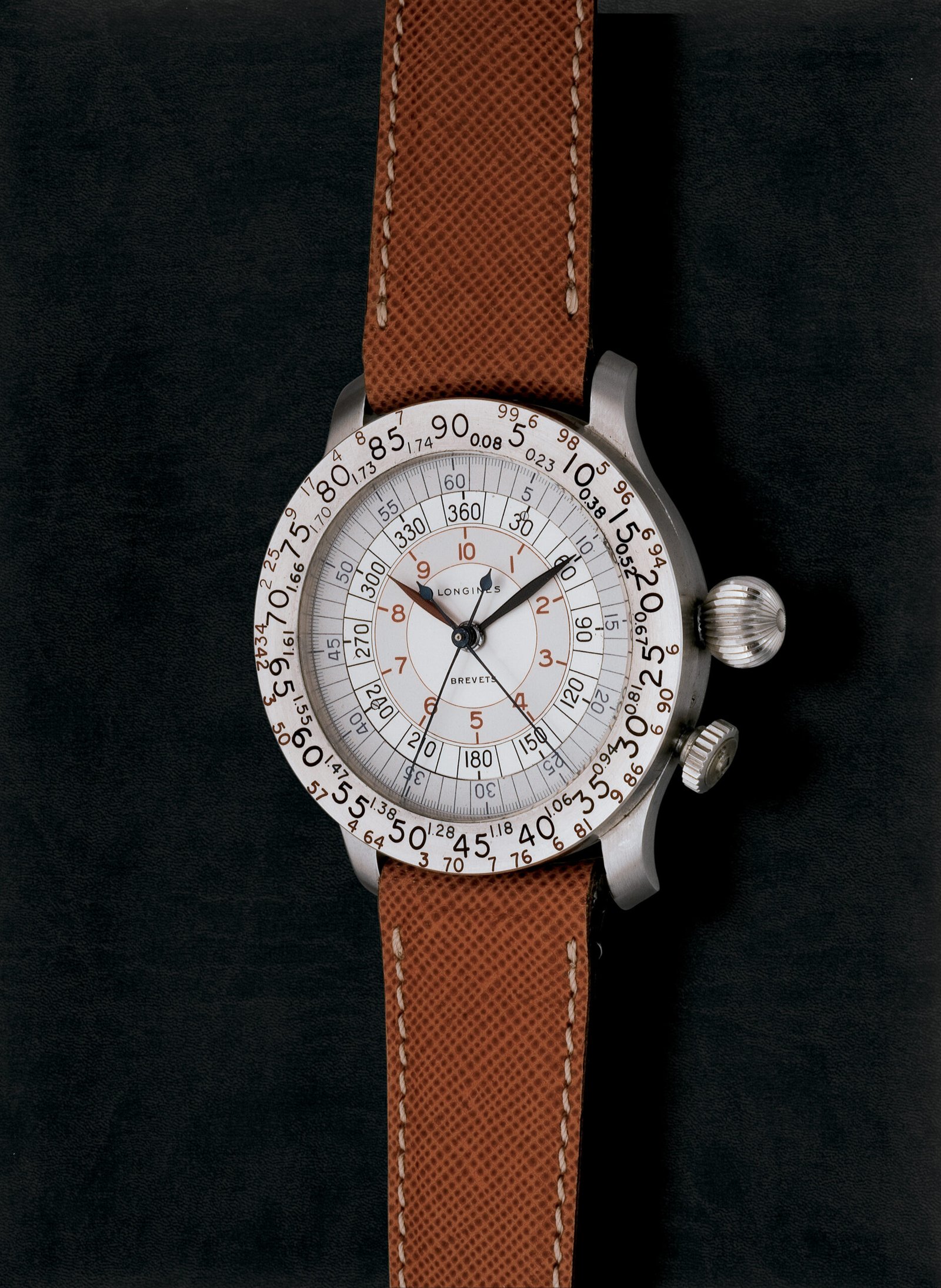
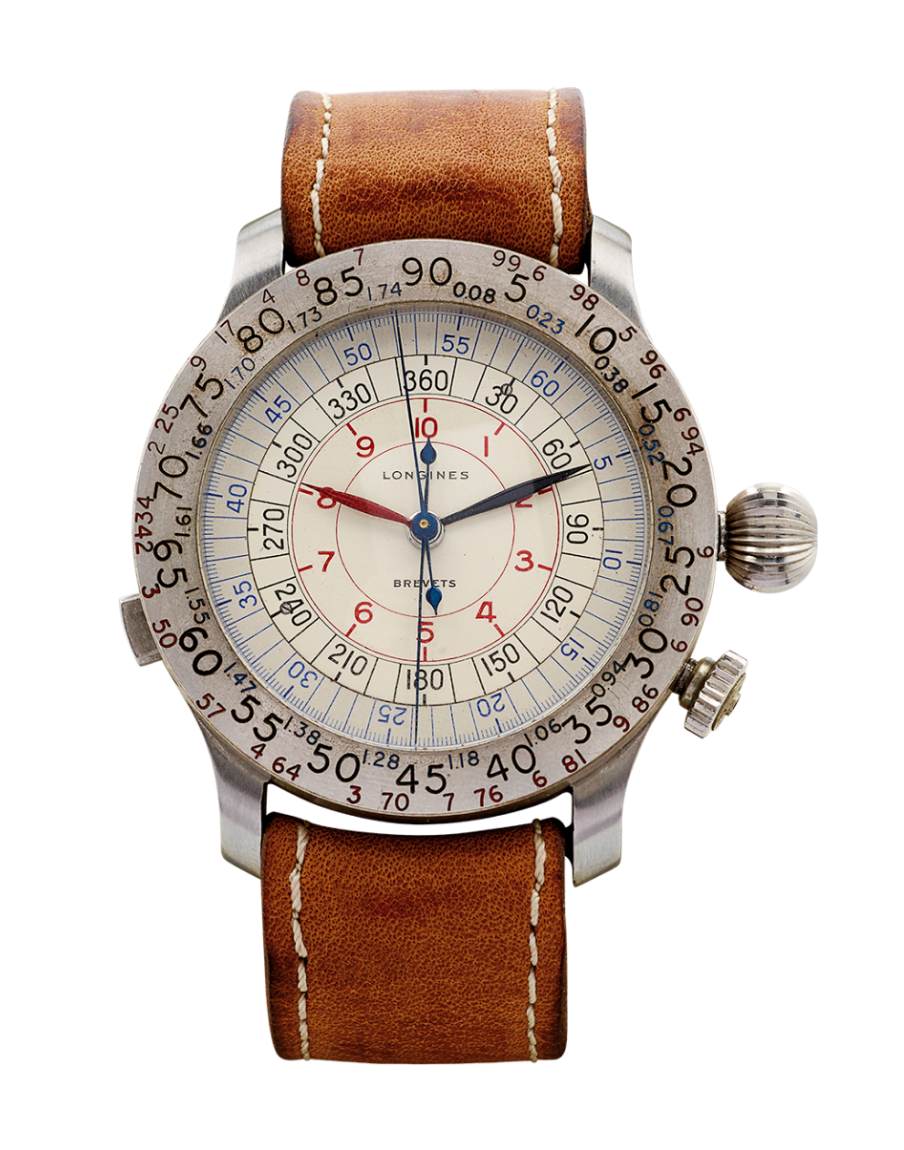
Blue rattrapante sweep freezes the instant of a sextant sight; double graduated rhumb line bezel aids dead reckoning. Oversized onion crown and auxiliary pusher for gloved use; LONGINES BREVETS signature, an ultra rare wrist variant believed made in only 6 examples.
To make this functionality practical in a turbulent cockpit or at sea, Longines incorporated rattrapante (split-seconds) features. Period texts (FH 1939/40; brochure MAY 1939) and surviving dials confirm the arrangement:
Reading order: blue → red → black. Example from the brochure’s Aldebaran observation: blue 47′, red 7°, black 270–280° band ⇒ 277° 47′.
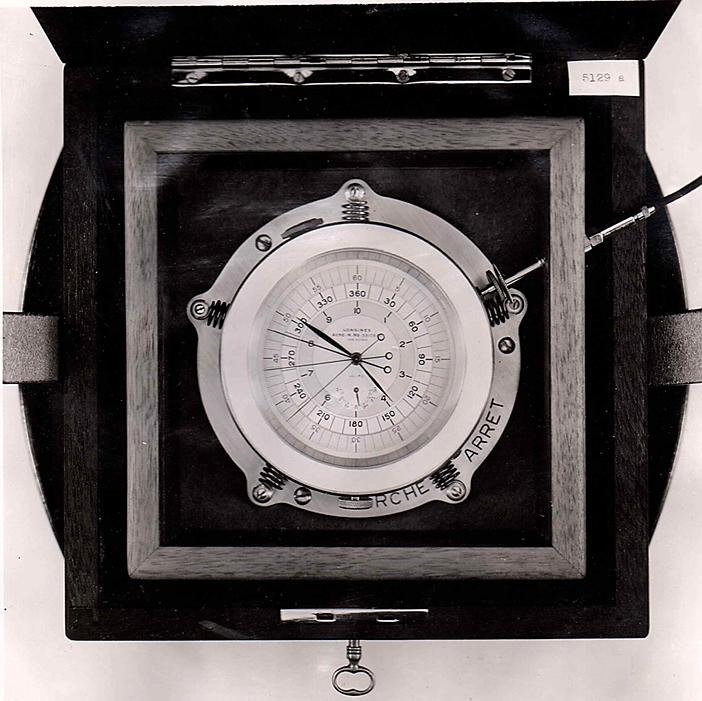
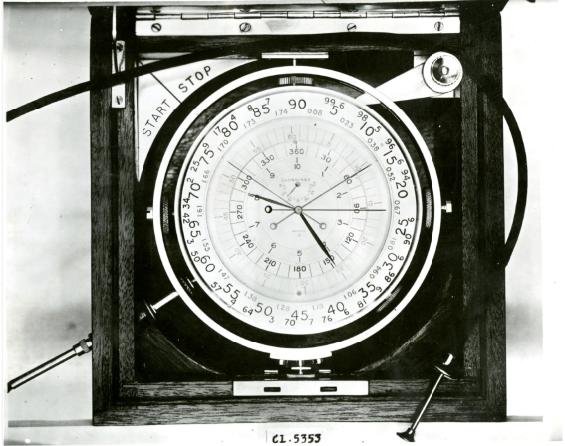
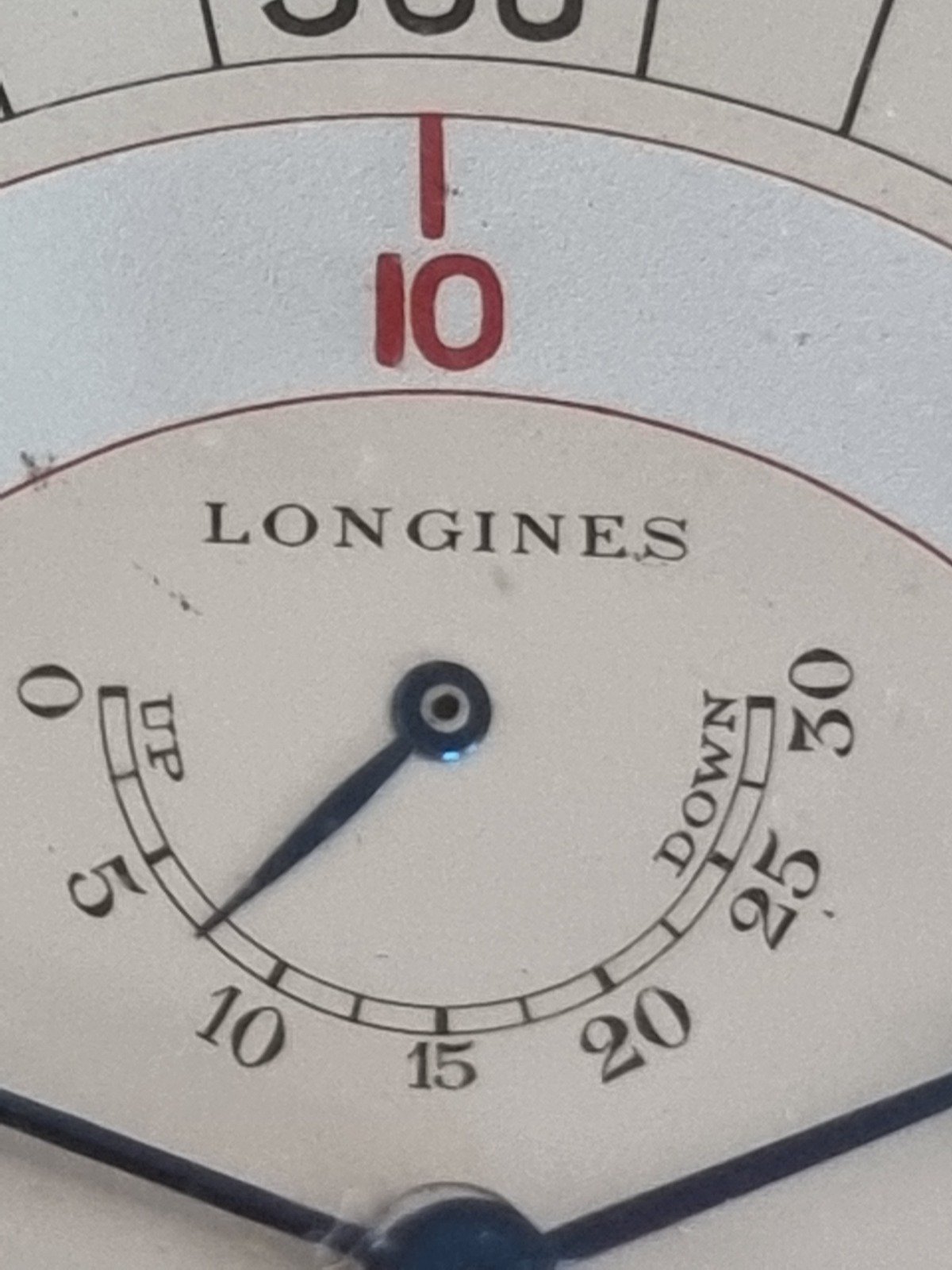
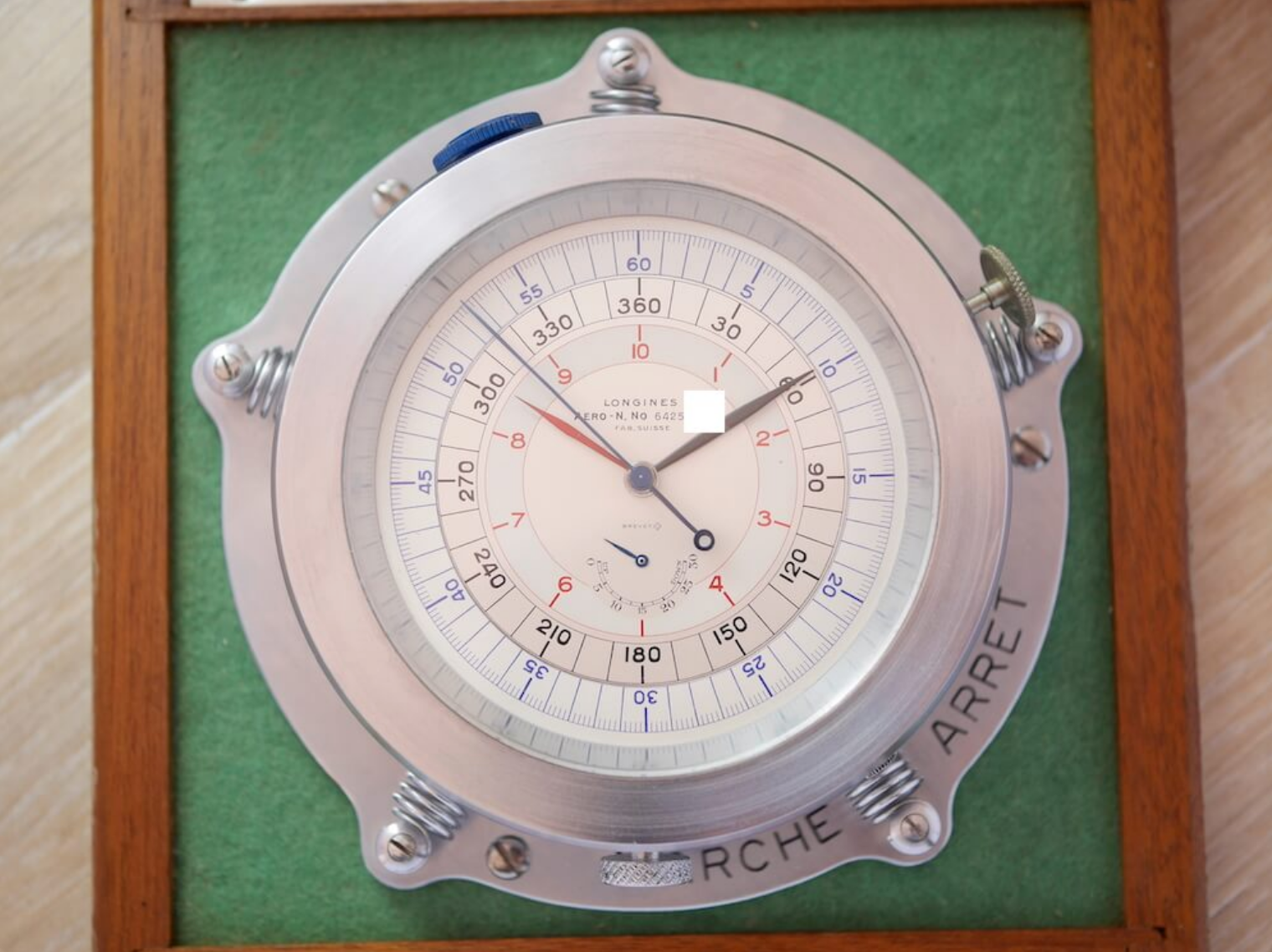
To synchronise: rotate the outer ring so that at the Greenwich radio tick, the printed “60” sits directly under the blue hand, then push the blue crown to re-engage. The slide marked START/STOP (MARCHE/ARRÊT) hacks the balance for signal alignment. Some capsules add a power-reserve indicator at 12.
In practical aerial work, reading precision beyond 0.2′ (12″) is illusory, turbulence, bubble wander and instrument parallax dominate long before the scale becomes the limiting factor. The outer ring’s 300-tick density is therefore an engineering choice calibrated to real-world conditions rather than theoretical maximum resolution.
Almost all Siderographs share a common dial layout: a two-tone silvered face – outer brushed chapter, inner matte with three concentric scales (black 0–360°, red 0–10° within each block, blue 0–300 outer ticks) and a power reserve arc at 12. Many carry an inner rotating bezel or ring, described in German as innere Drehlünette, tied to the rhumb line (course-plotting) patent CH 210856: one bezel for sidereal calibration, another for course calculations.
On the wrist-worn Siderographs the crown engaged the movable inner dial ring, allowing rotation for alignment or calibration. Surrounding this were one or sometimes two graduated outer bezels engraved with degrees of arc and trigonometric scales described in period texts as double lunette tournante graduée. Most likely one bezel acted as an hour angle index ring while the other embodied the rhumb line calculator of patent CH 210856. Surviving examples show bezels engraved with sine and cosine values and interpolation factors, confirming real computational use. The combination of a rotatable inner dial and data-laden bezels makes the wrist Siderograph a uniquely sophisticated piece of 1930s navigation engineering, a mechanical calculator worn on the wrist.
Single split. At the exact moment of your sextant reading, the blue hand freezes the instant while the running blue continues. Read the frozen hand (blue → red → black), note the value, press again to reunite.
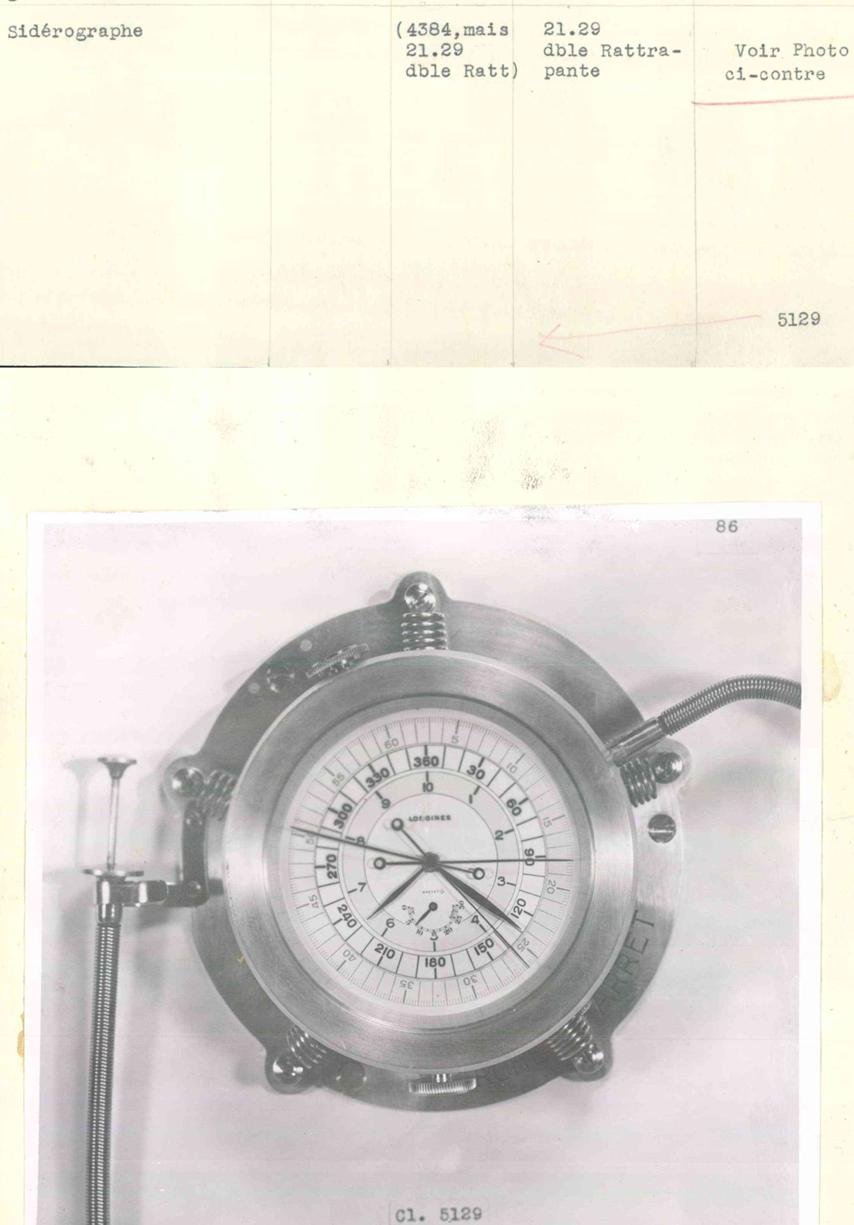
Double rattrapante (averaging). A single sight in rough conditions can be skewed by random motion; capturing two stops and reading their mean cancels much of that error. Two stop hands share the arbor and are controlled by one pusher. Take a rapid series period literature suggests six sights in ~3 minutes. Freeze the first (α₁) and last (α₂). The mean is ᾱ = (α₁ + α₂)/2 found on the dial by bisecting the angle between the two stopped hands. This forgives aircraft motion and bubble wander in air-sextants. In some variants a flexible cable release or electromagnet fires the split remotely, so the observer never leaves the eyepiece.
What makes the Siderograph so coveted among collectors is not just its rarity, but also its uncompromising engineering. Longines took their finest chronometer movement and extensively modified it for this specialised task.
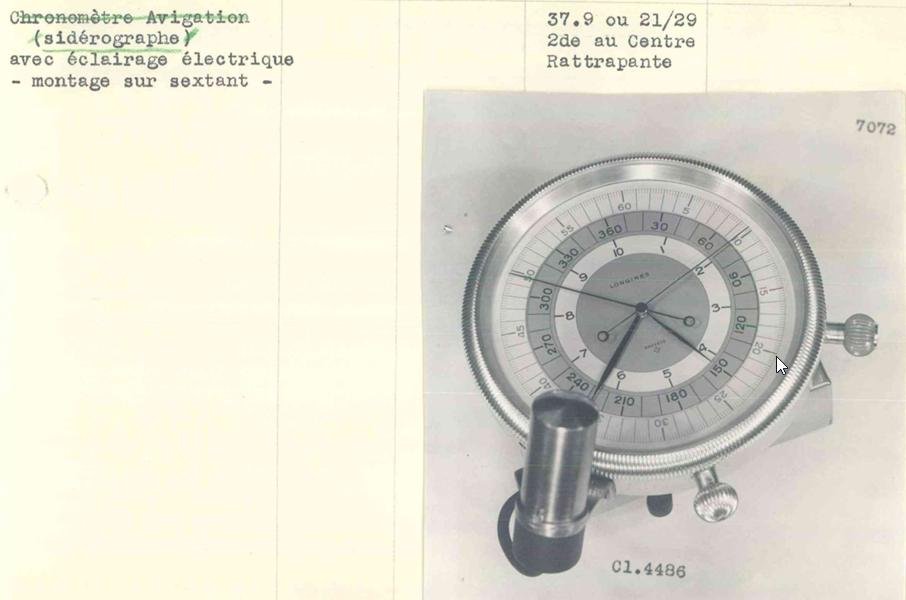
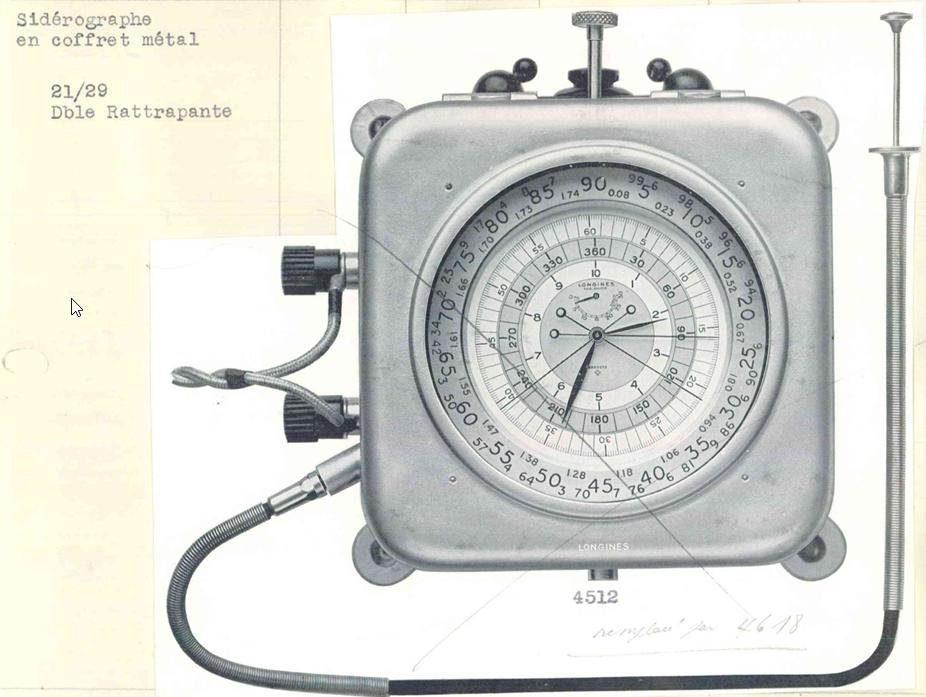
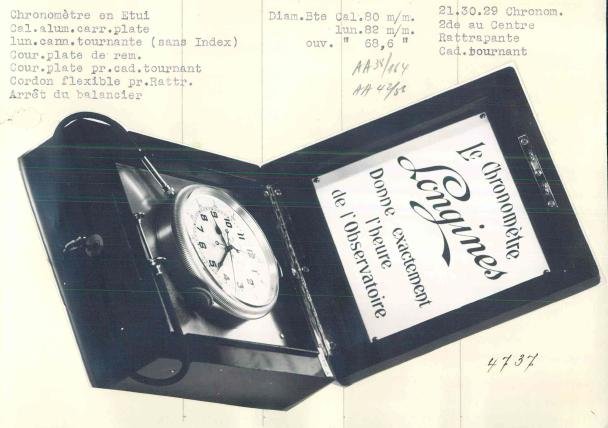
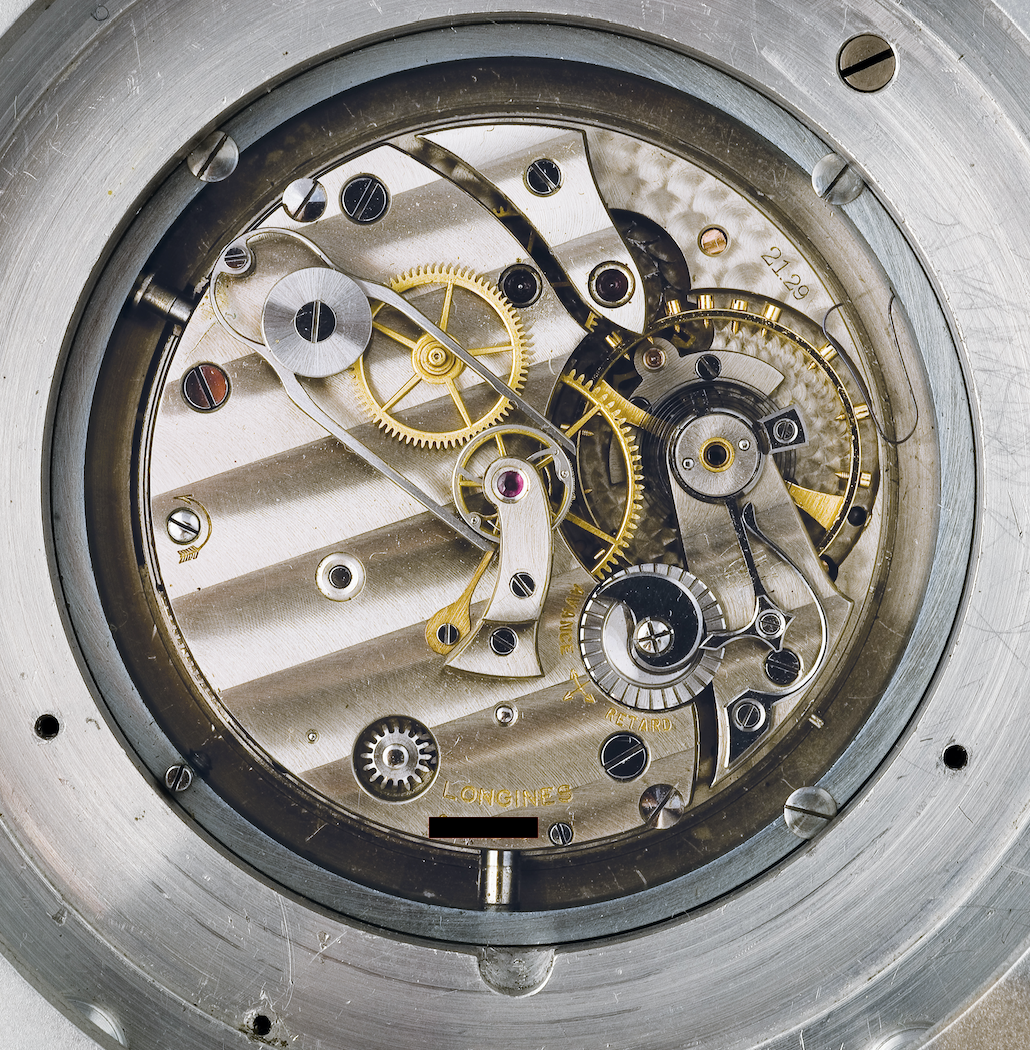
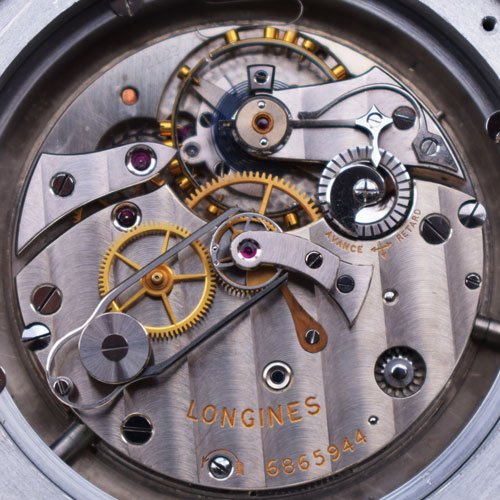
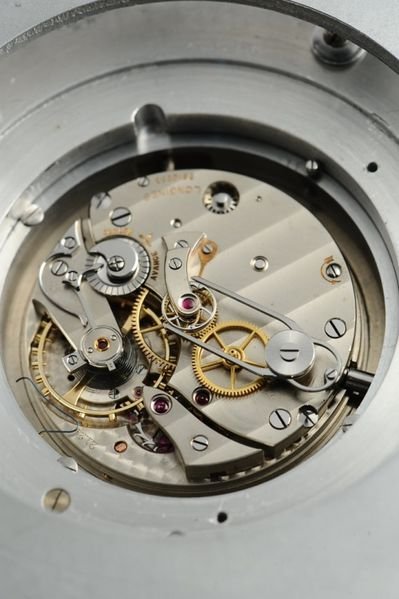
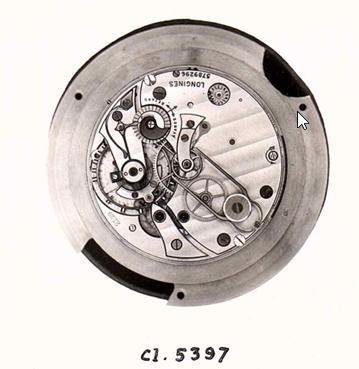
At the heart of the deck Siderograph is Longines’ cal. 21.29, a large 21-ligne (~47.2 mm) movement originally built for deck chronometers and observatory trials, the most accurate in Longines’ 1930s stable. For the Siderograph it was regulated to sidereal rate (approximately 3 minutes 56 seconds per day faster than mean solar time) and equipped with purpose-built functions: a split-seconds rattrapante capture mechanism on some instruments with two split hands for averaging and an up/down power-reserve. Refinements include a bimetallic temperature-compensated balance, Breguet over-coil hairspring and micrometric regulator, plus a hacking (MARCHE / ARRÊT) device for precise synchronisation. Finishing is chronometer-grade: Côtes de Genève, a large screwed balance, and crisp bevels throughout.
Sidereal gearing. The going train is re-ratioed so the cannon for the black hand completes 360° per sidereal day. Secondary trains step up to move the red hand 36× faster (10° per black-hand division in 40 sidereal minutes) and the blue hand 360× faster (1° in ~4 sidereal minutes). The outer scale’s 300-tick/degree resolution means the blue arbor and hand-hub must run true with minimal radial lash a reason the split works are unusually refined.
Split-seconds works. The blue arbor carries a classic rattrapante clamp system with polished steel jaws and a resilient spring to arrest without bounce and to rejoin cleanly at speed. On double versions a second clamp and hand are stacked; careful jewelling and end-shake control keep drag low. Surviving examples show relieved levers and mirror-polished contact faces.
Hacking & control. A lateral lever halts the balance when the MARCHE/ARRÊT slide is pulled. A separate train links the blue crown and outer ring for zeroing to the signal.
Service implications. The instrument was designed to run warm. Period texts specify −30°C ambient with a thermostat holding the capsule at ~20°C. Modern oils extend range, but amplitude still collapses if the heater or thermal path fails. Split clamps must be set parallel – any twist drags the running hand.
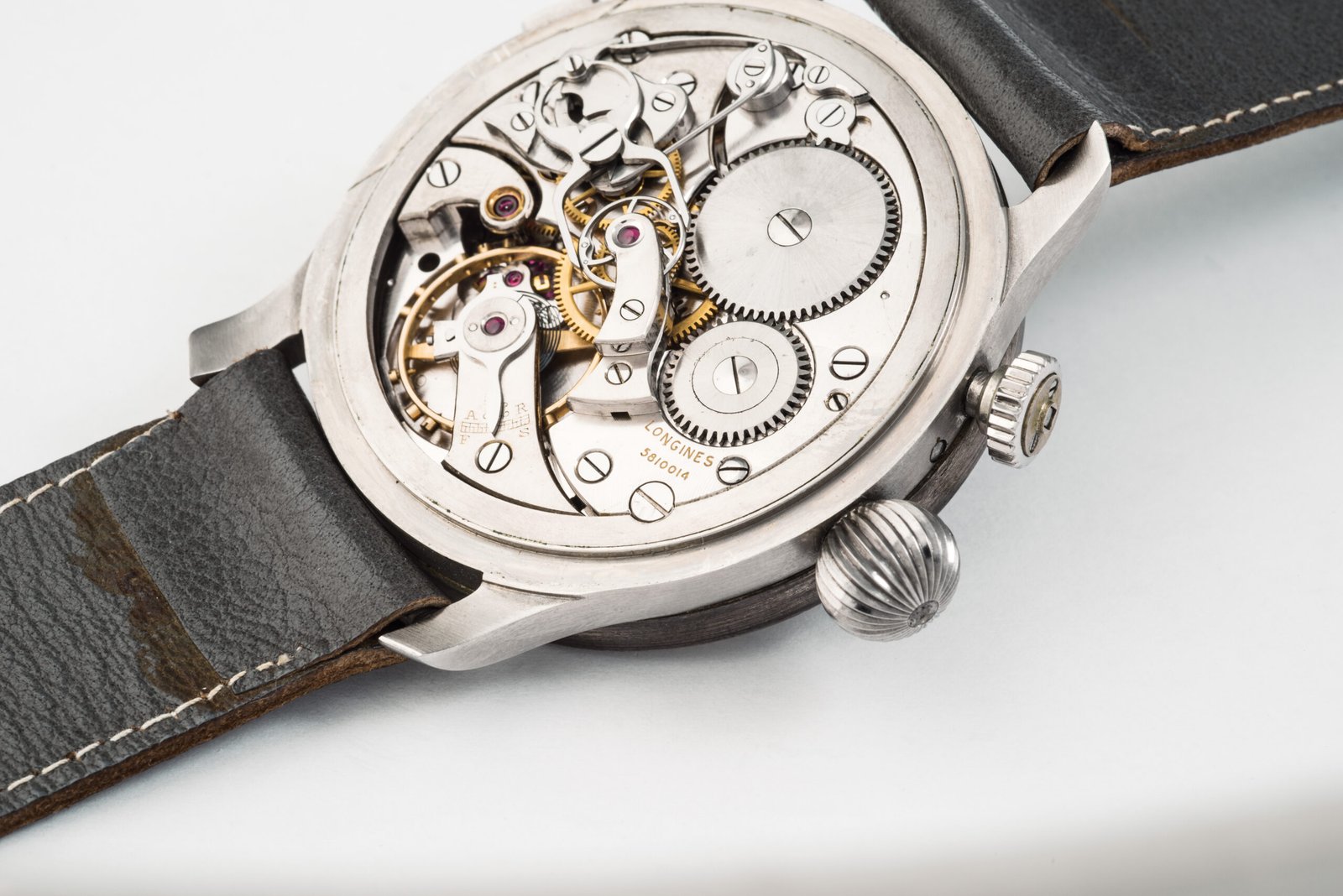
Where the deck Siderograph used the large-format cal. 21.29 with its heated capsule and power-reserve, the wrist variants required Longines to achieve an even more complex feat of engineering, miniaturising the same navigational functionality in a movement small enough to wear. Their solution was cal. 37.9 a 16½-ligne split-seconds movement adapted specifically for sidereal duty.
Base calibre. Longines cal. 37.9 split-seconds, manual wind; 16½ lignes (~37.9 mm), height 7.7 mm, 16 jewels, lever escapement at 18,000 A/h, bimetallic balance with Breguet over-coil, six-bridge nickel finish. Production of the base calibre begins in 1932; the museum wrist example (no. 5810014) is from this family.
Adaptation for Siderograph duty. Sidereal gearing: the going train is re-ratioed so the black hand completes 360° per sidereal day (≈ 23 h 56 m 4 s). Indication drives: secondary ratios deliver the red hand (0–10° per 40 sidereal minutes) and the blue sweep (1° per ≈ 4 sidereal minutes) over the 300-tick outer scale (0.2′ / 12″ per tick). Rattrapante works: the split-seconds clamp on the blue sweep’s train allows the observer to freeze a sight while the runner continues; some instruments show provision for first/last capture and reading the bisector for averaging. Hacking & zeroing: MARCHE / ARRÊT slide to stop the balance for radio-tick synchronisation; crown/outer-ring arrangement to set the blue sweep to the printed “60” index at the signal.
Contrast with deck units. Deck/capsule Siderographs use cal. 21.29 (21-lignes), often with power-reserve and housed in a heated aluminium capsule on gimbals; the wrist Siderograph omits the heater and power-reserve yet manages to package the same triple-scale, split-capture logic around cal. 37.9 to make the concept wearable.
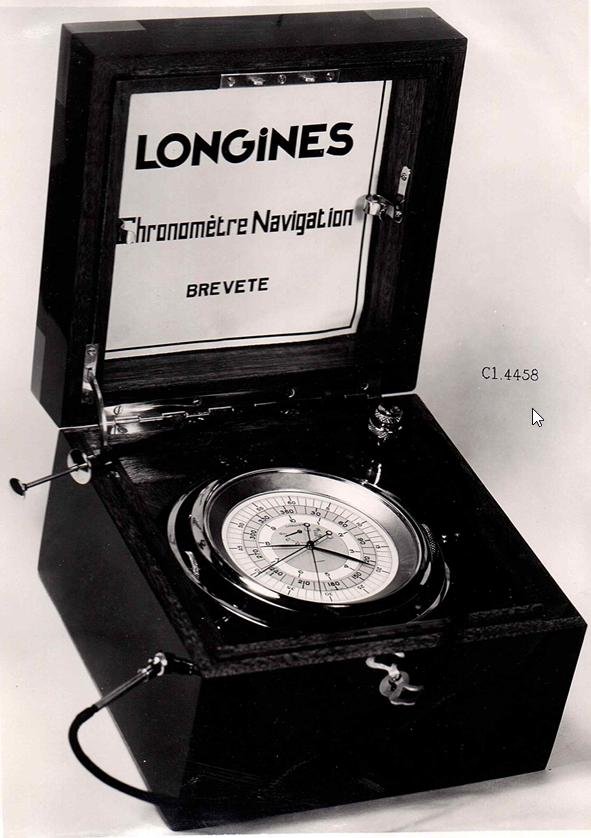
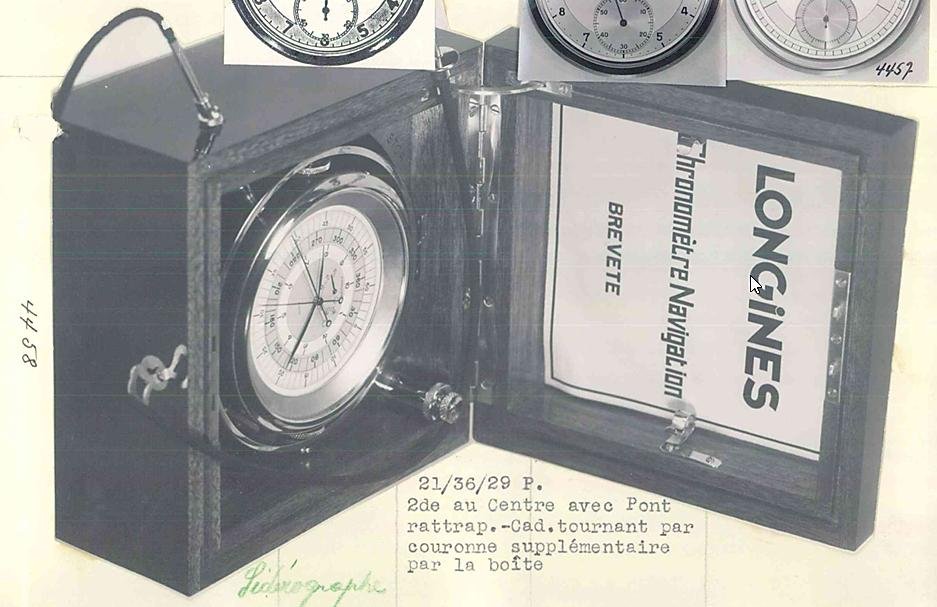
Where the wrist variants of 1942–43 traded thermal management for portability, the deck and cockpit instruments went the other way. The case is itself a precision instrument, a heated, gimballed aluminium capsule built to keep the movement at a stable temperature, isolated from vibration, and legible at a glance in poor light. The principal elements are summarised below.
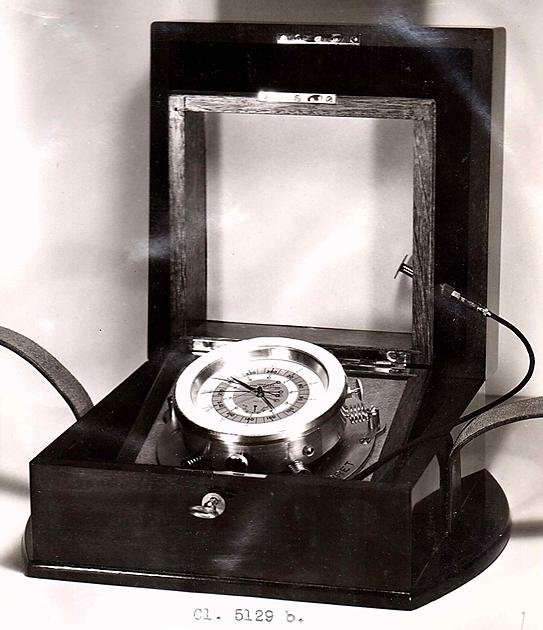
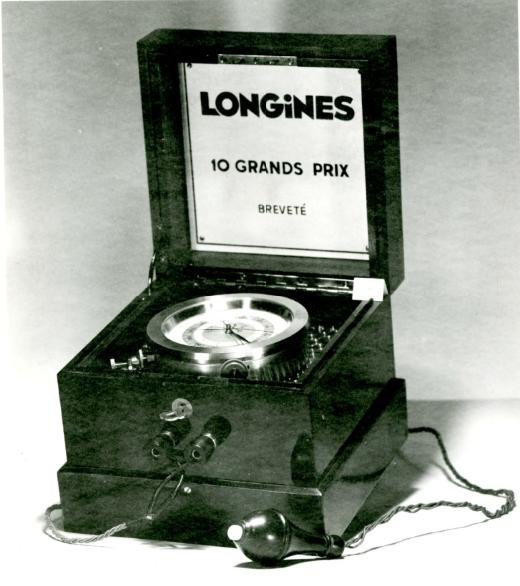
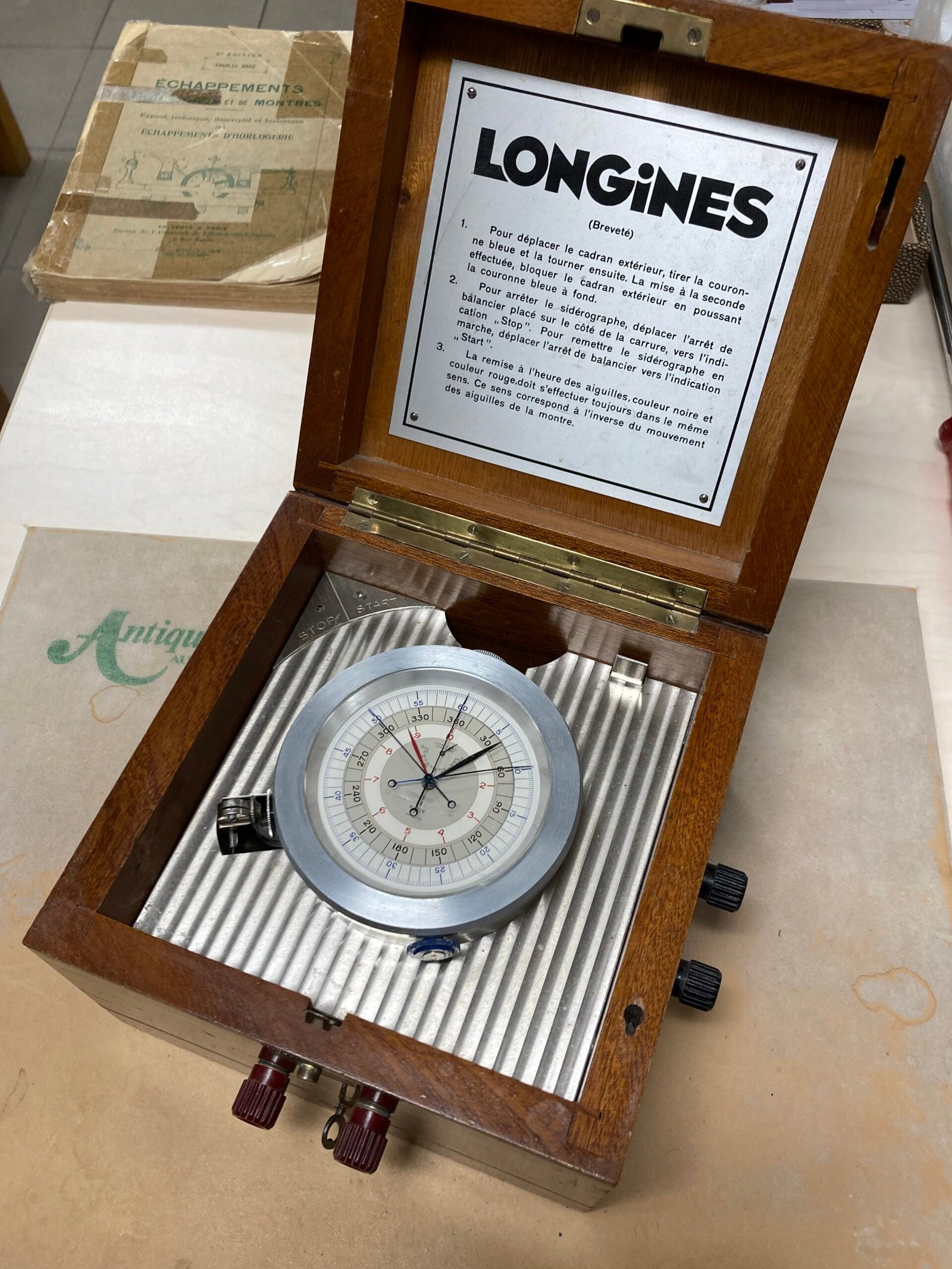
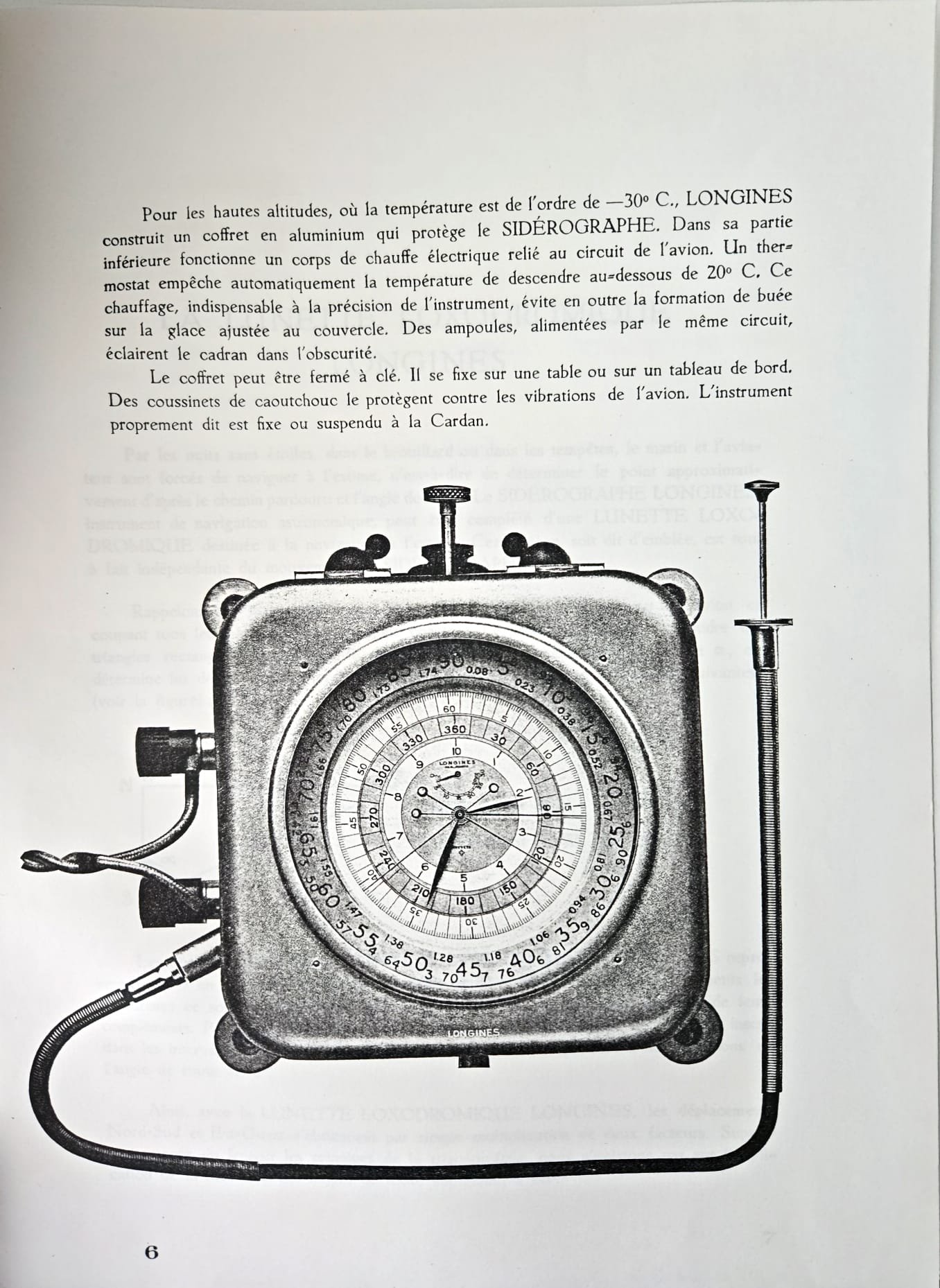
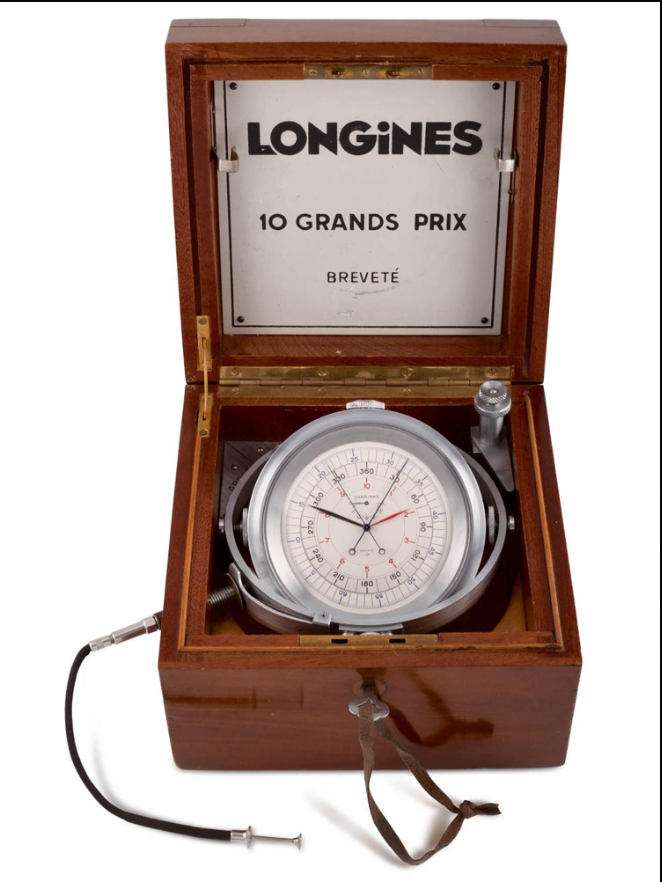
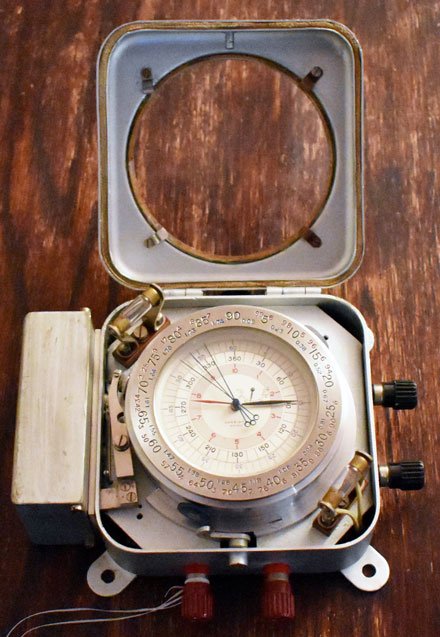
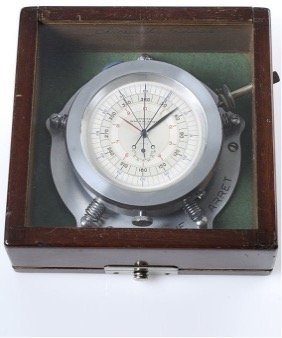
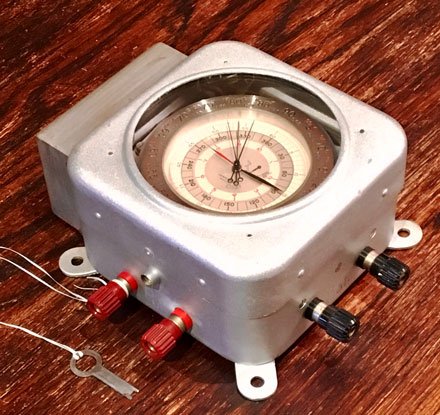
Several surviving deck Siderographs feature a circular aluminium container with a built-in electrical heater and thermometer, powered by the aircraft’s or ship’s circuit. A Siderograph auctioned by Sotheby’s was noted to have a heating system in its outer case, complete with an on-off switch and wiring (though untested at time of sale). This assembly was typically mounted on shock-absorbing springs within a gimballed box the entire setup resembling a small marine chronometer: a mahogany box with brass gimbal rings suspending a round metal case beneath a glass cover. Serial 6425248 (Christie’s 2004) and 5810653 (Dr. Crott Auction 2014) both show this configuration. On military examples, “Marche/Arrêt” (Start/Stop) is often engraved near the external stop lever or cable attachment, reinforcing the instrument’s purpose-built character.
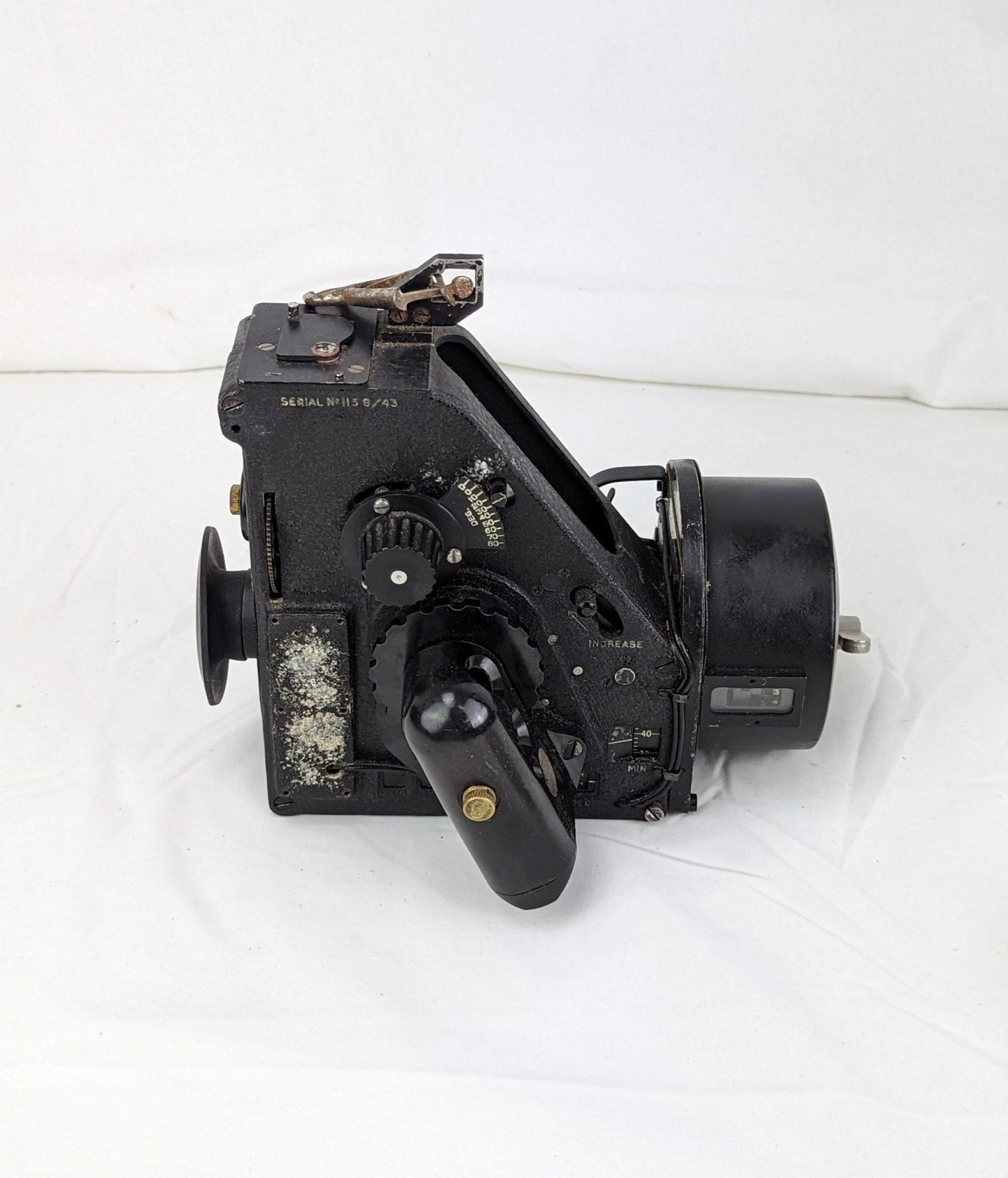
Capsule. Die-cast aluminium housing, typically 94 mm frontal diameter for cockpit legibility; four or more mounting bosses; locking glazed cover.
Heating. Electric element in the base, wired to aircraft supply; thermostat prevents drop below 20°C and suppresses fogging at altitude. The brochure shows the element and wiring.
Suspension. Gimbal ring (Cardan) and rubber isolation decouple vibration; some capsules include jewelled pivots for the gimbal.
Lighting. Small bulbs, same circuit as the heater, illuminate the dial; some capsules include a thermometer aperture.
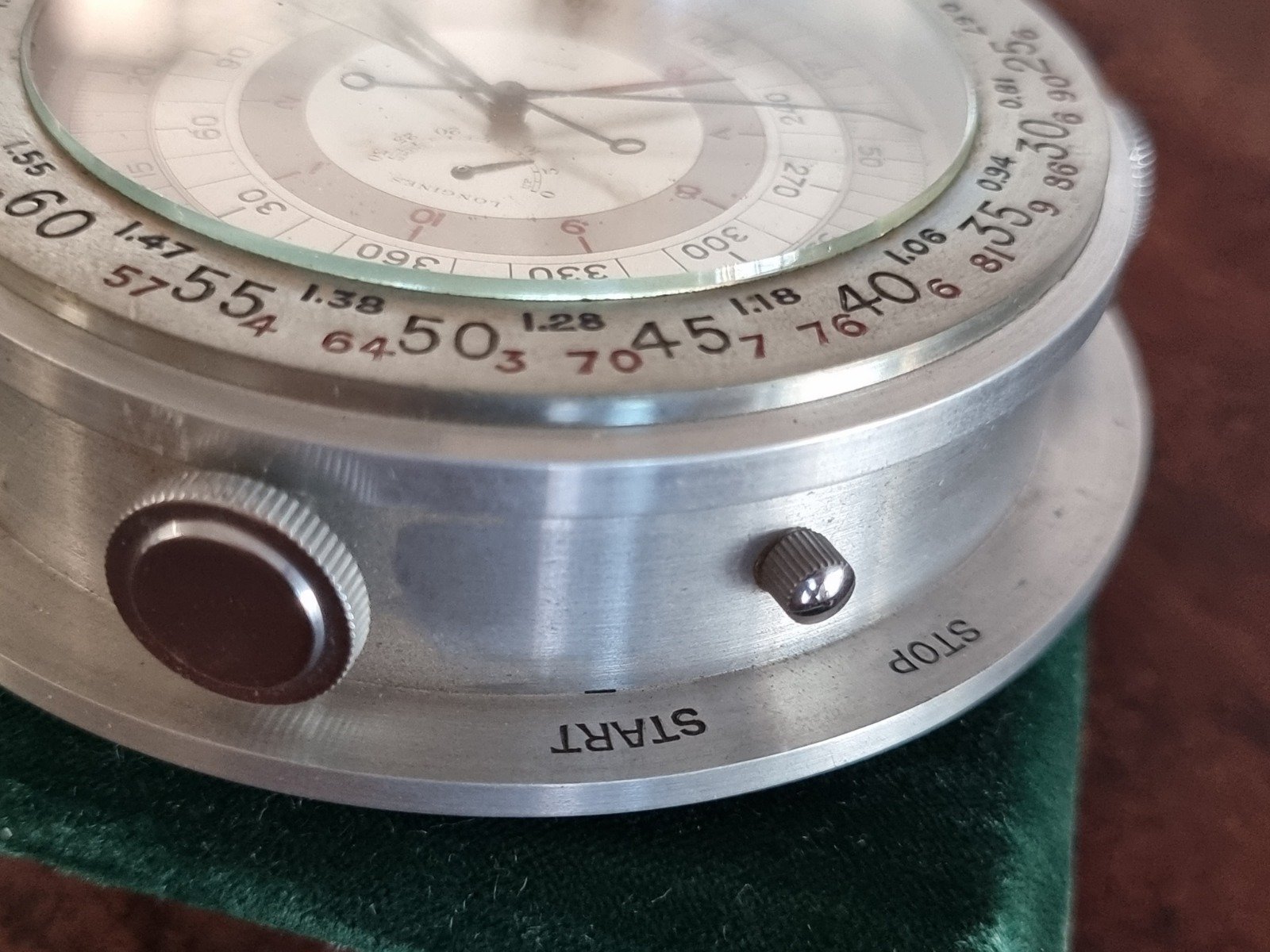
Controls. External START/STOP slide; colour-coded knurled crowns (blue relates to the outer ring); long-throw pusher for the split; port for remote cable.
Field ergonomics. The outer ring’s blue “60” alignment is visible at a glance; the power-reserve arc sits at 12; the split pusher is oversized for gloved use; and the START/STOP slide is engraved in clear capitals.
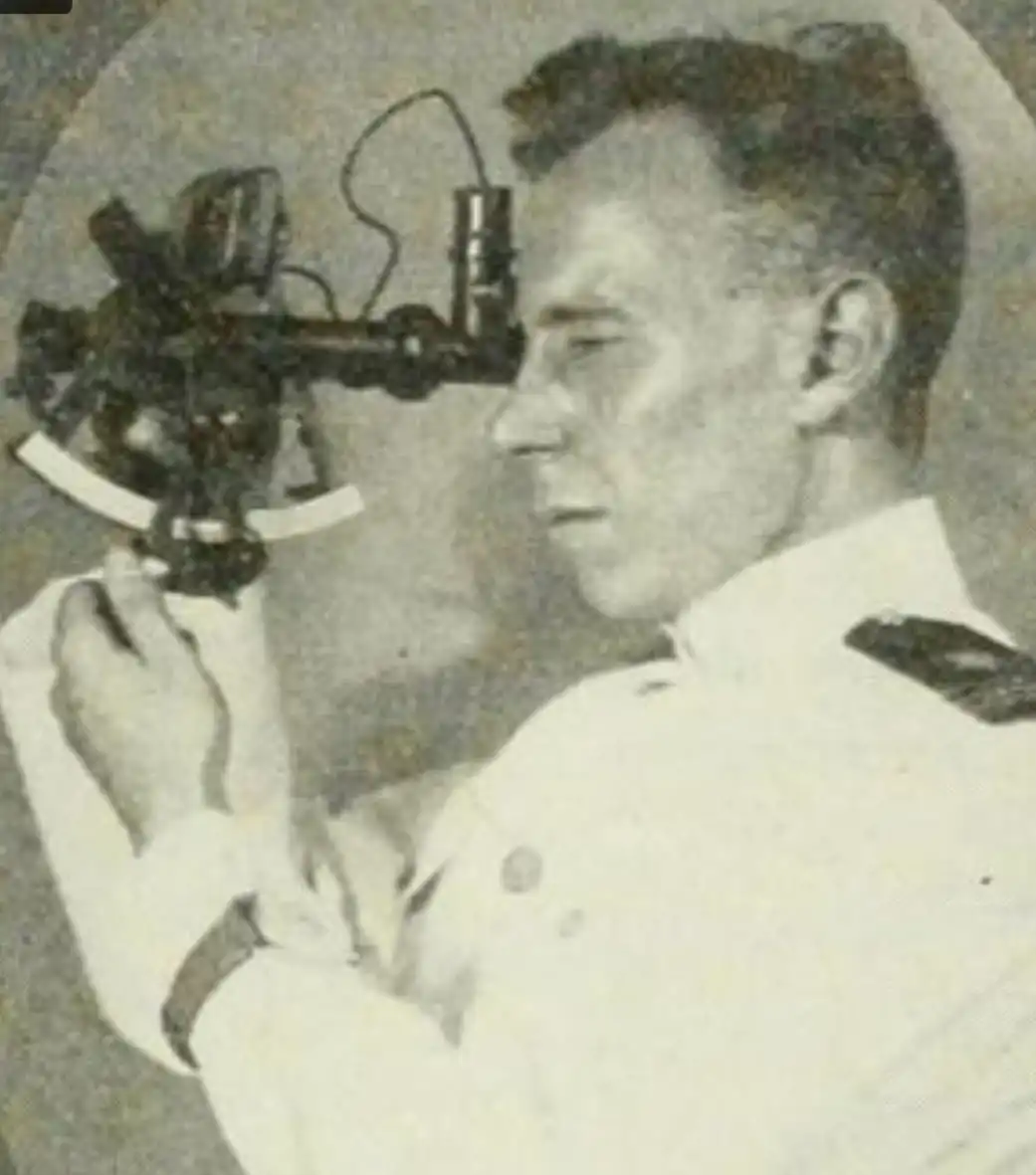
Harry P. Connor transatlantic aviator and one of the first pilots to publicly review and endorse Longines navigation instruments taking a sextant sight, wearing his Longines Weems Aerochronometer. Aero Digest, August 1930. Image credit: flightbirds.net
The Siderograph survives in three principal configurations, each tailored to a different platform. The deck and cockpit instrument was the canonical form, housed in its heated aluminium capsule. The wrist variant compressed the same triple-scale logic into a wearable case for navigators in flight. And a small number were built directly onto a sextant, with the chronograph trigger linked to the sighting mechanism for in-line celestial fixing.
Deck / Cockpit (~94 mm)
The “canonical” Siderograph: aluminium capsule; power-reserve at 12 on many examples; one running blue + one or two split blues; remote provision. Period dials often carry AERO-N marks and a dial serial under the signature.
Wrist Siderographs (cal. 37.9, c. 1942–43)
Six wrist Siderographs are known to the market. Longines archive entries record at least two wrist serials, 5 810 014 and 5 810 032, in 1942–43; the adjacent 5 810 015 appears to be a related deck/pocket variant. One wrist example is preserved by the Longines Museum, Saint-Imier. At least one 37.9 Siderograph has surfaced uncased, and a spare original dial is also known in collectors’ hands. As such, the wrist Siderograph ranks among the most important vintage Longines on the market.
Configuration
Steel case 46 mm (over-sleeve fit); cal. 37.9 split-seconds re-geared to sidereal rate; blue rattrapante for instant capture (occasional double-split for averaging); inner rotating ring coupled to the crown; double-graduated rhumb-line bezel (CH 210856); onion/mushroom crown with auxiliary pusher; LONGINES BREVETS signature. Compared with deck units, wrist pieces omit the heater and power-reserve but retain the full tri-scale sidereal display.
Sextant-Mounted
Longines supplied a Siderograph mounted directly on a sextant, the dial lit by the sextant’s lamp or a small independent cell. The brochure frames the coupling with the identity H = f(α) — the observed height H is a function of the sidereal angle α so both must be recorded simultaneously; the rattrapante makes that practicable.
The following is taken directly from the Longines internal catalogue of 1939, explaining the Siderograph’s purpose in the company’s own words:
In the past, the naval officer was required to make long and difficult calculations in order to determine both their current position and direction of travel. However, the slow pace of sea navigation made such calculations possible and plausible. But a pilot flying an aircraft at 400 miles per hour must be able to determine their position in just a few minutes. The success of the flight will depend on it. It was therefore an imperative necessity to adapt navigation methods to the requirements of aeronautics. The navy could also benefit from such an improvement.
First we had to make the ephemeris more practical. This was the task of the official office in charge of composing them the Bureau des Longitudes in France, H.M. Nautical Almanac Office in England. New tables appeared which give directly in degrees, minutes and tenths of a minute of arc the Greenwich hour angle of the vernal point, the right ascensions of the Sun, the Moon, the planets and the main stars.
But a parallel simplification was necessary in chronometry. The Longines watch company produced such a tool no surprise to naval officers who already knew the quality of its on-board instruments, nor to aviators, since the most famous among them used the special watches it created for them. Today it provides them with a completely new device: the Sidérographe. Until now, we had to transform the times marked by the stopwatch into angular values. Set on the sidereal day, divided not into hours, minutes and seconds, but into degrees, minutes and fifths of a minute of arc, the Longines Siderograph directly indicates the Greenwich hour angle of the vernal point.
Thanks to this double improvement in ephemerides and on-board instruments, the Greenwich hour angle of any star can now be obtained by simple subtraction or addition. From the sidereal angle marked in arc on the dial of the new Longines device, we subtract the right ascension of the star expressed also in angular units or we add its versed ascension.
At heart the Longines Siderograph is not a clock at all but a mechanical computer for celestial navigation. Instead of showing hours and minutes, its dial is laid out in degrees and minutes of arc and is geared to turn at the sidereal rate the rotation of the Earth relative to the stars rather than the Sun. Set correctly, it gives the Greenwich sidereal angle directly, so the navigator can work in the same angular units as the modern ephemerides.
In practice the Siderograph sits on the navigator’s table in its heated, gimballed aluminium capsule. The navigator sets the instrument using the star tables, then when a star “kisses” the horizon in the sextant he arrests the split-seconds hand. The reading on the dial, combined with the star’s right ascension from the tables, gives the Greenwich hour angle of the star with a single subtraction. What previously demanded a chain of time conversions and trigonometry collapses into one mechanical reading.
Because the Siderograph works in pure angles it bridges sea and air navigation precise enough for observatory work, robust enough for the North Atlantic, and quick enough for an aircraft covering several miles a minute. That blend of theoretical astronomy and very practical engineering is what makes the instrument so unusual in Longines’ history and why surviving examples are so sought after today.
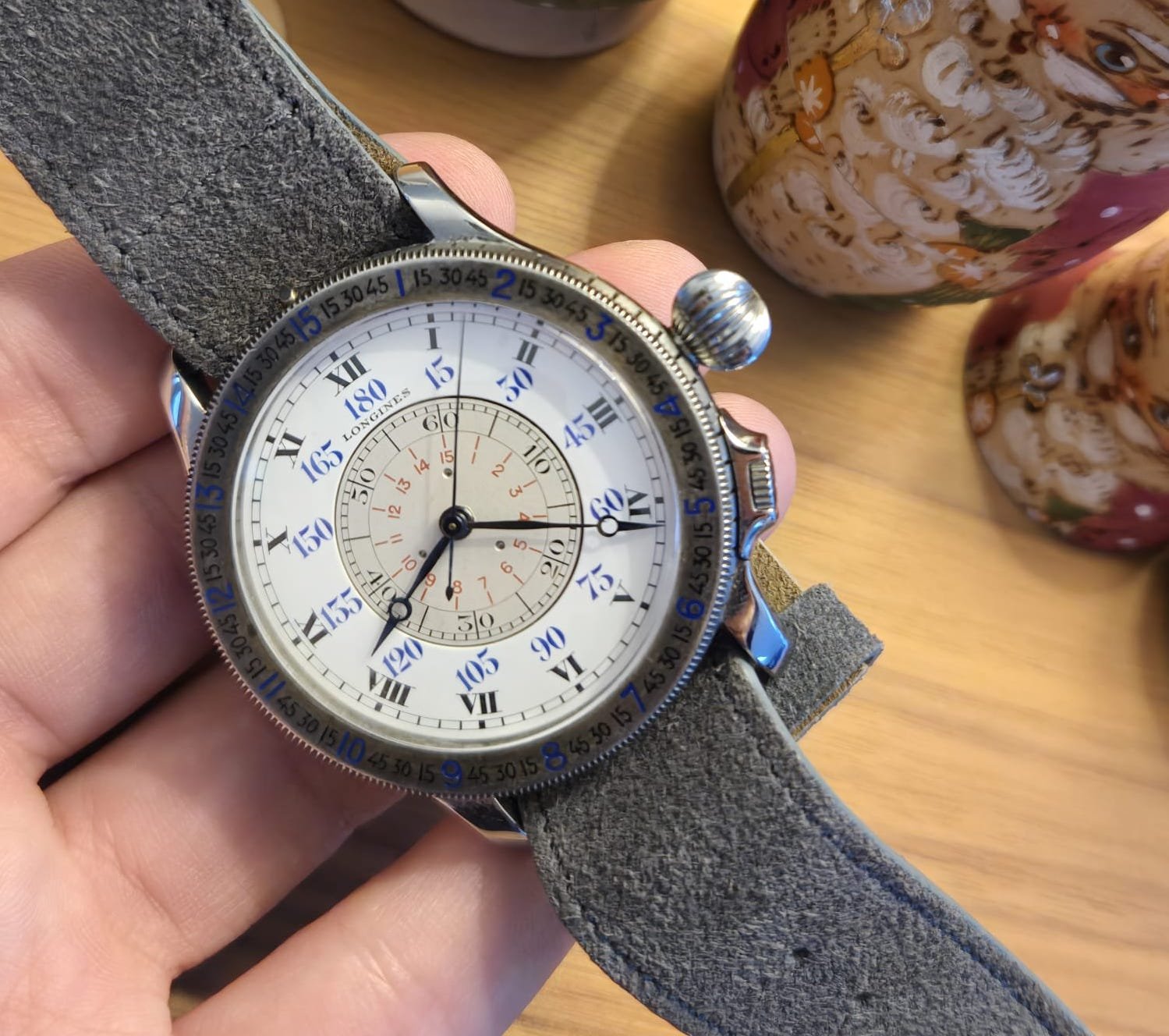
To understand the Siderograph’s significance, it’s useful to compare it with other aviation chronometers of the era and recognize how it streamlined the celestial navigation process.
Weems Second-Setting Watch
Introduced in 1929, this instrument served as a civil-time synchronization aid, featuring a rotating seconds ring that allowed pilots to align their timepiece with radio time signals without stopping the movement. However, it lacked computational capabilities and still required pilots to manually convert hours-minutes-seconds readings into angular measurements for celestial calculations. Its primary use-case centered on radio discipline and maintaining accurate logbook records.
Lindbergh Hour Angle Watch
Introduced in 1931, the Lindbergh Hour Angle Watch was Longines’ second collaboration with the aviator and used a more sophisticated conversion dial that could transform civil time into hour angles for celestial navigation. While this reduced some computational burden, pilots still faced the time-consuming HMS-to-angle conversion process during calculations. The Lindbergh represented an important stepping stone, cheaper, lighter and adequate for many flights, but still requiring mental arithmetic conversions that were error-prone under stress.
The Siderograph
In 1938 Siderograph’s revolutionary contribution was eliminating the time-to-angle conversion step that plagued earlier instruments. Pilots still needed to take sextant sights and consult tables for right ascension/declination (or co-right ascension/versed ascension), but the Siderograph provided direct angular readings, eliminating a critical computational bottleneck and source of errors.
American and British air services experimented with bubble sextants with integral clocks, averaging devices, and periscopic sextants such as the Kollsman periscopic sextant used by the USAAF and the British Mark IX none of which integrated a sidereal angular dial with rattrapante in a portable watch-format the way Longines did.In this narrow niche, Longines stands at the fore-front of innovation during this period.
Movement no. | Type | Date (delivered/invoice) | Agent / Destination | Dial & features | Notes
How to Use the Longines Siderograph – Three Simple Steps
Step 1: Synchronise Before Your Flight. Set the Siderograph to Greenwich sidereal time using a radio signal. Rotate the outer ring so the blue “60” mark aligns with the sweep hand at the time signal, then use the START/STOP slide to hack the balance for precise synchronisation. Verify the heater is maintaining ~20°C and check the power reserve indicator at 12 o’clock.
Step 2: Capture Your Celestial Observation. At the exact moment your sextant sight is aligned, when the star hits the horizon, press the remote trigger or pusher to freeze the split-seconds hand. The dial now displays the Greenwich sidereal angle at that precise instant. Read the three scales in order: blue hand (minutes of arc), red hand (degrees within the 10° segment), then black hand (which 10° segment on the 360° scale).
Step 3: Calculate Your Position in One Step. Subtract the star’s right ascension from the dial reading to get the Greenwich Hour Angle: GHA = GSA − RA. For the Sun, add the co-right ascension instead. Use this GHA with your sextant altitude and standard sight reduction tables to plot your line of position.
For navigators taking multiple observations in rough conditions, the double-rattrapante version allows you to freeze both the first and last sights of a series, then read the bisector angle between the two stopped hands as your averaged value.
In practice, here is how an aviator or mariner in 1939 would have used it:
Pre-Flight Setup.
Before departure the navigator would establish his reference. For star sights, sidereal mode is natural the instrument runs continuously from takeoff, synchronised to Greenwich sidereal time via a radio tick. For sun sights, civil time with an equation-of-time correction could be used instead; Longines noted this explicitly, observing that “when regulated to civil time for observations with the sun” the hands make analogous rotations but the equation of time must be applied to get apparent solar time. A standard GMT chronometer ran alongside the Siderograph throughout providing the civil date and time needed for almanac lookups, while the Siderograph itself provided the sidereal angle at the moment of the sight.
Taking a Sight.
Say it is night and you are taking a sight on Aldebaran (the brightest star in the Taurus constellation). At the moment the star touches the horizon in the sextant, press the remote the blue hand stops. The dial reads, for example, 132° 15.4′. From the Nautical Almanac, Aldebaran’s right ascension for the date is approximately 68° 44′. Subtract: 132° 15.4′ − 68° 44′ = 63° 31.4′. That is the Greenwich Hour Angle of Aldebaran at the moment of observation. Combined with the measured altitude and standard sight reduction tables, this gives a line of position. Repeat with a second star or the moon and you have a cross-fix.
The 1939 Fédération Horlogère worked example is equally clear: an aviator sights the sun on 13 April 1939. The Siderograph reads 293° 35′. The Aeronautical Ephemerides give the sidereal angle of the sun as 339° 12′. They subtract to get the hour angle. A second example using alpha Tauri shows adding the versed ascension instead. One method, all celestial bodies, where previously the sun and stars required separate techniques.
Dead Reckoning with Rhumb Bezel.
When weather or daylight precluded star sights entirely, the navigator could fall back to rhumb line navigation using the Siderograph’s bezel scales. Patent CH 210856 describes a bezel with pre-calculated trigonometric value sin and cos increments at 5° intervals allowing displacement from course and speed to be computed without manual sine and cosine arithmetic. A pilot flying an hour at 200 knots on heading 045° could read his northing and easting directly from the bezel. Longines was integrating what we would now call flight computer functions into a wearable instrument, decades before digital avionics.
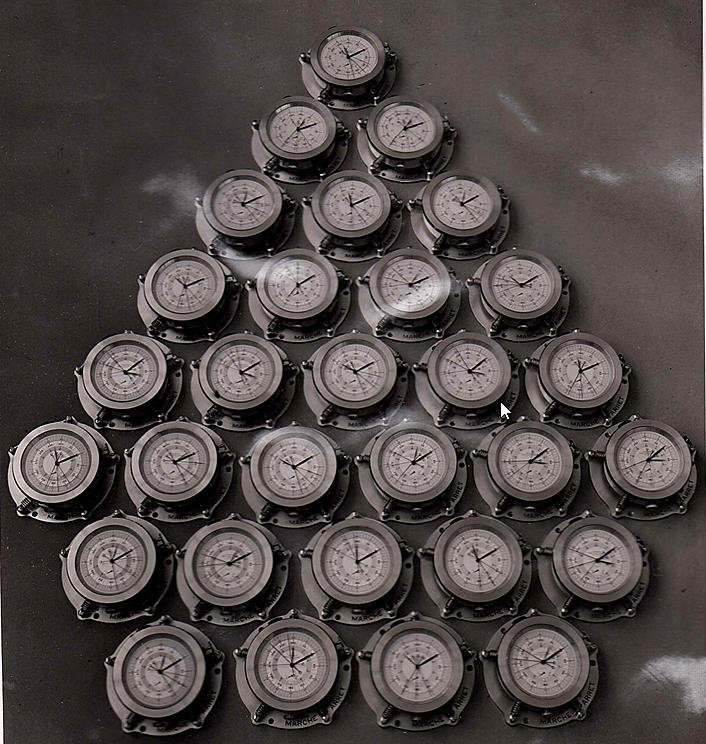
Production of the Siderograph was rare, the serial evidence points to a tightly controlled, client-driven programme rather than anything approaching a generally commercial production. Longines’ archive records indicate movements in the 5.78 to 5.81 million range, corresponding to the period 1938–1942, with at least one confirmed delivery as late as May 1943.
1938–39 – Introduction, prototypes, patent filings. The first units including movement 5,810,653 – were likely completed in 1938. Longines trademarked the name in 1939 and began advertising in technical journals.
1939–40 – Orders from confirmed military clients. The French Aéronavale received at least two deck instruments serials 6,425,248 and 6,425,252, both with cal. 21.29 documented through Christie’s Geneva sale records in 2004 and 2006. The Italian Navy received a consignment via Ostersetzer of Milan, with a delivery confirmed by Longines heritage archive records dated 21 May 1943. British RAF interest is documented anecdotally, with at least one example reportedly used on long-range Atlantic patrols.
1941–43 – Small-batch production. Serials 5,810,014 and 5,810,032 were delivered in this window. The Monaco auction piece (movement 5,789,285, case 5,676,429) was delivered May 1943 the differing movement and case numbers hinting at in-house assembly from existing parts. Wider deployment was likely curtailed by the advance of electronic radio beacons and LORAN.
Post-1945 – Electronic and inertial navigation superseded the concept. By the late 1940s the need for a mechanical sidereal instrument had faded. Longines did not pursue civilian commercialisation; the Siderograph remained a bespoke tool. Daria Marozzi’s Longines reference book (1990) covers it on pp.100–107 by then already a historical footnote known only to dedicated collectors.
A partial census of known examples, drawn from auction records and archive material:
The Siderograph was designed to solve a specific, urgent, life-or-death problem faced by navigators flying at speed over a featureless ocean or terrain in the years before electronic aids made celestial navigation outdated. Longines solved it by reimagining the scope of what a mechanical instrument could be. And then other technologies superseded it.
LORAN, the wartime radio navigation system operational across the North Atlantic by early 1943, did not merely improve on celestial navigation, it made it optional. No clear sky required. No sextant, no almanac, no arithmetic, only a receiver. The Siderograph’s design window, the years between the new angular ephemerides of the mid-1930s and the arrival of radio fixes, lasted perhaps half a decade. The concept did not fail, the problem it solved was itself resolved by other technologies, faster than anyone could have anticipated when Longines filed the first patent in April 1938.
This is probably the most technically important instrument Longines ever produced. More ambitious than the 13ZN flyback chronographs, more sophisticated than the Lindbergh Hour Angle watch that preceded it, a dazzling chronometer-grade movement regulated to sidereal time, with a rattrapante capture mechanism. Alfred Pfister, Longines’ own technical director, described it in 1942 as without doubt the supreme expression of the company’s aviation timekeeping work. It is difficult to argue with that assessment. Built to a level of complexity and precision that would have placed it in an entirely different category of expenditure from any catalogue watch of the period, it was from the outset an instrument for a very unique client with a very specific need.
Longines evidently understood and was proud of its historical significance. In 1955, the company formally donated a Siderograph to the Musée d’horlogerie in La Chaux-de-Fonds, where it was placed alongside marine chronometers and astronomical watches. Alfred Pfister, who wrote the technical description that introduced the instrument to the wider horological press, was present at the handover. It was a fitting acknowledgement that the Siderograph belonged not in a display case or a dealer’s catalogue, but in the horological equivalent of the hall of fame.
The Siderograph is a contribution to navigation that remains chronically underappreciated. Whilst owning one is a near impossibility, it beguiles as exemplary evidence of Longines at their peak, during the golden age of mechanical watchmaking, when, in my opinion, the brand was the single most important manufacturer in aviation horology.
Special thanks to Auro Montanari (archive images and Longines Legendary Watches), Daniel Hug ( Head of Branding & Heritage), Philippe Heinsen (manuscript review and steady support), Louis F. Vuille (photographs of his Siderograph dial and movement, and for documenting the reverse stamping), and Santi (mimandcroket) for permitting use of his Marine Nationale Aéronavale deck-instrument image.
Appendix A — Glossary (Selected Terms)
Greenwich Sidereal Angle (GSA): The Greenwich Hour Angle of the vernal point; the angular measurement displayed directly on the Siderograph’s dial in degrees.
Right Ascension (RA): The angular distance eastward along the celestial equator from the vernal equinox to the hour circle of a celestial body.
Co-RA / Versed Ascension: A mathematical complement used in some period tables (especially for solar calculations) that allows addition instead of subtraction in the GHA formula.
Lunette Loxodromique: The rhumb-line bezel featuring tabulated trigonometric values and interpolation scales; operates independently of the watch movement.
Cardan: Gimbal suspension system used to keep the instrument level during navigation.
Trotteuse / Rattrapante: Running sweep hand / split-seconds hand mechanism.
Appendix B — Mathematical Reference (Sexagesimal Conversions)
Angular Units: 1° = 60′; 0.1′ = 6″
Sidereal Hand Rates:
Sight Reduction Formula:
Longitude from Dead Reckoning:
Appendix C — Worked Intercept Example
Objective: Derive a line of position from a star sight using the Siderograph for direct GHA determination.
Setup: Assumed DR position φ = 51° 30′ N, λ = 2° 00′ W. Celestial body: Aldebaran. Declination: δ ≈ +16° 31′.
Key Advantage: Steps 4–6 follow standard celestial navigation practice. The Siderograph’s innovation is that Steps 1–2 provide direct angular readings without time-to-angle conversion.
Appendix D — Primary Sources and References
Patent Documentation:
Contemporary Trade Publications:
Company Documentation:
Secondary Sources and Archival Material: